Parshas Bamidbar for Kids: The Counting, the Degalim & Why Every Yid Counts
Parshas Bamidbar opens Sefer Bamidbar with a count of Bnei Yisrael, each shevet with its own flag and place around the Mishkan. Here is the story, its lesson that every Yid counts, and how to explain it to a 3-4 year old, a 6-7 year old and a 9-12 year old.
Published by Torah Tale.
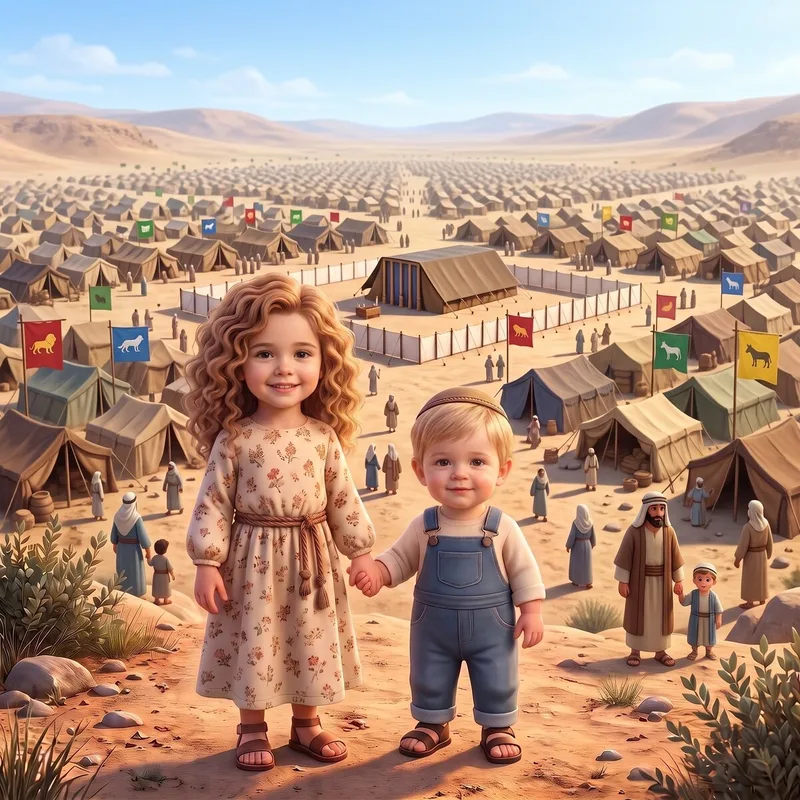
Create this book for your child
Parshas Bamidbar is the parsha where Hashem has Moshe count Bnei Yisrael, shevet by shevet, and then arranges them around the Mishkan, each under its own flag. Children connect to it quickly because the message is one they feel: you are counted, you have a place, and you belong. It is also the parsha we read just before Shavuos.
What happens in Parshas Bamidbar?
The Torah tells us that Hashem spoke to Moshe in Midbar Sinai, in the Ohel Moed, on the first day of the second month in the second year after Bnei Yisrael left Mitzrayim. He told Moshe and Aharon to count the men from twenty years old and up who were able to go out to the army, and a nasi from each shevet helped them.
The Torah gives the total of the men counted: 603,550 (Bamidbar 1:46). The Levi'im were not counted in this number, because they had a different task.
Next comes the camp itself. The Torah says that each man camps under his own degel, at a distance around the Ohel Moed. Three shevatim are grouped under each of four flags: Yehuda with Yissachar and Zevulun to the east, Reuven with Shimon and Gad to the south, Efrayim with Menashe and Binyamin to the west, and Dan with Asher and Naftali to the north.
The Mishkan stands in the middle, and the Levi'im camp right around it. The families of Gershon, Kehas and Merari each have their own side and their own work in carrying the Mishkan. Toward the end of the parsha, the Levi'im are counted separately, from the age of one month, and they take the place of the firstborn.
Why does Hashem count Bnei Yisrael?
A count can sound dry, but Rashi explains it warmly. At the beginning of the parsha he writes that Hashem counts Bnei Yisrael because of His love for them. You count what you treasure, and nobody is left out of the count.
This is the heart of the parsha for a child. Being counted means that someone noticed you, knows you are here and wants you in the camp. That is a feeling a four-year-old and a ten-year-old both understand, especially one who sometimes feels like the smallest or the quietest in the family.
It also connects to loving every Yid. If Hashem counts every Yid, then every Yid is worth noticing at our table too.
What are the degalim and why does each shevet have a place?
The Torah says each person camps "by his degel, with signs" around the Ohel Moed. Rashi brings a midrash that each shevet's flag was the color of that shevet's stone on the choshen. So each shevet had its own flag, its own color and its own place.
Children can picture an organized, beautiful camp: the Mishkan in the middle, the Levi'im close around it, and the shevatim in four groups beyond them. Nobody is crowded out and nobody stands in someone else's spot.
The lesson is that a place is not a competition. Yehuda does not need Reuven's flag, and Reuven does not need Yehuda's place. Together they make one camp around the Mishkan. This is a gentle way to talk to siblings about each having their own role without being jealous of someone else's.
The Levi'im show the same idea. Their work was to take down, carry and set up the Mishkan. The Torah assigns families and sides to Gershon, Kehas and Merari, and each had its own duties. Even the work nobody sees on the road is holy work.
Why was the Torah given in a midbar?
The name of the parsha and of the whole sefer is Bamidbar, in the desert. The Midrash (Bamidbar Rabbah) relates that the Torah was given in a midbar to teach that it belongs to everyone, like a desert that belongs to no one. The same Midrash teaches that to acquire Torah a person should make himself like a midbar: humble and open.
That is why Bamidbar is read right before Shavuos. If your family is starting to talk about Matan Torah, our Shavuos story for kids is a good next read.
How do I explain Parshas Bamidbar to a young child?
Ages 3 to 4: Use one sentence: "Hashem loves Bnei Yisrael so much that He counted every shevet, and everybody had a place around the Mishkan." Then go around the table and say each child's name out loud, with a smile. Ask each one, "Where is your place?" and let them point to their seat.
Ages 6 to 7: Add the degalim. Explain that each shevet had its own flag and a place around the Mishkan, and the Levi'im stood closest because they took care of it. Ask what job your child does at home that nobody else does, and how that helps everyone.
Ages 9 to 12: Go deeper into the idea of being counted. Ask why Hashem counts when He already knows every Yid, and bring Rashi's answer that it comes from love. Then talk about the midbar: why would the Torah be given in a place that belongs to no one, and what does it say about the humility needed to learn Torah?
On a weekday afternoon or erev Shabbos, you could make a family degel together. Each child chooses a color and a symbol for their own flag, and you hang the flags somewhere at home. Coloring and drawing are not for Shabbos or Yom Tov, so keep this one for a weekday.
Questions to ask at the Shabbos table
Talking, singing and questions are perfect for the Shabbos table, with no props needed. Here are some questions that work for a mixed-age table:
- What did Hashem ask Moshe to do at the beginning of the parsha?
- Why do you think Hashem counts Yidden, according to Rashi?
- Where did each shevet camp, and where was the Mishkan?
- Why did the Levi'im camp closest to the Mishkan?
- What is one job in our family that only you do?
- How can we make sure that nobody at our table feels uncounted this week?
Let the youngest answer first, then pass the question around so everyone has a turn. If you want your child to feel what it means to be counted, you can call each person by name at the end, and let each answer, "Here I am."
What is a personalized Parshas Bamidbar book like?
A Torah Tale book is a storybook in which your child is the hero. Your child's name and, from one uploaded photo, their likeness appear on every page, illustrated in high-resolution 3D animated-film style. You can include up to eight siblings in one book, ages 0 to 18. For a parsha about every Yid having a place, it is a nice fit when a child sees himself or herself in the story and not just reading about a camp from long ago.
Every book is written with careful rabbinical guidance and strict tznius, and our team reviews it before it goes to print. It ends with a discussion page of 10 questions mixing comprehension with middos, which turns the book from something read to a child into something talked about at the table. If you add parents and grandparents, they appear with the children on a closing family page in every format.

Softcover 8″×8″

Hardcover 8″×8″

Board book 6″×6″

Coloring book 8.5″×11″
There are three formats: a 6x6 board book with rounded safety corners for ages 0-4, an 8x8 softcover photo book for ages 4-8, and an 8x8 hardcover photo book for ages 5-18. The softcover and hardcover open with a dedication page. You can also add a matching 8.5x11 coloring book in black-and-white line art, a one-time add-on to a book that is for weekdays only. Books can be ordered in English, Hebrew or Yiddish. A book makes a good Shabbos-table read, since reading is perfect for Shabbos and Yom Tov.
Creating a book takes about five minutes. You need a free account and a few short questions: each child's name, boy or girl, age and one photo, any siblings, the story, your community (asked once), the language and the printed format. If you are not sure which parsha to choose, see how to choose the weekly parsha for your child's book.
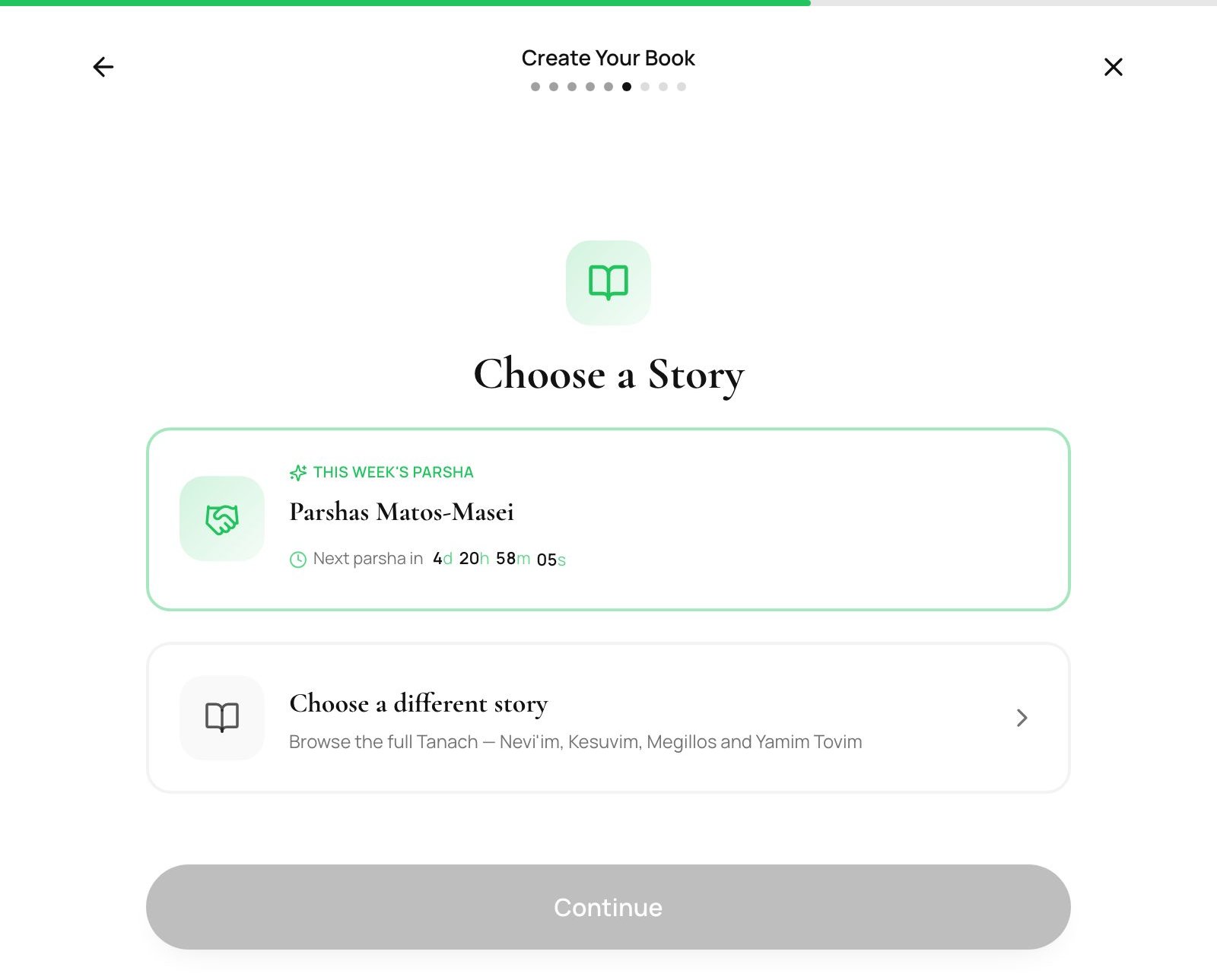
When you are ready, you can create the book and give your child a parsha where they are counted, they have a place and they belong.
Frequently asked questions
What is Parshas Bamidbar about?
Parshas Bamidbar is about Hashem telling Moshe to count Bnei Yisrael in Midbar Sinai and arrange them in four camps, each shevet under its own flag around the Mishkan. The Levi'im are counted separately and given the work of caring for the Mishkan and carrying it when the camp travels.
What is the lesson of Parshas Bamidbar for children?
The main lesson is that every Yid counts and every Yid has a place. Rashi explains that Hashem counts Bnei Yisrael out of love for them. Children can also learn that each person has their own role, and that together the roles make one camp around the Mishkan.
How do I explain Parshas Bamidbar to a 4-year-old?
Keep it to one picture: Hashem loved Bnei Yisrael so much that He counted them, and every shevet had its own flag and its own place around the Mishkan. Then ask your child where their place is at home, and tell them that they count too.
Why is Parshas Bamidbar read before Shavuos?
Parshas Bamidbar is read just before Shavuos, the Yom Tov of Matan Torah. The Midrash relates that the Torah was given in a midbar, a place that belongs to no one, to teach that the Torah is open to every Yid. Many families use the parsha to start talking about Shavuos.
Why were the Levi'im not counted with the other shevatim?
The Torah tells us that the Levi'im were not counted among Bnei Yisrael in the same count, because their work was the Mishkan: they camped around it, took it down, carried it and set it up again. The Torah also tells us they were counted by their families from the age of one month and replaced the firstborn.
Is there a personalized book for Parshas Bamidbar?
Yes. Torah Tale makes personalized Torah storybooks starring your child, with their name and a likeness from one uploaded photo in 3D animated-film style. You can choose the parsha in the story picker, pick English, Hebrew or Yiddish, and choose a board book, softcover or hardcover by your child's age.