Parshas Matos-Masei for Kids: Vows, Reuven and Gad & the End of the Journey
Matos-Masei closes Sefer Bamidbar with a promise kept, brothers standing together and the long journey reaching Eretz Yisrael. Here is the story, the lessons, how to explain it to a 4, 7 and 11-year-old, and Shabbos table questions.
Published by Torah Tale.
Create this book for your child - Parshas Matos · Create this book for your child - Parshas Masei
Parshas Matos-Masei is the double parsha that closes Sefer Bamidbar, and children connect with it through three simple ideas: a person keeps the word that leaves his mouth, Yidden stand with their brothers, and Hashem was with Bnei Yisrael at every stop on the long road to Eretz Yisrael. In many years Matos and Masei are read together on one Shabbos, and in other years they are read separately, so check your luach or ask your rav.
What happens in Parshas Matos-Masei?
In Matos, Moshe Rabbeinu speaks to the heads of the tribes about vows. The Torah says that when a man makes a neder he must not break his word, and that he must do all that left his mouth.
Then Hashem tells Moshe to take vengeance on Midyan. Moshe sends one thousand men from each tribe, and Pinchas goes with them, carrying the holy vessels and the trumpets. When the soldiers return, the officers count them and report that not one man is missing, and they bring a gift of gold to Hashem as an atonement for themselves.
Reuven and Gad have a great deal of livestock and see that the land east of the Yarden is good for their flocks. They ask Moshe to let them stay there. Moshe asks whether their brothers will go out to war while they sit at home.
They answer that they will build pens for their animals and cities for their children, and then arm themselves and go ahead of Bnei Yisrael until every Yid has his place. Moshe accepts, and half of Shevet Menashe also receives land there.
In Masei, the Torah tells that Moshe wrote down the places where Bnei Yisrael set out and camped, at the word of Hashem. We also read that Aharon HaKohen passed away on Har HaHor.
Then Hashem gives the borders of Eretz Yisrael and names a nasi from each tribe to help divide the land. The Leviim receive forty-eight cities, and six of them are arei miklat, cities of refuge for someone who hurt another person by accident.
Toward the end of the parsha, Bnos Tzlafchad marry within their tribe, so that their father's land stays in Shevet Menashe, as Hashem commanded.
What is the lesson of Parshas Matos-Masei?
Words matter. The Torah's opening message in Matos is that a Yid's word is something he must keep. Children can feel that, because they make promises all day: "I'll share it after supper," "I'll clean up in a minute." For more on teaching this at home, see Keeping a Promise for kids.
Brothers stand together. Moshe's question to Reuven and Gad is one a child can understand: will your brothers go to war while you sit here? Their answer, that they would go ahead and not return until everyone had a home, is a picture of keeping your word to others.
Rashi brings from Chazal that Reuven and Gad mentioned their sheep before their children. When Moshe replied, he reversed the order and said to build cities for the children first and then pens for the flocks. This is an easy lesson for older children: the people we love come before our things.
Why does the Torah list all forty-two journeys?
Masei names the places where Bnei Yisrael camped, forty-two journeys by the count of the meforshim. A child may reasonably ask why the Torah lists stops that no one remembers.
Rashi explains that the list shows Hashem's kindness to Bnei Yisrael. Even though He had decreed that they would wander in the midbar, they did not travel nonstop.
A simple way to say it to a child is that Hashem knew every place they stopped, and each one is written in the Torah. That is a good way to remember that Hashem is with us on our own journeys too, to a new school, a new home or a new year.
How do I explain Matos-Masei to a 4-year-old, a 7-year-old and an 11-year-old?
For a 4-year-old: Bnei Yisrael walked a very long way with Moshe, and now they are nearly home to Eretz Yisrael. Reuven and Gad promised to help their brothers, and they kept their promise.
For a 7-year-old: Talk about the promise. Reuven and Gad said exactly what they would do, and a Yid does what he says. Ask your child about a promise he or she made recently and whether it was kept.
For an 11-year-old: Bring in Rashi's point about the order of their words, and the idea that the Torah lists the journeys to show Hashem's chasadim. You can also talk about the arei miklat, a place of safety for someone who caused harm by accident, and why the Torah takes it so seriously.
What is a personalized Torah Tale book of Matos-Masei like?
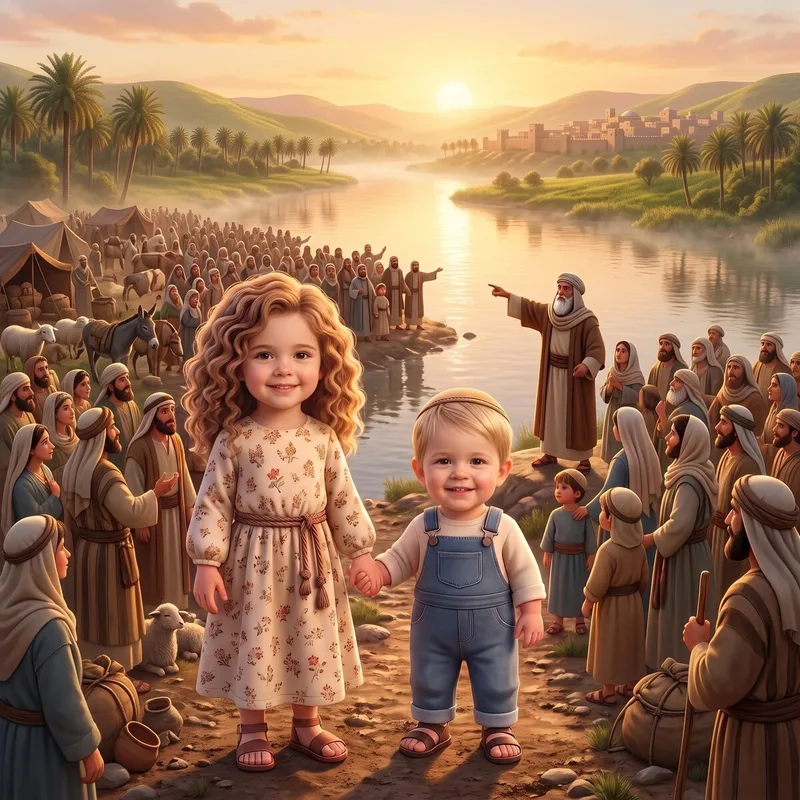
In a Torah Tale book, your child is the hero. Their name and, from one uploaded photo, their likeness appear on every page, in high-resolution 3D animated-film style. Up to eight children can appear in one book, ages 0 to 18. If you add parents, grandparents and other relatives, they appear with the children on a closing family page in every format.
Because Matos and Masei are often read together, a double-parsha week produces one book covering both. When the parsha is read separately, the stories are also in Parshas Matos for Kids and Parshas Masei for Kids. A parsha book comes from the Torah collection, and every book is written with careful rabbinical guidance and strict tznius and reviewed by our team before it goes to print.
The formats are a 6x6 board book with rounded safety corners (ages 0-4), an 8x8 softcover photo book (ages 4-8) and an 8x8 hardcover photo book (ages 5-18). Softcover and hardcover open with a dedication page.

Softcover 8″×8″

Hardcover 8″×8″

Board book 6″×6″

Coloring book 8.5″×11″
Every book ends with a discussion page of ten questions that mix comprehension with middos, asking what happened and what it asks of the child. To create one, you open a free account and answer a few short questions: each child's name, boy or girl, age and one photo, any siblings, the story, your community (asked once), the language (English, Hebrew or Yiddish) and the format. The book creator suggests the first parsha that can still arrive before its Shabbos, with a live countdown to the order deadline.
What can we ask at the Shabbos table about Matos-Masei?
Reading is just right for Shabbos, and so are questions. Here are a few to try:
- Why do you think the Torah says a person must do all that leaves his mouth?
- What did Moshe ask Reuven and Gad, and what did they promise?
- Why did Moshe want them to say "cities for your children" first?
- Why do you think Hashem had every journey written down?
- What is a promise you could make this week that you know you can keep?
- Why was it good that Hashem arranged cities of refuge?
A weekday activity: a map of the journeys
On a weekday afternoon or erev Shabbos, an older child can draw a simple map of a few of the stops, with a line from Mitzrayim toward the Yarden. Drawing is not for Shabbos or Yom Tov, so keep it to weekdays. The optional matching coloring book (8.5x11, black-and-white line art) is also a weekday activity, and a one-time add-on to a book.
When you are ready, you can create the book and make this parsha one your child remembers.
Frequently asked questions
What is Parshas Matos-Masei about?
Matos teaches the seriousness of keeping our words, tells of the war against Midyan, and tells how Reuven and Gad asked to settle east of the Yarden and promised to fight with their brothers. Masei lists the journeys of Bnei Yisrael, describes the borders of Eretz Yisrael and the cities of the Leviim, teaches about the arei miklat, and tells how Bnos Tzlafchad married within their tribe.
Is Matos-Masei always read as a double parsha?
Not in every year. In many years Matos and Masei are read together on one Shabbos, and in other years each is read on its own. Your luach or your rav will tell you what is read in a particular year.
What is the lesson of Parshas Matos-Masei for children?
A child can take three things from it: a Yid keeps the word that leaves his mouth, we stand with our brothers and do not leave them to carry a burden alone, and Hashem was with Bnei Yisrael at every stop of their journey. Each one is easy to turn into something small and doable, like keeping a promise made this afternoon.
How do I explain Reuven and Gad to a young child?
Tell a child that Reuven and Gad had a great many animals and wanted to stay in a good place for them. Moshe reminded them that their brothers were going to fight, and they promised to go first and help until everyone had a home. Then say that they kept their promise, which is what a good friend or brother does.
Can a Torah Tale book cover both Matos and Masei?
Yes. In a double-parsha week the order produces one book that covers both parshiyos. The child's name and, from one uploaded photo, their likeness appear on every page, and every book ends with a discussion page of ten questions that mix comprehension with middos.
Is it appropriate to read the Matos-Masei book on Shabbos?
Yes, reading a storybook is entirely appropriate on Shabbos, and the discussion questions at the end are well suited to the Shabbos table. Coloring, drawing and writing are melacha, so the optional matching coloring book is only for weekdays.