Parshas Masei for Kids: The Journeys, Arei Miklat & Dividing the Land
Parshas Masei looks back at every stop of the journey from Mitzrayim and ahead to Eretz Yisrael. Here is the story retold for children, the lesson, how to explain it at ages 3-4, 6-7 and 9-12, and questions for the Shabbos table.
Published by Torah Tale.
Create this book for your child
Parshas Masei is the last parsha of Sefer Bamidbar, and it is where the Torah looks back over the whole trip from Mitzrayim and then looks ahead to Eretz Yisrael. Children connect to it because it is concrete: a long list of stops, a map of the land, and real questions about who gets which piece and what to do when someone makes a mistake. This guide retells it for kids and gives you words to use at the Shabbos table.
What happens in Parshas Masei?
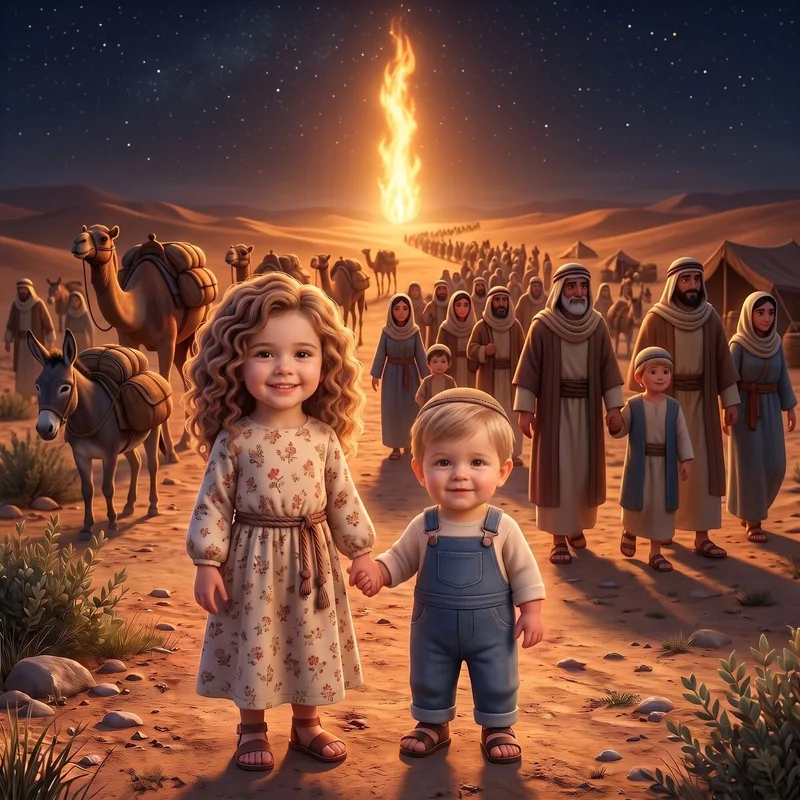
The parsha opens with the stops of Bnei Yisrael's journey. The Torah tells us that Moshe wrote down where they set out from and where they traveled, by the word of Hashem. The list begins in Ramses, where they left Mitzrayim, passes through places like Sukkos, Refidim and Midbar Sinai, and goes on until they camp in Arvos Moav, by the Yarden across from Yericho.
In the middle of the list, the Torah mentions that Aharon HaKohen went up Har HaHor and passed away there, on the first day of the fifth month, at the age of a hundred and twenty-three. His passing is told earlier, in Parshas Chukas (see our Parshas Chukas for Kids).
Then Hashem tells Moshe what to say to Bnei Yisrael before they cross the Yarden: drive out the inhabitants of the land, destroy their idols and settle Eretz Yisrael. Hashem gives the borders of the land, and the land will be divided by goral, by lottery. Elazar HaKohen and Yehoshua will divide it, with one nasi from each shevet helping. Kalev ben Yefuneh is named as the nasi of Yehuda.
The Leviim will not receive a portion like the other shevatim. Instead, Bnei Yisrael give them forty-eight cities with open land around them, among the other shevatim. Six of those cities are arei miklat, cities of refuge, for a person who harmed someone by accident.
Toward the end of the parsha, the heads of Menashe's family come to Moshe about the Bnos Tzlafchad. If the sisters marry into another shevet, their portion would move with them. Moshe, by Hashem's word, tells them they may marry whom they wish, but within the family of their own shevet. The pasuk says they did exactly as Hashem commanded, and they married sons of their uncles. Their story began in Parshas Pinchas (see Parshas Pinchas for Kids). In many years Masei is read together with Matos, which comes just before it (see Parshas Matos for Kids).
Why does the Torah list every stop of the journey?
Children often ask this, and it is a good question. Rashi, quoting a Midrash Tanchuma, explains it with a parable. A king took his sick son to a faraway place to be healed. On the way home, the father began to recount each stop: here we slept, here we were cold, here you had a headache.
The picture is of a father who remembers every step of the trip, not only the arrival. The Torah did not write only where Bnei Yisrael ended up. It wrote where they went, one stop after another.
What is the lesson of Parshas Masei?
There are a few lessons here, and you can choose the one that fits your child right now.
- Every step counts. A big goal is made of many small stops, and Hashem is with us at each one, including the hard ones.
- We are responsible for what we do. The arei miklat show that even an accident matters, and also that the Torah sets up a place of safety and care.
- Listening and doing. The Bnos Tzlafchad did as Hashem commanded, and the Torah says so plainly.
- The land is shared with care. It is divided by lottery, one nasi from each shevet helps, and the Leviim are given cities among all the shevatim.
How do I explain Parshas Masei to a 3 or 4 year old, a 6 or 7 year old and a 9 to 12 year old?
- Ages 3 and 4: Keep it to the trip. "Bnei Yisrael traveled in the midbar and stopped in many places. Moshe wrote down every stop, because Hashem remembers every step. Then Hashem showed them where their new home, Eretz Yisrael, would be." Leave out the arei miklat at this age.
- Ages 6 and 7: Add Rashi's parable of the king and his son, and the idea of dividing the land fairly. Ask what it means that Hashem remembers every stop.
- Ages 9 to 12: Talk about the arei miklat gently: a person who hurt someone by accident still has to take responsibility. Then talk about Bnos Tzlafchad and why keeping a portion in its own shevet mattered.
What are good Shabbos-table questions for Parshas Masei?
Shabbos is a good time for talking, singing and storytelling, so these need no paper and no pens. Pick one or two.
- Why do you think Hashem wanted every stop written down?
- If your father told you, "Here we slept, here we were cold, here you had a headache," how would you feel?
- Which stop from the stories we learned do you remember best?
- The Bnos Tzlafchad did what they were told and the Torah mentions it. When did you do something right away because someone asked?
- Think of a day with many stops, like home, school and back. What was the hardest stop, and what helped?
What can we do on a weekday to bring Parshas Masei to life?
Draw a journey map on a weekday afternoon, or on erev Shabbos before candle lighting. Drawing and coloring are melacha, so keep this for a weekday and save the Shabbos table for talking. Start with Ramses and put five stops on a long, winding line: Ramses, Sukkos, Refidim, Midbar Sinai and Arvos Moav. Younger children can add the cloud or little figures along the way, and older children can add a few more stops from the parsha.
When the map is done, ask your child to point and retell the trip. If you add a Torah Tale coloring book to an order, it is a weekday activity, for erev Shabbos or a weekday afternoon, never for Shabbos or Yom Tov.
What is a personalized Parshas Masei book like?
A Torah Tale book makes your child the hero of the parsha. Their name and, from one uploaded photo, their likeness appear on every page, illustrated in 3D animated-film style. Each book is written with careful rabbinical guidance and strict tznius, and our team reviews it before it goes to print. You choose the story in the creator, and the parsha books come from the Torah collection. In a double-parsha week, one book covers both parshiyos.

Softcover 8″×8″

Hardcover 8″×8″

Board book 6″×6″

Coloring book 8.5″×11″
There are three formats. The board book is 6"x6" with rounded safety corners, for ages 0-4. The softcover is 8"x8", for ages 4-8, and the hardcover is 8"x8", for ages 5-18. Softcover and hardcover books open with a dedication page. An optional matching coloring book, 8.5"x11" in black-and-white line art, can be added as a weekday activity. Books come in English, Hebrew or Yiddish, and up to eight children can appear in the same book. If you add parents and grandparents, they appear with the children on a closing family page in every format.
Every book ends with a discussion page of 10 questions about the story, mixing comprehension with middos, so the book becomes something you talk about at the table and not only something you read to your child. The storybook itself is a lovely thing to read at the Shabbos table or on a Yom Tov afternoon, while the coloring book stays a weekday activity. Creating a book needs a free account and a few short questions: each child's name, boy or girl, age and one photo, any siblings, the story, your community (asked once), the language and the printed format. It takes about five minutes.
Parshas Masei is a good parsha to read slowly with a child, one stop at a time. When you are ready, you can create the book and make your child part of the journey.
Frequently asked questions
What is Parshas Masei about?
Parshas Masei recounts the stops of Bnei Yisrael's journey from Mitzrayim until they camp in Arvos Moav by the Yarden. It then gives the borders of Eretz Yisrael, the nesiim who will help divide it, the cities of the Leviim and the arei miklat. Toward the end of the parsha, the Bnos Tzlafchad marry within their own shevet so that their portion stays where it belongs.
What is the lesson of Parshas Masei for children?
One lesson is that Hashem is with us at every stop of a journey, including the hard ones, and that every step counts. Another is that we are responsible for our actions, even when something happens by accident, and that the Torah cares for the person involved. The parsha also teaches children to listen and do what they are asked, as the Bnos Tzlafchad did.
How do I explain Parshas Masei to a 5-year-old?
Tell it as a trip: Bnei Yisrael traveled in the midbar with Hashem, stopping in many places, and Moshe wrote down every stop. Then say Hashem showed them where their new home in Eretz Yisrael would be. You can add Rashi's picture of a father telling his child, 'Here we slept, here we were cold, here you had a headache,' to show that Hashem remembers every step.
What are the arei miklat, in simple words for kids?
The arei miklat are six cities that the Torah sets aside in Parshas Masei for a person who caused harm to someone by accident. The person stays there under the Torah's care until the Kohen Gadol passes away, as the pasuk says. For younger children it is enough to say that the Torah makes places of safety and takes responsibility seriously.
Is Parshas Masei read together with Matos?
In many years Masei is read together with Matos as one double parsha. In a double-parsha week, Torah Tale produces one book covering both parshiyos. The creator also lets you choose the story you want when you order.
Is there a personalized book for Parshas Masei?
Yes. Torah Tale makes personalized storybooks for the weekly parsha, with your child's name and likeness on every page, illustrated in 3D animated-film style. Every book ends with a discussion page of 10 questions about the story. You can start at torahtale.com/create with a free account and a few short questions.