Parshas Eikev for Kids: Mann, Seven Species & Thank You
Parshas Eikev is Moshe Rabbeinu's reminder to Bnei Yisrael to remember what Hashem did for them and to say thank you when they are full. Here is the story, the lesson, and how to explain it to a 3 or 4-year-old, a 6 or 7-year-old and a child of 9 to 12.
Published by Torah Tale.
Create this book for your child
Parshas Eikev is the third parsha in Sefer Devarim, and in it Moshe Rabbeinu tells Bnei Yisrael, before they enter Eretz Yisrael: remember everything Hashem has done for you, and do not forget Him when life becomes comfortable. Children connect with it because it is about things they know well: food, clothes that fit, rain, and saying thank you after a meal.
What is Parshas Eikev about?
Sefer Devarim is made up of Moshe's words to Bnei Yisrael near the end of his life, as they stand ready to cross into the land. Eikev is one of the warmest of these speeches. Moshe describes the brachos that come with keeping the mitzvos, looks back over the forty years in the midbar, and looks ahead to the good land.
The parsha is named for the word eikev in its first pasuk. Rashi explains that the word hints at the mitzvos a person might tread on with his heel, the ones that seem small. Hashem asks us to keep those carefully too.
What happens in Parshas Eikev, step by step?
Moshe begins with the promise of Hashem's chesed and brachos for Bnei Yisrael if they listen: blessing on their families, on the land, and on the grain, wine and oil. He tells them not to be afraid of the nations in the land, and to remember what Hashem did to Pharaoh and Mitzrayim.
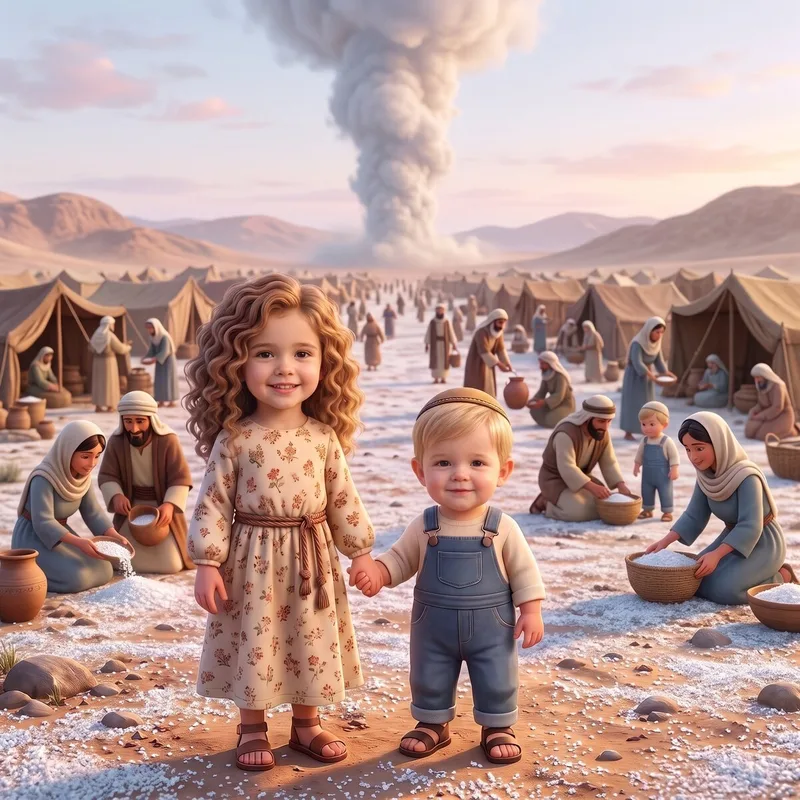
Then he asks them to remember the whole road of the midbar. The Torah tells us that Hashem fed them with the mann, something neither they nor their fathers had known, so that they would learn that man does not live by bread alone, but by all that comes from the mouth of Hashem. In those forty years their clothes did not wear out and their feet did not swell.
Next comes a description of Eretz Yisrael as a good land, and the Torah names seven kinds of produce: wheat, barley, grapevines, figs, pomegranates, olive oil and date honey. Moshe says: when you eat and are satisfied, bless Hashem for the good land. He also warns against building fine houses, becoming rich, and then saying "my power and the strength of my hand made me this wealth."
Moshe then reminds them of the Eigel. He tells them they were given the land not because of their own righteousness, and he recalls how he fell down before Hashem and davened for forty days and forty nights. He tells how Hashem told him to carve two new Luchos, how he made an aron of shittim wood to hold them, and how the Leviim were set apart for their service.
After that, Moshe asks what Hashem wants from us: to fear Him, walk in His ways, love Him and keep His mitzvos. He tells them to love the ger, since they were gerim in Mitzrayim, and recalls that seventy souls went down to Mitzrayim and now Bnei Yisrael are like the stars of the heavens in number.
Later in the parsha, Moshe tells them that Eretz Yisrael drinks the rain of heaven, and that the eyes of Hashem are on it from the beginning of the year to its end. Then comes the second paragraph of Shema, "V'haya im shamoa." It speaks of rain in its time, of teaching our children, of tefillin, and of the mezuzah on our doorposts.
What is the lesson of Parshas Eikev for children?
The main lesson is hakaras hatov. The Torah gives a warning for the moment we are full: it is easy to remember Hashem when we are hungry and asking, and easy to forget Him when the table is set and the house is comfortable. Moshe asks Bnei Yisrael to say the thank you out loud.
For a child this is concrete. It means a bracha before eating, bentching after a meal, and thanking the people who help us. If you want to build the habit at home, see Bentching (ברכת המזון) for Kids. The pasuk "v'achalta v'savata u'verachta" is where Chazal learn that Birkas HaMazon is a mitzvah min haTorah.
A second lesson comes from the name of the parsha: the small mitzvos matter. A child who is careful with a quick bracha or a mezuzah kiss is already living what Eikev teaches.
How do I explain Parshas Eikev to a 3 or 4-year-old, a 6 or 7-year-old and a child of 9 to 12?
Ages 3 to 4. Keep it to one picture: Hashem gave Bnei Yisrael food in the midbar called mann, and Hashem takes care of us too. Then connect it to the table: "When we finish eating, we say thank you to Hashem." Ask, "What was your favorite food today?"
Ages 6 to 7. Tell the story of the forty years: the mann, the clothes that did not wear out, the feet that did not swell. Then ask why Moshe wanted them to remember it. You can say that when we have everything, it is easy to forget who gave it to us.
Ages 9 to 12. Talk about the warning in the pasuk, "my power and the strength of my hand made me this wealth," and ask how a person can work hard and still remember that Hashem gives the strength to succeed. This is also a good age to look at Rashi on the word eikev and ask which mitzvos we are tempted to rush through. For background, see Parshas Va'eschanan for Kids, where the Shema first appears.
What can we ask at the Shabbos table about Parshas Eikev?
Eikev is a very table-friendly parsha, since it is about eating, thanking and remembering. These questions need nothing but talking and can be used at the Shabbos seudah:
- Why did Moshe tell Bnei Yisrael to remember the midbar before they entered the land?
- What do you think it was like to see the mann every morning?
- Which of the seven kinds of produce would you most like to taste in Eretz Yisrael?
- When is it easy to forget to say thank you? When is it easy to remember?
- What is one small mitzvah we can be extra careful with this week?
For a weekday activity, you can put out the seven species, such as dates, figs, grapes and pomegranate when in season, and wheat or barley in bread or cereal. Make the brachos together and talk about how Eretz Yisrael was described as a good land. To go deeper on thank-yous, see Saying Thank You for Kids.

Softcover 8″×8″

Hardcover 8″×8″

Board book 6″×6″

Coloring book 8.5″×11″
What is a personalized Torah Tale book of Parshas Eikev like?
A Torah Tale book makes your child the hero of the parsha. Their name and, from one uploaded photo, their likeness appear on every page, illustrated in high-resolution 3D animated-film style. Up to eight children can appear in the same book, ages 0 to 18. Every book is written with careful rabbinical guidance and strict tznius, and is reviewed by our team before it goes to print.
The format depends on your child's age. The board book is 6"x6" with rounded safety corners, for ages 0-4. The softcover photo book is 8"x8", for ages 4-8, and the hardcover photo book is 8"x8", for ages 5-18. Softcover and hardcover open with a dedication page. If you add parents, grandparents and other relatives with their photos, they appear with the children on a closing family page in every format.
Every book ends with a discussion page of 10 questions about the story, mixing comprehension with middos: what happened, and what it asks of the child. That turns the book from something read to a child into something talked about at the table. A storybook is just right for reading at the Shabbos table. There is also an optional matching coloring book, 8.5"x11" in black-and-white line art. Coloring is a weekday activity, for erev Shabbos or a weekday afternoon, and not for Shabbos itself.
When can I order a book of Parshas Eikev?
Eikev is read in the summer, in the month of Av, but a child can enjoy the story at any time of year. The book creator suggests the first parsha that can still arrive before its Shabbos, usually two to three weeks out, with a live countdown to that parsha's order deadline. If you are ordering for a particular Shabbos, check the countdown to the order deadline for delivery before the Shabbos the parsha is read.
Creating a book takes about five minutes. You need a free account and a few short questions: each child's name, boy or girl, age and one photo, any siblings, the story, your community (asked once), the language and the printed format. Languages are English, Hebrew and Yiddish.
When you are ready, you can create the book and give your child a Parshas Eikev they will want to read again, and to talk about at the table after bentching.
Frequently asked questions
What is Parshas Eikev about, in simple words?
Parshas Eikev is Moshe Rabbeinu speaking to Bnei Yisrael before they enter Eretz Yisrael. He reminds them how Hashem cared for them in the midbar, describes the good land ahead, retells the story of the Eigel and the second Luchos, and tells them to keep the mitzvos and to love and fear Hashem. Throughout, he asks them to remember and not to forget.
What is the lesson of Parshas Eikev for children?
The main lesson is hakaras hatov: remembering that everything we have comes from Hashem, and thanking Him, especially when we are full and comfortable. The Torah warns against thinking "my power and the strength of my hand made me this wealth." For a child, this becomes saying a bracha before eating, bentching after a meal, and saying thank you to the people who help us.
How do I explain Parshas Eikev to a 4-year-old?
Keep it to one idea: Hashem took care of Bnei Yisrael in the midbar, and He takes care of us too. You can say that Hashem gave them mann to eat, and clothes that did not wear out, and that when we finish eating we say thank you to Hashem in bentching. Ask your child what food they are thankful for today.
Where does bentching come from in Parshas Eikev?
The pasuk in Eikev says "v'achalta v'savata u'verachta es Hashem Elokecha al ha'aretz hatovah," you will eat and be satisfied and bless Hashem for the good land. Chazal learn from this pasuk that Birkas HaMazon is a mitzvah min haTorah. It is a good way to connect the parsha to what happens at your own table.
What does "eikev" mean, and why is the parsha named that?
The parsha is named for the word eikev in its first pasuk, "v'haya eikev tishme'un." Rashi explains that the word hints at the mitzvos a person may be tempted to treat lightly, as if tread on with the heel. The lesson is to care about the small mitzvos too.
Can I give my child a personalized book of Parshas Eikev?
Yes. Torah Tale makes personalized storybooks of the weekly parsha, with your child's name and likeness on every page in 3D animated-film style, and a discussion page of 10 questions at the end. The book creator suggests the first parsha that can still arrive before its Shabbos, with a live countdown to the order deadline.