Bentching (ברכת המזון) for Kids: Teaching Birkas HaMazon
Bentching is the thanks we say to Hashem after a meal with bread. Here is where it comes from, how to explain it to a 3-year-old, a 6-year-old and a 10-year-old, and how to start at your own table.
Published by Torah Tale.
Create this book for your child
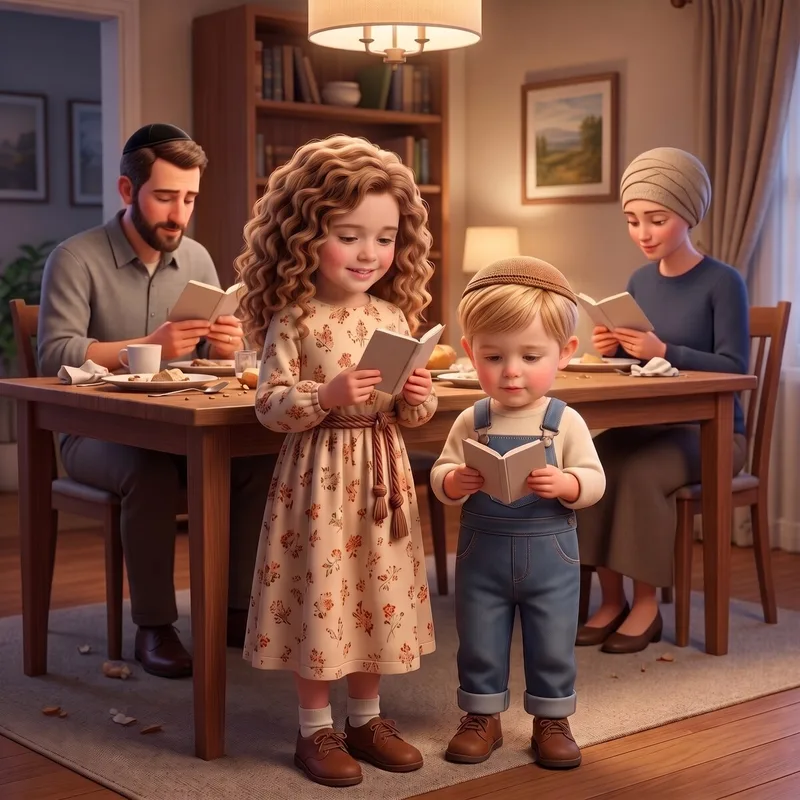
Bentching, or Birkas HaMazon, is the thanks we say to Hashem after we eat a meal with bread. It lands with children because it is a mitzvah they can do every single day, at their own table, right after food they actually enjoyed. Torah Tale's Bentching After a Meal (ברכת המזון), from the Mitzvos collection, is set in everyday life today and stars your child.
What is bentching and why do we do it?
The Torah tells us in Devarim 8:10 that when we have eaten and are satisfied, we should bless Hashem for the good land He gave us. That pasuk is the source of the mitzvah, and it is read in Parshas Eikev.
Notice when the Torah asks for the thanks: after we are full. Saying a bracha before eating is easy, because we are hungry and the food is right there. Bentching asks a child to stop once the plate is empty and remember who gave them the meal.
That is a lesson worth teaching in a concrete way, and bentching does it three times a day for families who have bread meals.
Where do the four brachos of bentching come from?
Birkas HaMazon is made up of four brachos. The Gemara in Berachos 48b tells us who instituted each one, and children enjoy hearing that different people from different times added to it.
| Bracha | What we thank Hashem for | Credited to (Berachos 48b) |
|---|---|---|
| Hazan | Feeding the whole world | Moshe Rabbeinu |
| Haaretz | Eretz Yisrael, the bris and the Torah | Yehoshua |
| Boneh Yerushalayim | Yerushalayim and the Beis Hamikdash | Dovid and Shlomo |
| Hatov V'hameitiv | Hashem being good and doing good | The beis din at Yavneh |
For a young child, you can say it simply: Moshe thanked Hashem for the food, Yehoshua thanked Him for the land, Dovid and Shlomo asked about Yerushalayim, and the Chachamim at Yavneh added a bracha that Hashem is good and does good.
What is the lesson of bentching for a child?
The lesson is hakaras hatov, recognizing that the food on the table came from Hashem and saying so out loud. A child who learns to stop and say thank you after a meal is practicing a habit that reaches well beyond the kitchen. We have a separate article on teaching hakaras hatov at home if you want to build on this.
Children also learn from what they see. When a child watches a parent put down a fork, pick up a bentcher and say the words with kavanah, that teaches more than any explanation.
How do I explain bentching to a 3-year-old, a 6-year-old and a 10-year-old?
- Ages 3-4: One sentence is enough: "We finished eating, so now we say thank you to Hashem for our food." Let them hold a bentcher, turn the page when you do, and join in on a line they know.
- Ages 6-7: Add the idea that bentching has four brachos and that people like Moshe and Yehoshua are connected to them. A child who is learning to read can follow the first words of each bracha in the bentcher with their finger.
- Ages 9-12: Talk about why the Torah asks for thanks after we are full, and what it means that the brachos mention Eretz Yisrael and Yerushalayim at an ordinary meal. Older children can also learn the additions for Shabbos, Yom Tov and Rosh Chodesh, which appear in the bentcher.
How much a child should say at each age is a question for your rav or your child's teacher. Aim for a little, said carefully, rather than a lot, said in a rush.
How do we start bentching with kids at home?
A few small habits make the difference:
- Keep bentchers on the table or within reach, so nobody has to go looking for one.
- Say the words aloud together at a calm pace, so children can hear where each bracha begins.
- On Shabbos and Yom Tov, it is customary to sing Shir HaMaalos before bentching, and children usually love joining in.
- When three adult men eat together, a zimun is said, and children can learn to listen for it. Ask your rav about how women and children take part.
- If you are unsure whether you left something out, ask your rav rather than guessing.
Bentching pairs naturally with what comes at the start of the meal. Our article on netilas yadayim before bread covers the other end of the bread meal.
What questions can we ask at the Shabbos table about bentching?
Shabbos is a good time for this, because the meal is long and no one is rushing. These are talking questions only, so they work well at the end of a meal:
- What did we eat today that we are thankful for?
- Who do you think worked to bring this food to our table?
- Why do you think the Torah asks us to say thank you after we are full?
- Which bracha of bentching is your favorite, and why?
- How can we remember to say thank you to Hashem on a regular weekday?
For more on a Shabbos-centered family routine, see Shabbos with My Family.
What is a personalized Torah Tale book about bentching like?
In Bentching After a Meal (ברכת המזון), your child's name and, from one uploaded photo, their likeness appear on every page, illustrated in 3D animated-film style. The story is set in everyday life today, which is exactly where this mitzvah is kept. Up to eight children can appear in the same book, so siblings can share one.

Softcover 8″×8″

Hardcover 8″×8″

Board book 6″×6″

Coloring book 8.5″×11″
The book comes in three formats, matched to age: a 6x6 board book with rounded safety corners for ages 0-4, an 8x8 softcover for ages 4-8, and an 8x8 hardcover for ages 5-18. Softcover and hardcover books open with a dedication page. If you add parents, grandparents and other relatives, they appear with the children on a closing family page in every format.
Every book ends with a discussion page of 10 questions that mix comprehension with middos: what happened, and what it asks of the child. That page turns a book you read to your child into something you talk about at the table. Each book is written with careful rabbinical guidance and strict tznius, and reviewed by our team before it goes to print.
The book is a good one to read on Shabbos or Yom Tov. If you add the optional matching coloring book (8.5"x11", black-and-white line art), keep it for a weekday afternoon or erev Shabbos, since coloring is melacha and not for Shabbos or Yom Tov.
Ready to make it? Creating a book takes about five minutes: a free account, then a few short questions about each child's name, boy or girl, age and one photo, any siblings, the story, your community (asked once), the language (English, Hebrew or Yiddish) and the printed format. When you are ready, create the book and put your child at the center of a mitzvah they keep every day.
Frequently asked questions
What is bentching and why do we do it?
Bentching, or Birkas HaMazon, is the blessing we say after eating a meal with bread. The Torah commands it in Devarim 8:10, where we are told that after we have eaten and are satisfied we should bless Hashem for the good land He gave us. It is a way of saying thank you for the food we just enjoyed.
How do I explain bentching to a 4-year-old?
Keep it to one sentence: before we eat we say a bracha, and after we eat we say thank you to Hashem for the food. Let your child hold a bentcher, point to the words if they can, and say or sing a short part with you. Ask your rav or your child's teacher which parts to focus on at this age.
What are the four brachos of Birkas HaMazon?
They are Hazan, which thanks Hashem for feeding the whole world; Haaretz, which thanks Him for Eretz Yisrael, the bris and the Torah; Boneh Yerushalayim, which asks for Yerushalayim to be rebuilt; and Hatov V'hameitiv, which praises Hashem as good and doing good. The Gemara in Berachos 48b credits Moshe, Yehoshua, Dovid and Shlomo, and the beis din at Yavneh, with these brachos.
At what age should a child start bentching?
Children usually begin as part of chinuch, learning a little at a time while they are young. How much a child should say, and when they become obligated, depends on their age and ability, so ask your rav or your child's teacher. At home, the most helpful thing is simply that the child sees and hears bentching at every bread meal.
Is there a Torah Tale book about bentching?
Yes. Bentching After a Meal (ברכת המזון) is in the Mitzvos collection and is set in everyday life today, with your child as the hero by name and likeness. The board book is 6x6 with rounded safety corners for ages 0-4, the softcover is 8x8 for ages 4-8, and the hardcover is 8x8 for ages 5-18.
Can we read the book at the Shabbos table?
Yes, reading a storybook is entirely appropriate on Shabbos and Yom Tov, and a bentching book fits naturally at the end of a meal. The optional matching coloring book is a different matter: coloring is melacha, so keep it for a weekday afternoon or erev Shabbos.