Parshas Acharei Mos-Kedoshim for Kids: The Kohen Gadol & Loving Your Friend
Two parshiyos read as one: the Kohen Gadol entering the Kodesh HaKodashim on Yom Kippur, and a long list of everyday mitzvos that end with loving your friend like yourself. Here is how to tell it to a child, and what to ask at the Shabbos table.
Published by Torah Tale.
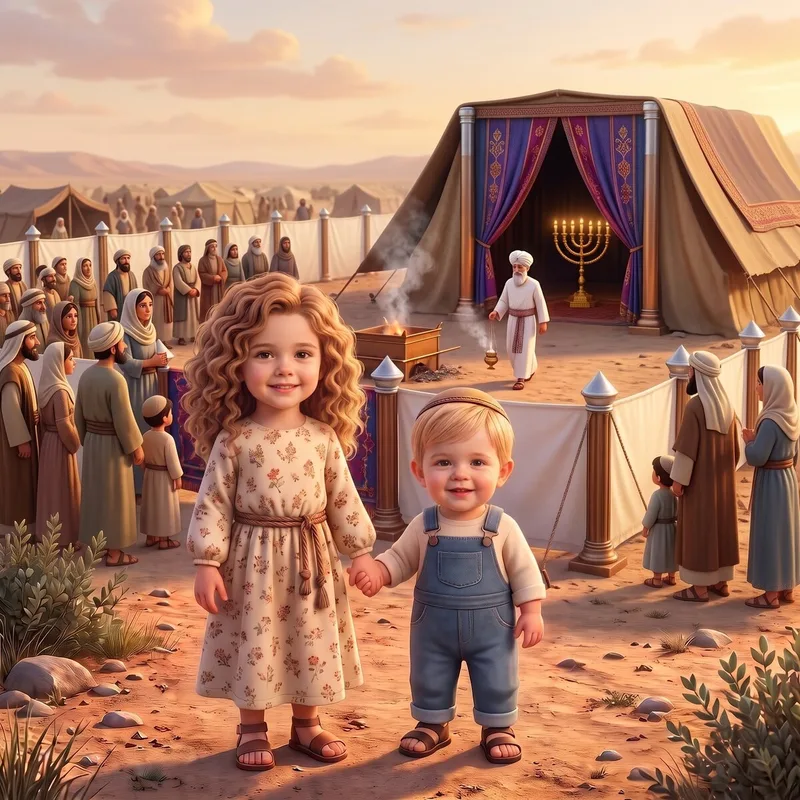
Create this book for your child - Parshas Acharei Mos · Create this book for your child - Parshas Kedoshim
Parshas Acharei Mos-Kedoshim is two parshiyos of Sefer Vayikra read as one. The first half takes a child into the holiest place on the holiest day: the Kohen Gadol, dressed in plain white linen, entering the Kodesh HaKodashim on Yom Kippur. The second half comes straight back out to the street and the kitchen and the classroom, with "Kedoshim tihyu" and a long list of mitzvos about how a Yid treats other people. Children feel the contrast immediately, and that contrast is the whole point.
What happens in Parshas Acharei Mos-Kedoshim?
Acharei Mos opens by looking back at the two sons of Aharon who came too close in the Mishkan, which we read about in Parshas Shemini. Hashem tells Moshe that Aharon may not simply walk into the Kodesh HaKodashim whenever he wishes. There is one day a year, and one exact order, for entering.
On Yom Kippur the Kohen Gadol takes off the gold garments and puts on four plain white linen ones. He brings a korban for himself and his household first. Then he takes two goats that look alike and casts lots on them: one lot comes up for ה', and that goat is brought as a korban, and the other goat is sent away into the midbar.
After that the Kohen Gadol fills his hands with ketores, carries it in on a pan of coals, and the Kodesh HaKodashim fills with the cloud of the ketores. He brings in the blood of the korbanos and brings kapparah for the Mishkan, for the kohanim and for all of Klal Yisrael. The parsha also teaches kisui hadam, covering the blood of a bird or a wild animal after shechitah, and closes with the laws of which marriages are holy for a Jewish family and which are forbidden.
Then Kedoshim begins, and the tone changes. Hashem tells Moshe to say to the whole assembly of Bnei Yisrael: "Kedoshim tihyu" - you shall be holy. Rashi brings that this parsha was said b'hakhel, to everyone gathered together, because so much of the body of Torah depends on it.
What mitzvos are in Kedoshim?
Kedoshim is one of the most mitzvah-packed parshiyos in the Torah, and almost all of them are things a child can picture:
- Having awe for your mother and father, and keeping Shabbos.
- Leaving the corner of your field (peah) and the fallen stalks (leket) for the poor, and leaving the fallen grapes and single grapes of the vineyard too.
- Not stealing, not lying, not swearing falsely.
- Paying a worker on time, before the night passes.
- Not cursing a deaf person and not putting a stumbling block before a blind person.
- Judging fairly, not going around as a talebearer, not hating your brother in your heart.
- Not taking revenge and not holding a grudge.
- Standing up for an elderly person and honoring a talmid chacham.
- Honest weights, honest measures, honest scales.
- Orlah: not eating the fruit of a new tree for its first three years.
In the middle of that list sits the pasuk that holds the rest together: v'ahavta l'reiacha kamocha, love your fellow Yid as yourself. Chazal record that Rabbi Akiva called it a great klal of the Torah. Near its end, Kedoshim has Hashem telling us that He separated us from the nations so that we should be holy to Him.
Why are Acharei Mos and Kedoshim read together?
A regular Jewish year has fewer Shabbosos than a leap year, so certain pairs of parshiyos are joined to finish the Torah on time. Acharei Mos and Kedoshim are one of those pairs. In a leap year, children usually hear them a week apart, and we have separate articles for Acharei Mos and for Kedoshim.
When they land together, it is worth pointing out to an older child what the pairing teaches. One Yid, once a year, in one room, with ketores. And then: every Yid, every day, in every store and every classroom. Both are called kedushah.
In the Torah Tale book creator, a double-parsha week produces a single book that covers both parshiyos, so the child gets the Kohen Gadol and "Kedoshim tihyu" in one story rather than two half-stories.

How do I explain this parsha at different ages?
Ages 2 to 4. Keep it to pictures. "On Yom Kippur the Kohen Gadol wore white clothes and went into the special room where nobody else ever goes. He asked Hashem to forgive all the Yidden." Then one mitzvah from Kedoshim: "And Hashem says, be nice to your friend like you want your friend to be nice to you."
Ages 5 to 7. Add the two goats and the lots, and add the farmer leaving the corner of his field. Children this age love that the poor person does not have to ask for the food. It is already waiting for him, and he picks it himself. Ask them who else could use something left for them without having to ask.
Ages 8 to 12. Now the harder mitzvos are the interesting ones. Not hating in your heart. Not taking revenge, and not holding a grudge even while you do the favor. Putting a stumbling block before a blind person, which Chazal explain also means giving someone bad advice that leads them to fall. An eight-year-old can discuss whether it is possible to be commanded to feel something, and that is a real conversation to have with a parent.
What is a personalized Torah Tale book of Acharei Mos-Kedoshim like?
Torah Tale prints the weekly parsha as a storybook in which your own child is the hero. You upload one photo, and the child's name and likeness appear on every page, illustrated in a high-resolution 3D animated-film style. Up to eight siblings, ages 0 to 18, can appear together in the same book, which matters for a parsha like this one where half the story is about how people treat each other.
Every book is written with careful rabbinical guidance and strict tznius and reviewed by our team before printing. Books come in English, Hebrew or Yiddish, and a family can order the same story in more than one language. Every book ends with a discussion page with ten questions about the story, mixing what happened with what it asks of the child, which is what turns the book from something read aloud into something argued about happily at the Shabbos table.
Three formats: a 6"x6" board book with rounded safety corners for ages 0 to 4, an 8"x8" softcover for ages 4 to 8, and an 8"x8" hardcover for ages 5 to 18. Softcover and hardcover end with a blank page for the child to draw their own picture; the board book ends with a family page. An 8.5"x11" matching coloring book in black-and-white line art can be added, and a cover jigsaw puzzle can be added to a one-time order.

Softcover 8″×8″

Hardcover 8″×8″

Board book 6″×6″

Coloring book 8.5″×11″
Shabbos-table questions and a weekday activity
Five questions that work for a mixed-age table:
- Why do you think the Kohen Gadol wore plain white linen on Yom Kippur instead of the gold clothes?
- The two goats looked the same. What made them different?
- The farmer leaves the corner of his field. Why is that better for the poor person than handing him food?
- What is the difference between taking revenge and holding a grudge?
- Name one thing you did this week that was "loving your friend like yourself." Name one chance you missed.
For a weekday afternoon, try the corner-of-the-field project. Give each child a bag and have them set aside, from their own things, something real for someone else: a toy in good condition, a snack for a friend who never has one, coins for the tzedakah pushke. The rule of peah is that you leave it before you need it, not after. That is the part worth saying out loud.
The matching coloring book, if you added one, is a weekday activity. Keep it for a weekday afternoon, erev Shabbos while the cooking is going on, the days before a Yom Tov, or Chol HaMoed. The storybook itself is made for the Shabbos table and for a long Yom Tov afternoon.
Say it in one sentence
"Hashem's holiest room was open one day a year to one person, and Hashem's holiness in your life is open every day to you, in how you talk to your friend and what you leave for someone who has less."
That sentence carries both halves of the double parsha, and a six-year-old can repeat it back.
Torah Tale's book creator suggests next week's parsha with a live countdown to the order deadline for delivery before that Shabbos. It takes about five minutes: your child's name, age, one photo, the story, the language and the format. You can create the book now, or first read how to choose the weekly parsha for your child's book.
Frequently asked questions
What is the main lesson of Parshas Acharei Mos-Kedoshim for children?
That holiness is not only something that happens in the Beis HaMikdash. Acharei Mos shows the holiest place and the holiest day, where only the Kohen Gadol enters, once a year, dressed in plain white linen. Kedoshim then says "Kedoshim tihyu" to every single Yid and fills in what that looks like: honoring parents, leaving food for the poor, paying workers on time, speaking honestly and loving your fellow Yid as yourself.
Why are Acharei Mos and Kedoshim read together?
The Jewish calendar has fewer Shabbosos in a regular year than in a leap year, so certain parshiyos are paired to keep the yearly cycle on schedule. In most non-leap years, Acharei Mos and Kedoshim are read on the same Shabbos as one parsha. In a leap year they are usually read separately on two consecutive weeks.
How do I explain v'ahavta l'reiacha kamocha to a 5-year-old?
Say it like this: "Hashem says to care about your friend the same way you care about yourself." Then make it concrete with something from that day: if you would not want someone to grab your toy, do not grab theirs; if you would want someone to save you a seat, save them one. Chazal teach that Rabbi Akiva called this pasuk a great klal, a rule that holds many other mitzvos inside it.
What were the two goats in Acharei Mos?
On Yom Kippur the Kohen Gadol took two goats that looked alike and cast lots on them. One lot said it was for ה' and that goat was brought as a korban; the other goat was sent away to the midbar. The whole avodah of the day was done to bring kapparah for all of Klal Yisrael.
Which Torah Tale format is best for this parsha?
For a toddler aged 0 to 4, the 6"x6" board book with rounded safety corners holds up to small hands and ends with a family page. For ages 4 to 8 the 8"x8" softcover photo book works well, and for ages 5 to 18 the 8"x8" hardcover. Softcover and hardcover both end with a page where the child draws their own picture, and every format ends with a discussion page of ten questions.
Can we read the Torah Tale book on Shabbos?
Yes. Reading a storybook at the Shabbos table or on a long Yom Tov afternoon is exactly what these books are for. The optional matching coloring book is different: coloring is melacha, so it is a weekday activity, right for a weekday afternoon, erev Shabbos, the days before a Yom Tov, or Chol HaMoed.