Noach Feeds Every Animal in the Teivah: Midrash for Kids
The pasuk tells Noach to gather food for everyone in the teivah, and the Midrash tells us how he did it. Here is the story, the lesson of caring for those who depend on you, and questions for your table.
Published by Torah Tale.
Create this book for your child
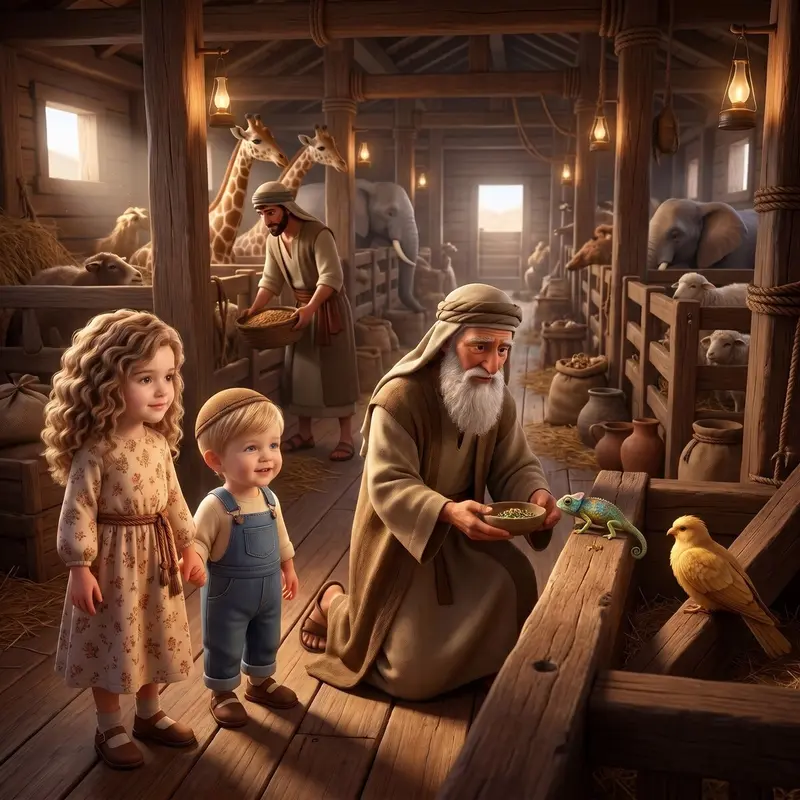
Noach feeding every animal is a Midrash about the year Noach and his sons spent in the teivah, looking after every creature Hashem had brought inside. Children love it because it is easy to picture and easy to feel: a very big job, a lot of hungry animals, and one family who kept going. It also gives a child a simple question to carry: what do I do when someone is counting on me?
What is the story of Noach feeding every animal?
After Hashem told Noach about the Mabul, Noach built the teivah, and the animals, birds and creeping things came in with him and his family. For about a year they were inside, while the waters covered the earth. The question the Midrash asks is a practical one: who looked after all of them?
The Midrash relates that Noach and his sons took on this work themselves. Every animal had its own kind of food and its own time to eat, and they brought each one what it needed. Chazal tell us that because of this they did not sleep as people usually do during that year, since the animals needed them.
One Midrash adds a small, human moment. It relates that Noach was once late bringing a lion its food, and the lion struck him. It shows how demanding the work was, and how careful even a great tzaddik like Noach had to be with every single task.
What does the Torah say, and what does the Midrash add?
It helps to tell children which part is which. The pasuk itself says that Hashem told Noach: "ואתה קח לך מכל מאכל אשר יאכל ואספת אליך והיה לך ולהם לאכלה", take every kind of food that is eaten and gather it, and it will be food for you and for them. The Torah then tells us that Noach did all that Hashem commanded him.
The Torah does not describe a daily schedule inside the teivah. The picture of Noach and his sons feeding each animal at its time, going without regular sleep, and the story of the lion all come from Chazal in the Midrash, in Midrash Tanchuma and Bereishis Rabbah on Parshas Noach. When you tell it at home, you can say "the Torah tells us" for the food and "Chazal tell us" for what it looked like in practice.
This is also the way Torah Tale treats the Midrash & Aggadah collection: these are the stories Chazal tell behind the pesukim, told from their sources, without adding to what the source says. If you want the parsha itself, see Parshas Noach for Kids.
What is the lesson for children?
The main lesson is achrayus, responsibility. Noach was given a job that did not end at the end of the day, and he and his sons did it with care. Children understand this well when you connect it to what they know: a pet that needs water, a baby sibling who needs a bottle, a plant that must be watered, a friend who is counting on them to show up.
A second lesson is kindness to living creatures. The animals in the teivah could not ask for anything, so Noach had to notice what each one needed. This is the same quiet attention behind the mitzvah of tzaar baalei chaim, which you can read more about in Being Kind to Animals for Kids.
A third is patience for a long job. Noach was not finished after one meal. A child who learns that some mitzvos and some chesed take days and weeks, not minutes, has learned something useful for school, for family life and for davening.
How do I explain it to a 4-year-old and to an older child?
Ages 3 to 4: Keep it to one picture. "Hashem told Noach to take animals into the teivah. Noach gave every animal its own food, so nobody was hungry." Ask which animal they would feed first and what it eats. Do not go into the Mabul in detail; the story for this age is about the helping.
Ages 6 to 7: Add the idea that it was a big job and Noach and his sons shared it. Ask: "What is hard about feeding so many animals?" They will say there were a lot, they all eat different things, and it never stopped. Then ask who in your family has a job like that, such as Ima making dinner every day or Abba davening every morning.
Ages 9 to 12: Older children can handle the distinction between pshat and Midrash. Ask them what the pasuk gives us and what Chazal fill in. They can also take on the harder question: why does the Midrash include the lion, and what does it teach about taking care when you are exhausted?
What questions can we ask at the Shabbos table?
This story works well for a Shabbos meal because it needs only talking. A few questions you can use:
- Who did Noach need to feed, and who helped him?
- Why do you think each animal got its own food and its own time?
- When is it hard to keep doing a job that nobody sees?
- Who takes care of you every day, and how can we say thank you?
- What is a small job at home that you could take on and not forget?
Let the youngest answer first, and let the older children add. If you want something hands-on, a weekday afternoon or erev Shabbos is the time for coloring or drawing the animals. Those activities are melacha, so they stay off Shabbos and Yom Tov, while reading and talking are exactly right for them.
What is the Torah Tale book of Noach feeding every animal like?
Torah Tale makes personalized Torah storybooks in which the child is the hero. Your child's name and, from one uploaded photo, their likeness appear on every page, illustrated in 3D animated-film style. Up to eight children can appear in the same book, ages 0 to 18, so siblings can share one story.
Softcover 8″×8″ Hardcover 8″×8″ Board book 6″×6″ Coloring book 8.5″×11″



This story is in the Midrash & Aggadah collection, which is made up of the stories Chazal tell behind the pesukim, each from its named source in the Gemara or Midrash. Every book is written with careful rabbinical guidance and strict tznius, and is reviewed by our team before it goes to print.
Every book ends with a discussion page of 10 questions about the story, mixing comprehension with middos: what happened, and what it asks of the child. That page is what turns a book you read to a child into one you talk about together at the table. If you add parents, grandparents or other relatives with their photos, they appear with the children on a closing family page in every format.
Which format fits which age?
There are three formats. The board book is 6"x6" with rounded safety corners, for ages 0-4. The softcover photo book is 8"x8", for ages 4-8. The hardcover photo book is 8"x8", for ages 5-18. Softcover and hardcover open with a dedication page.
You can also add a matching coloring book, 8.5"x11" in black-and-white line art, as a one-time add-on. It is a weekday activity for erev Shabbos, an afternoon during the week, or Chol HaMoed, never something for Shabbos or Yom Tov. The book itself is the opposite: it is perfect to read on Shabbos. If you are new to the process, How to Create a Personalized Torah Storybook walks through it step by step.
Ready to make it? Creating a book takes about five minutes and needs a free account and a few short questions: each child's name, boy or girl, age and one photo, any siblings, the story, your community (asked once), the language (English, Hebrew or Yiddish) and the printed format. When you are ready, create the book and choose Noach Feeds Every Animal from the Midrash & Aggadah collection.
Frequently asked questions
Does the Torah say Noach fed the animals?
Yes. Hashem told Noach to gather every kind of food that is eaten and store it for himself and for them (Bereishis 6:21), and the Torah says Noach did all that Hashem commanded (6:22). The details of how he and his sons tended to the animals through the year come from the Midrash.
Where does the Midrash about Noach not sleeping come from?
Chazal speak of this in the Midrash on Parshas Noach, including Midrash Tanchuma and Bereishis Rabbah. They describe Noach and his sons as busy with the animals and birds all year, and not sleeping as usual because the animals needed them.
What is the lesson of Noach feeding the animals?
The lesson is responsibility and kindness. Noach and his sons were given living creatures to look after, and they kept going day and night even when it was hard. Children can learn that caring for others, including animals, takes patience and effort.
How do I explain this story to a 4-year-old?
Keep it short and concrete: Hashem told Noach to take animals into the teivah, and Noach made sure every animal got the right food. You can ask which animals your child thinks ate which foods, and say that Noach was a kind helper who did not forget anyone.
Can we read this story on Shabbos?
Yes, reading a storybook at the Shabbos table or on Shabbos afternoon is entirely appropriate. If you want to color, draw or do a craft connected to the story, keep that for a weekday or erev Shabbos, since coloring and drawing are melacha on Shabbos.