My Great-Grandparents and Me: A Torah Story for Kids
My Great-Grandparents and Me is a Family story set at home today. Here is what it is about, why the Torah cares so much about the generations, and how to talk about it with a 3-, 6- or 10-year-old.
Published by Torah Tale.
Create this book for your child
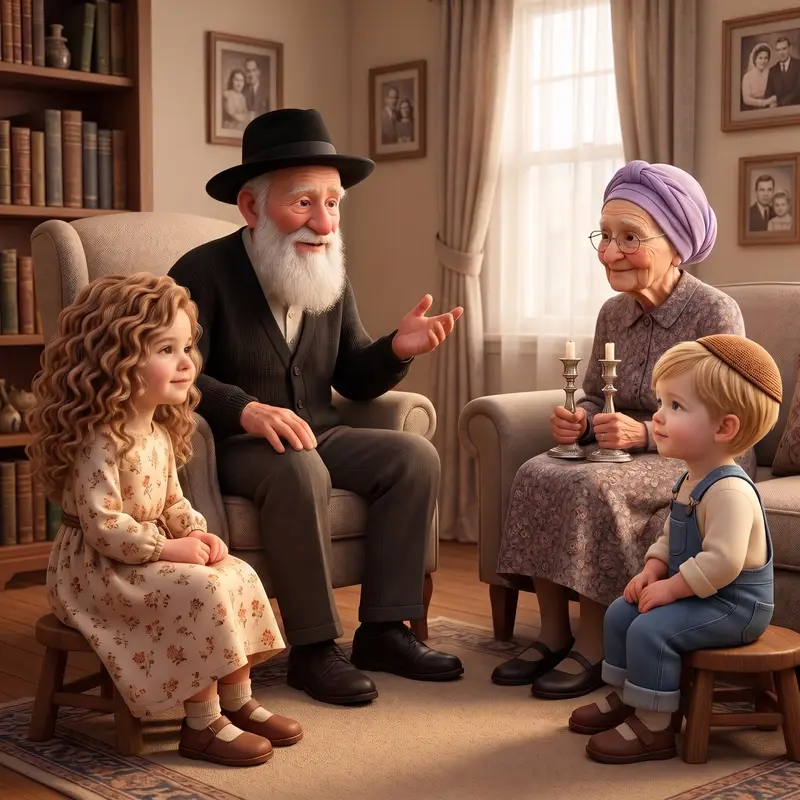
My Great-Grandparents and Me (סבא רבא, סבתא רבתא ואני) is a story from Torah Tale's Family collection, set at home today, about a child and the great-grandparents who love them. It lands with young children because a great-grandparent is often the oldest person they know, and the story helps them see that person as someone who has something to hand down.
What is My Great-Grandparents and Me about?
The Family collection is about a child and the grown-ups who love them: Mommy, Totty, Bobby and Zaidy, and in this story the great-grandparents. Each book is set at home, today, and is about what they do together and what a parent or grandparent teaches.
As in every Torah Tale book, your child is the hero. Their name and, from one uploaded photo, their likeness appear on every page, illustrated in 3D animated-film style. Up to eight siblings, ages 0 to 18, can appear in the same book.
We will not retell scenes page by page here, because the best way to meet the story is to read it with your child. What we can offer is the Torah background that makes this kind of story matter, and ways to talk about it afterward.
Why do great-grandparents matter in the Torah?
The Torah is full of one generation speaking to the next. In Devarim 4:9 we are told to make the Torah known to our children and to our children's children (והודעתם לבניך ולבני בניך). That already reaches past parents and grandparents.
In Ha'azinu, Moshe says: שאל אביך ויגדך זקניך ויאמרו לך, ask your father and he will tell you, your elders and they will say to you (Devarim 32:7). The Torah expects a child to ask, and expects the older generation to answer.
Mishlei 17:6 says עטרת זקנים בני בנים, grandchildren are the crown of the elders. A great-grandparent who sees a great-grandchild is seeing that crown grow. Children can feel that when they walk into the room.
The Torah also commands respect for the elderly: מפני שיבה תקום והדרת פני זקן (Vayikra 19:32). For more on that mitzvah, see Standing Up for an Older Person for Kids.
What is the lesson for a child?
The idea at the heart of a story like this is mesorah, something received and then passed on. Our great-grandparents lived through years our children never saw, and kept what they kept for a reason. Whatever a child sees them do at home, whether it is a bracha, a niggun or the way they welcome people, is part of that chain.
It also teaches kavod and hakaras hatov in a very natural way. A small child can sit quietly beside an older person, listen and say thank you. Those are real ways of living out the mitzvos, long before a child can learn the pesukim.
How do I explain it to a 3-year-old, a 6-year-old and a 10-year-old?
Age 3 or 4. Use names and faces. Say: "This is Mommy's Bubby. She is very, very special, and she knew Mommy when Mommy was little." Let your child point to the photo and repeat the name. One concrete sentence about that person is enough.
Age 6 or 7. Explain the line: "Bubby's Bubby, Zaidy's Zaidy, all the way back." Children this age enjoy working out who is whose parent. Then ask what they noticed that the great-grandparents do, and what they would want to learn from them.
Age 10 to 12. Bring in the pesukim above. Ask why the Torah says to ask our elders, and what a great-grandparent knows that no sefer can tell us. An older child can also start asking about the family's own history, in a respectful and curious way.
For a younger child, the board book (6x6 with rounded safety corners, ages 0-4) is built for small hands. Older children can have the softcover (8x8, ages 4-8) or the hardcover (8x8, ages 5-18).

Softcover 8″×8″

Hardcover 8″×8″

Board book 6″×6″

Coloring book 8.5″×11″
What can we ask at the Shabbos table?
Reading is entirely appropriate on Shabbos, and so is talking, singing and telling stories. Here are questions that need nothing but conversation:
- Who is the oldest person in our family that you know? What do you like about being with them?
- What does a great-grandparent do that Totty or Mommy also does?
- Why do you think the Torah says to ask our elders?
- What is one thing you would like to ask a great-grandparent, and how would you ask it respectfully?
- What is something you would like to teach your own grandchildren one day?
Every Torah Tale book also ends with its own discussion page of 10 questions, mixing comprehension with middos. It turns the book from something read to a child into something talked about at the table.
What can we do this week to bring it to life?
These are weekday activities, since they involve writing or coloring and are not for Shabbos or Yom Tov. On a weekday afternoon, ask a great-grandparent, or a grandparent who remembers them, for one story and one saying. Let your child ask the questions, and write the answers down for a family notebook. Even a photo and three sentences will become something your child treasures.
If a great-grandparent is no longer alive, the same project works through the stories that grandparents and parents remember. For younger children, the optional matching coloring book (8.5x11, black-and-white line art) is a good weekday activity, for example on an afternoon or erev Shabbos.
For a related story about the grandparents' generation, see Bobby & Zaidy and Me for Kids.
What is the personalized book like?
You create it at torahtale.com/create with a free account and a few short questions: each child's name, boy or girl, age and one photo, any siblings, the story, your community (asked once), the language and the printed format. It takes about five minutes. The language can be English, Hebrew or Yiddish, and a book can be ordered in more than one.
The softcover and hardcover open with a dedication page, which is a good place for a message from the family. If you add parents, grandparents and other relatives with their photos, they appear with the children on a closing family page in every format. That can include the great-grandparents, if you add them.
Every book is written with careful rabbinical guidance and strict tznius, and reviewed by our team before it goes to print. You can also read about the Family collection's story about an aunt and uncle.
When you are ready, you can create the book and choose My Great-Grandparents and Me from the Family category.
Frequently asked questions
What is My Great-Grandparents and Me about?
It is a story in Torah Tale's Family collection, set at home today, about a child and the great-grandparents who love them: what they do together and what they teach. Your child is the hero, with their own name and likeness on every page. It sits alongside the Family books about Mommy, Totty, Bobby and Zaidy.
What does the Torah say about children and grandchildren learning from the older generation?
The Torah says to make its words known to our children and our children's children (Devarim 4:9). In Ha'azinu, Moshe says: ask your father and he will tell you, your elders and they will say to you (Devarim 32:7). Mishlei 17:6 adds that grandchildren are the crown of the elders.
How do I explain great-grandparents to a 3-year-old?
Keep it concrete: a great-grandparent is Mommy's or Totty's Bubby or Zaidy, so they are very special and have known our family for a very long time. Point to a photo, say the name, and tell one short thing about that person. A 3-year-old does not need more than that to feel the connection.
Can I tell my child stories about a great-grandparent who is no longer alive?
Yes. The conversation this story starts, about what the older generation taught and how they lived, works just as well through stories you tell about them. Share a name, a minhag they kept or something they used to say, and let your child ask questions.
Which format of the book suits my child?
The board book (6x6 with rounded safety corners) is for ages 0-4, the softcover (8x8) for ages 4-8 and the hardcover (8x8) for ages 5-18. The child's age is one of the few short questions when you create the book, along with name, boy or girl, one photo, siblings, the story, your community, the language and the format.
Is there something to do with the book on Shabbos?
Reading is entirely appropriate on Shabbos, and the discussion page of 10 questions makes a good conversation at the Shabbos table. The optional coloring book is a weekday activity only, for example on a weekday afternoon or erev Shabbos, never on Shabbos or Yom Tov.