My Family Takes Care of Me (המשפחה שלי שומרת עליי) for Kids
A parent's guide to 'My Family Takes Care of Me': what the story is about, the lesson of hakaras hatov and kibbud av va'em, how to explain it at ages 3-4, 6-7 and 9-12, and questions for the Shabbos table.
Published by Torah Tale.
Create this book for your child
"My Family Takes Care of Me" (המשפחה שלי שומרת עליי) is a Torah Tale story from the Family collection about a child at home and the grown-ups who love them. It lands with children because it puts words to something they feel every day: someone is watching over me. For a small child, being fed, tucked in and known by name is one of the clearest ways to feel that Hashem looks after them.
What is My Family Takes Care of Me about?
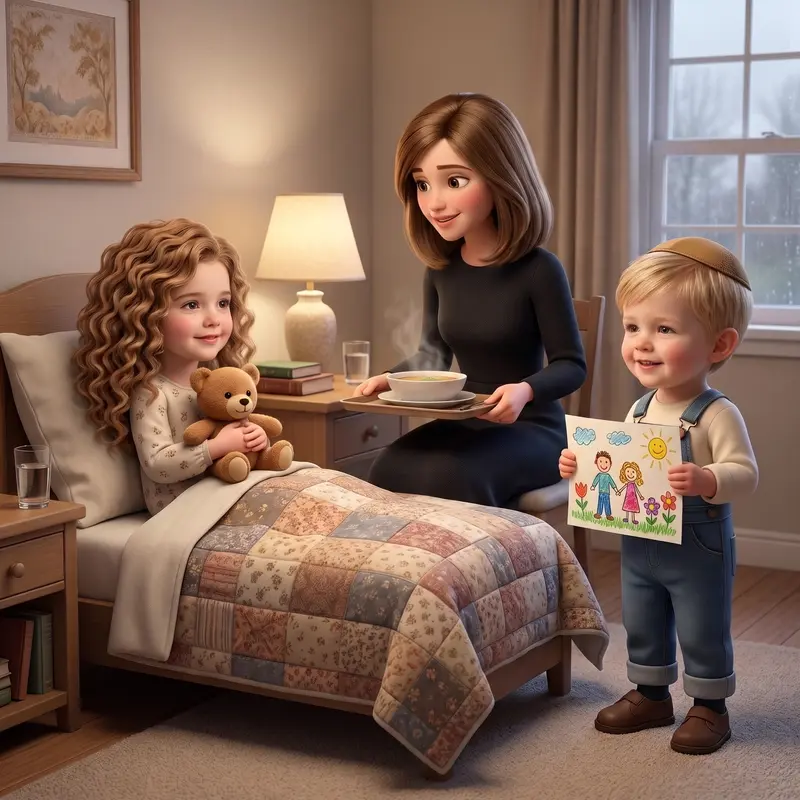
The story is set at home, today. Like the rest of the Family collection, it is about a child and the grown-ups who love them: what they do together, and what a parent or grandparent teaches. The child is the hero, with their own name and likeness in the illustrations.
Care at home is made of ordinary things. A hot supper, a hand held on the way to shul, a parent who checks the blanket at night, a grandparent who always has time to listen. None of it is dramatic, and that is exactly the point. Children rarely notice what works smoothly, so a story that stops to look at it gives them something new to see.
This is not a parsha or a story from Nevi'im, so there are no pesukim to retell. Its Torah comes from what a child is shown at home, and from the way the family talks about it afterward.
Why does a child need to hear that family takes care of them?
Young children assume that care simply exists, the way the floor exists. They do not yet connect a clean shirt to a parent who washed it. Naming the care is the first step toward being grateful for it.
Tehillim 121:5 calls Hashem our shomer, our guardian. A parent's care can be a child's first experience of what that word means. You can say it simply: Hashem looks after us, and He gives us a family to be part of that care. That is a way of putting the idea in a child's terms, and it keeps the family from standing in the place of Hashem or hiding Him.
What is the lesson of the story?
The lesson is hakaras hatov, noticing the good that others do for us and saying thank you for it. If you want to build on this at home, our article on teaching hakaras hatov goes into more detail.
It also points toward kibbud av va'em. The Torah commands, in the Aseres HaDibros, "כבד את אביך ואת אמך" (Shemos 20:12). Mishlei 1:8 says "שמע בני מוסר אביך ואל תטש תורת אמך", listen, my son, to your father's guidance and do not forsake your mother's teaching. A child who sees how much is done for them is better placed to understand why honoring parents is a real mitzvah and not just a rule. See also teaching kibbud av va'em at home.
The caring also goes both ways. Even a three-year-old can bring a napkin to the table or give Bubby a hug when she arrives. Small jobs show a child that they are part of the household's care and not only a receiver of it.
How do I explain it to a 3 or 4-year-old, a 6 or 7-year-old and a 9 to 12-year-old?
Ages 3 to 4. Use one sentence and point to real things in the room: "Mommy and Totty take care of you, and Bubby and Zaidy love you too. Hashem gave you your family." Then ask: "What did Mommy do for you this morning?" Let your child answer in their own words, even if the answer is just "breakfast."
Ages 6 to 7. Children this age love to count and sort. Ask who does what in your house, and who does what for them. Then ask a harder one: what do you do for someone else in the family? This is where the care starts to run in both directions.
Ages 9 to 12. Older children can notice the work they do not see: the planning, the cooking before Shabbos, the phone calls to arrange things, the tefillos a parent says for them. Talk about how a grandparent passes things on. The Torah says "שאל אביך ויגדך זקניך ויאמרו לך" (Devarim 32:7), ask your father and he will tell you, your elders and they will say to you. Ask your child what they would like to ask a grandparent.
What is a personalized Torah Tale book of this story like?
The child's name and, from one uploaded photo, their likeness appear on every page, illustrated in high-resolution 3D animated-film style. Up to eight children can appear in the same book, ages 0 to 18, which suits a family with several children who all want to be in the same story.
If you add parents, grandparents and other relatives with their photos, they appear with the children on a closing family page in every format. That page is a natural moment to ask a child to tell you who is who and what each person does for them.

Softcover 8″×8″

Hardcover 8″×8″

Board book 6″×6″

Coloring book 8.5″×11″
The book comes in three formats: a 6x6 board book with rounded safety corners for ages 0-4, an 8x8 softcover photo book for ages 4-8, and an 8x8 hardcover photo book for ages 5-18. Softcover and hardcover open with a dedication page. It can be ordered in English, Hebrew or Yiddish. Every book is written with careful rabbinical guidance and strict tznius, and is reviewed by our team before it goes to print.
Every book also ends with a dedicated discussion page of 10 questions that mix comprehension with middos: what happened, and what it asks of the child. That page is what turns the book from something read to a child into something talked about at the table.
What can we talk about at the Shabbos table?
Reading is entirely right for Shabbos, and so is talking. The following questions use only conversation, nothing written or prepared at the table:
- Who took care of you today, and what did they do?
- What is something someone does for you every day that you almost never notice?
- What is one thing you did this week to take care of someone in our family?
- What did Bubby or Zaidy teach you that you want to remember?
- Who can we say thank you to this Shabbos, and how?
Let the youngest answer first, since they usually have the shortest answers and are easily talked over. If your family goes around the table, a grandparent's answer to "who took care of you when you were little?" is often the one the children remember longest.
For a weekday afternoon or erev Shabbos, the optional matching coloring book (8.5"x11", black-and-white line art) is a quiet way to revisit the story. It is a one-time add-on to a book, and because coloring is melacha it belongs to weekdays only, never to Shabbos or Yom Tov.
If your child is a little older and likes grandparent stories, our article on grandparents and what they teach is a good companion to this one.
When you are ready, you can create the book. It takes a free account and a few short questions: each child's name, boy or girl, age and one photo, any siblings, the story, your community (asked once), the language and the printed format. The whole flow takes about five minutes.
Frequently asked questions
What is the lesson of 'My Family Takes Care of Me'?
The lesson is hakaras hatov, noticing and thanking the people who look after us, together with the mitzvah of honoring parents. A child who sees how much care fills an ordinary day learns that family love shows itself in small, steady actions. It also opens the door to the child taking care of others in return.
How do I explain to a 4-year-old that family takes care of them?
Keep it to one short sentence, such as: 'Mommy and Totty give you food, hold your hand and keep you safe, and Hashem gave you a family to do that.' Then ask your child to name one thing someone did for them today. Concrete examples work better than explanations at this age.
Is this a story from the Torah?
No. It is a story about home today, from the Family collection, so there is no parsha or pasuk being retold. The Torah ideas around it come from pesukim such as the mitzvah to honor father and mother in the Aseres HaDibros and Hashem being called our shomer in Tehillim 121.
Which format of the book suits which age?
Torah Tale offers a 6x6 board book with rounded safety corners for ages 0-4, an 8x8 softcover photo book for ages 4-8, and an 8x8 hardcover photo book for ages 5-18. An optional matching coloring book is a one-time add-on. The child's age is one of the short questions when you create the book.
Can grandparents and parents appear in the book?
Yes, if you add them. A family can add parents, grandparents and other relatives with their photos, and they appear with the children on a closing family page in every format. The story itself stars the children.
Can I use the book at the Shabbos table?
Yes. Reading is entirely appropriate on Shabbos and Yom Tov, and every book ends with a discussion page of 10 questions that works well around the table. The coloring book is only for weekdays, since coloring is melacha on Shabbos and Yom Tov.