Moshe Asks for a Day of Rest for Kids: Shemos Rabbah, Shabbos & Caring
Chazal tell us that Moshe saw how hard the Yidden worked in Mitzrayim and asked Pharaoh to let them rest one day. Here is the story, its source, its lesson and how to share it with children.
Published by Torah Tale.
Create this book for your child
Moshe Asks for a Day of Rest is a Midrash from Shemos Rabbah (1:28) about Moshe Rabbeinu seeing how hard the Yidden worked in Mitzrayim and going to Pharaoh with a simple request: let them rest one day. Children connect with it because the idea is so plain and so kind. Someone is tired, someone with power is asked to help, and Chazal tell us the answer was a day of rest, the day of Shabbos.
What happens in the story of Moshe and the day of rest?
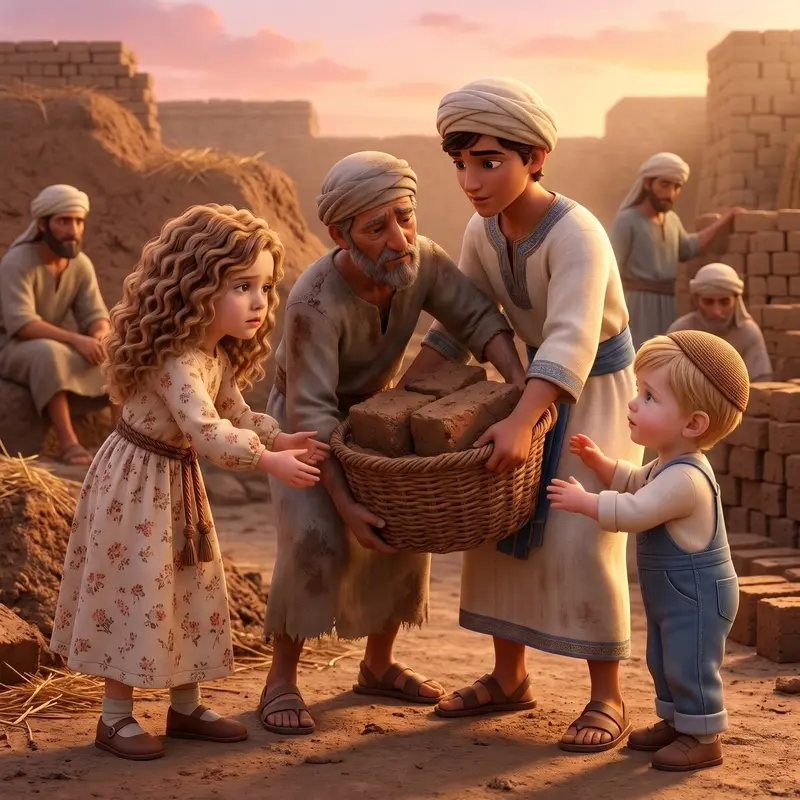
The Torah tells us (Shemos 2:11) that Moshe grew up, went out to his brothers and saw their burdens. Rashi explains the words vayar besivlosam: Moshe set his eyes and his heart to feel their pain. He had been raised as the son of bas Pharaoh (you can read how that began in Bas Pharaoh Saves Baby Moshe), yet he did not look away from the people he came from.
The Midrash relates what Moshe did about it. He went to Pharaoh and said that a person who owns servants and never lets them rest will not have them for long, because they will not survive. These are your servants, he said, so give them one day to rest.
Pharaoh told Moshe to go and do as he had said. Chazal tell us that Moshe then arranged the day of Shabbos for them. That is the whole story: a young man sees, speaks up, and a tired people receive a day of rest.
Is this story in the Torah, or is it a Midrash?
It is a Midrash. It is worth saying this clearly to children, because they learn early that some things we know from the pesukim and some from what Chazal tell us.
- From the Torah: the Yidden were worked with hard labor (Shemos 1:14), and Moshe went out to his brothers and saw their burdens (2:11).
- From Chazal: Moshe's request to Pharaoh, Pharaoh's answer, and Moshe arranging the day of Shabbos for them, as the Midrash relates in Shemos Rabbah.
In the Midrash & Aggadah collection, each story comes from its named source in the Gemara or Midrash, and this one is no different. A child who hears "the Midrash relates" from the start learns to listen for the source.
What is the lesson of Moshe asking for a day of rest?
The first lesson is noticing. Moshe saw the burdens of his brothers and felt them. Many children, and many adults, can walk past someone who is struggling without really looking.
The second is speaking up for someone who cannot ask for themselves. The Yidden in Mitzrayim were not in a position to make requests of Pharaoh. Moshe stood in front of a powerful king on their behalf.
The third is the gift of rest. We learn from this that rest is not laziness. It is something people need, and something worth protecting for others, not only for ourselves. In Pirkei Avos 6:6, Chazal list nosei b'ol im chaveiro, sharing a friend's burden, among the ways the Torah is acquired.
How do I explain it to a 4-year-old and to an older child?
The story works at different levels, so choose what fits.
- Ages 3 to 4: "The Yidden were working very hard and were so tired. Moshe asked the king to let them rest. Chazal tell us this is how they got a day of rest, like our Shabbos." Then ask: "What do you like to do when you rest on Shabbos?"
- Ages 6 to 7: Add the reason Moshe gave: people who never rest cannot go on. Ask what Moshe noticed that others might have missed, and who in your family or class sometimes needs someone to speak up for them.
- Ages 9 to 12: Talk about the pasuk and the Midrash side by side. The Torah says Moshe saw their burdens, and Rashi says he felt them. Ask what it cost Moshe to go to Pharaoh, and what small version of that courage looks like at school or at home.
For another Midrash about Moshe's care for others, see Moshe and the Thirsty Little Goat.
What is the Torah Tale book of Moshe Asks for a Day of Rest like?
The book is in the Midrash & Aggadah collection, one of the ten categories in the story picker. Your child's name and likeness, from one uploaded photo, appear on every page, illustrated in 3D animated-film style, and up to eight siblings, ages 0 to 18, can appear in the same book. If you add parents, grandparents and other relatives with their photos, they appear with the children on a closing family page in every format.
There are three formats. The 6x6 board book with rounded safety corners is for ages 0-4, the 8x8 softcover is for ages 4-8, and the 8x8 hardcover is for ages 5-18. Softcover and hardcover books open with a dedication page. You can order in English, Hebrew or Yiddish, and an optional matching coloring book (8.5x11, black-and-white line art) can be added. The coloring book is a weekday activity, for an afternoon or erev Shabbos, never for Shabbos itself.

Softcover 8″×8″

Hardcover 8″×8″

Board book 6″×6″

Coloring book 8.5″×11″
Every book is written with careful rabbinical guidance and strict tznius, and reviewed by our team before it goes to print. Every book also ends with a dedicated discussion page of 10 questions, mixing comprehension with middos: what happened, and what it asks of the child. That page turns the book from something read to a child into something talked about at the table.
Reading is perfectly appropriate on Shabbos, and a book about the origin of the day of rest suits the Shabbos table well. If you want to talk about Shabbos itself first, see The Shabbos Story for Kids.
Which questions can we ask at the Shabbos table?
These are talking questions only, so they work at the table with no paper or pencils.
- What did Moshe see when he went out to his brothers?
- Why did Moshe go to Pharaoh instead of just feeling bad?
- What reason did Moshe give Pharaoh for why people need rest?
- How does Shabbos feel different from the other days of the week?
- Who do you know who might need someone to speak up for them?
- What is one way we can help someone who is tired or carrying too much this week?
Let the younger children answer first, since they often give the simplest and most honest answers.
When you are ready for a version starring your own child, you can create the book with a free account and a few short questions, and the creation flow takes about five minutes.
Frequently asked questions
What is the story of Moshe asking for a day of rest?
The Midrash in Shemos Rabbah relates that Moshe saw how hard the Yidden worked in Mitzrayim and told Pharaoh that servants who never rest will not survive. Pharaoh told him to go ahead, and Chazal tell us that Moshe then arranged the day of Shabbos for them. It is a Midrash that tells the story behind the pasuk where Moshe goes out to his brothers and sees their burdens.
Is Moshe asking Pharaoh for a day of rest in the Torah?
No, the request itself is a Midrash and not an explicit pasuk. The Torah tells us in Shemos 2:11 that Moshe went out to his brothers and saw their burdens, and Chazal tell the rest in Shemos Rabbah. It helps to tell children which part is the pasuk and which part is what Chazal tell us.
What is the lesson of Moshe asking for a day of rest?
We learn from this that Moshe noticed other people's pain and did something about it, even when the people suffering were not in a position to ask. It also teaches children that rest is precious and that Shabbos is a gift. In Pirkei Avos 6:6 Chazal list nosei b'ol im chaveiro, sharing a friend's burden, among the ways the Torah is acquired.
How do I explain this story to a 4-year-old?
Keep it to three sentences: the Yidden were working very hard and were tired, Moshe asked the king to let them rest, and Chazal tell us this is how they got a day of rest, like our Shabbos. Then ask your child what they like to do when they rest on Shabbos. Very young children do best with one clear picture and one simple question.
Does Torah Tale have a personalized book of Moshe Asks for a Day of Rest?
Yes, it is in the Midrash & Aggadah collection, where each story comes from its named source in the Gemara or Midrash. Your child's name and likeness, from one uploaded photo, appear on every page in 3D animated-film style, and up to eight children can appear in one book. Every book ends with a discussion page of 10 questions about the story.