Bas Pharaoh Saves Baby Moshe for Kids: Shemos 2, Chazal & Compassion
Bas Pharaoh opened a basket on the Nile, heard a baby crying and saved him. What the pesukim say, what Chazal add, and how to tell it to a 3-4, 6-7 or 9-12 year old.
Published by Torah Tale.
Create this book for your child
Bas Pharaoh and baby Moshe is the story of a princess who heard a baby crying in a basket on the Nile and saved him, even though her own father had decreed that Hebrew baby boys be thrown into the river. The pesukim are in Shemos 2:5-10, and Chazal add why she came to the river and how she was rewarded. Children remember it because the rescue is something they can picture, and it asks them a simple question: when you see someone who needs help, what do you do?
What is the story of Bas Pharaoh and baby Moshe?
Pharaoh had decreed that every baby boy born to the Yidden be thrown into the Yor. Moshe's mother hid him for three months, and when she could hide him no longer she placed him in a basket among the reeds at the edge of the river (Shemos 2:2-3). The pasuk tells us his sister stood at a distance to see what would happen to him.
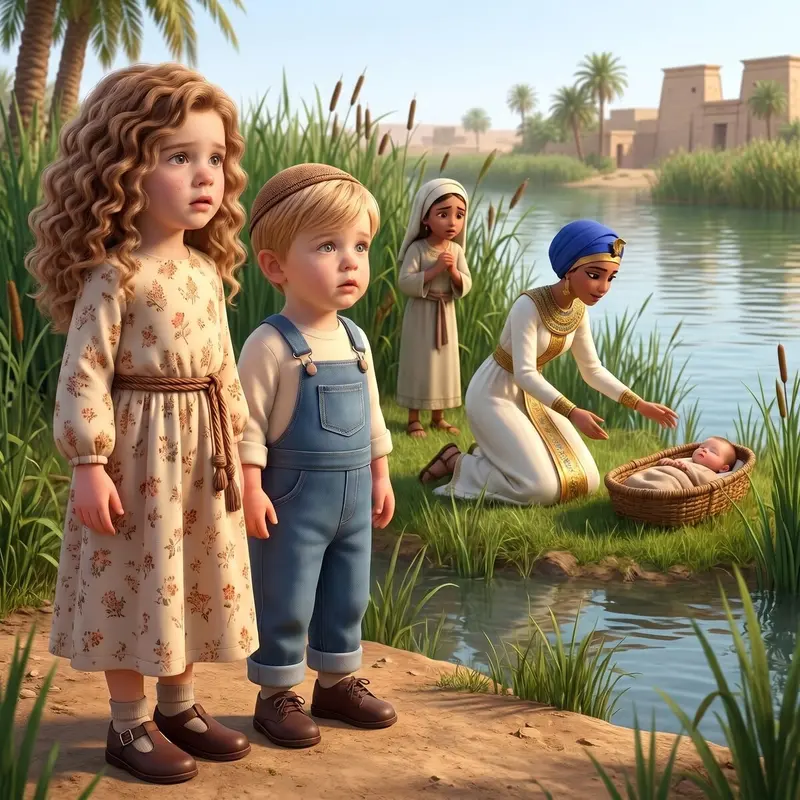
Then Pharaoh's daughter came down to bathe, while her young women walked along the riverbank. She saw the basket among the reeds and sent her maidservant to bring it. When she opened it, she saw a baby crying, and the Torah tells us she had compassion on him. She said, this is one of the Hebrew children (2:5-6).
At that moment his sister stepped forward and asked whether she should call a Hebrew nurse. Bas Pharaoh said yes, and the girl brought the baby's own mother. Bas Pharaoh told her to take the child and nurse him, and that she would pay her wages (2:7-9).
When the child grew, his mother brought him to Bas Pharaoh and he became her son. She named him Moshe, saying, because I drew him out of the water (2:10).
What do Chazal add to the story?
The pasuk says she went down to bathe. Rashi, bringing from Chazal, explains that she went to cleanse herself from the idols of her father's house. This is discussed in Sotah 12b.
The same Gemara records that her maidservants warned her to follow her father's decree, and Chazal tell that they did not stop her. It also records two views on the word amasah: one says it means her arm, and the other says it means her maidservant. According to the view that it means her arm, Chazal explain that it stretched far enough to reach the basket.
Rashi on Shemos 2:7 brings from Chazal why Miriam's offer to call a Hebrew nurse was so fitting: the baby had been brought to Egyptian women and would not nurse, because he was destined to speak with the Shechinah. Chazal identify the sister as Miriam, and the mother as Yocheved.
Finally, Chazal identify her with the Basya named in Divrei HaYamim I 4:18. Vayikra Rabbah 1:3 teaches that Hashem said to her, in effect: Moshe was not your son, yet you called him your son, and you are not My daughter, yet I call you My daughter. That is why the Midrash calls her Basya, daughter of Hashem.
When you tell it to children, keep the two layers apart: the pesukim say she found him, had compassion and raised him, and the Midrash tells us why she came and what she earned.
What is the lesson for children?
The lesson is rachamim, compassion that turns into action. The pasuk does not say she thought the baby was sad. It says she opened the basket, saw him crying, had pity, and took him in.
There is also a quiet lesson about courage. Chazal tell us that her maidservants advised her to follow her father's decree, and she did not listen. For younger children this just means that kindness sometimes needs courage. For older children, add that the decree was to kill innocent babies, so this is not a general permission to disregard parents. Questions about when a child may or may not do something should go to a rav or a teacher.
A third lesson is that every person in the story mattered. Yocheved hid and placed the basket, Miriam watched and spoke up at the right moment, and Bas Pharaoh opened the basket. The baby became Moshe Rabbeinu. You can follow how his life continues in Parshas Shemos for Kids.
How do I explain it to a 3-year-old, a 6-year-old and a 10-year-old?
Ages 3-4. Use a few short sentences: a baby in a basket, a princess who heard him cry, a kind rescue. Let your child use hands to show the basket rocking on the water. Ask one question only: what did the princess do when she heard the baby cry?
Ages 6-7. Tell the full story and give each character a job: Yocheved, Miriam, Bas Pharaoh. Ask which of them did something brave. Children this age love Miriam standing at a distance, because it shows that watching carefully is also a way to help.
Ages 9-12. Separate the pesukim from the Midrash and open Shemos 2 together. Ask why Chazal say she went to cleanse herself from idols, what it means that Hashem called her Basya, and why the Torah tells us she acted before anyone asked her to. This is also the age to discuss the question of her father's decree.
What can we ask at the Shabbos table?
These questions need only talking and listening, so they fit the Shabbos table well:
- What did Bas Pharaoh hear and see when she opened the basket?
- Why do you think Miriam stood far away and watched?
- Who in the story helped Moshe? Is there more than one answer?
- Why was the name Moshe a good name for him?
- Has there been a time when you did the kind thing even though it was hard?
If your child is quiet, tell the story again with a different character as the main one. Many children answer differently once they have heard it from Miriam's side.
What is a personalized Torah Tale book of this story like?
This story is in the Midrash & Aggadah collection, which tells the stories Chazal relate behind the pesukim, each from its named source in the Gemara or Midrash. In the book, your child's name and, from one uploaded photo, their likeness appear on every page, illustrated in 3D animated-film style. Up to eight children, ages 0 to 18, can appear in the same book.

Softcover 8″×8″

Hardcover 8″×8″

Board book 6″×6″

Coloring book 8.5″×11″
Every book ends with a discussion page of 10 questions that mix comprehension with middos: what happened, and what it asks of the child. That page is what turns the book into a conversation at the table, and reading a storybook is entirely appropriate on Shabbos and Yom Tov. Every book is written with careful rabbinical guidance and strict tznius, and is reviewed by our team before it goes to print.
There are three formats: a 6x6 board book with rounded safety corners for ages 0-4, an 8x8 softcover photo book for ages 4-8, and an 8x8 hardcover photo book for ages 5-18. Softcover and hardcover open with a dedication page. If you add parents, grandparents and other relatives with their photos, they appear with the children on a closing family page in every format.
There is also an optional matching coloring book, 8.5x11 in black-and-white line art. Coloring is melacha, so it is a weekday activity, for an afternoon or erev Shabbos, and never for Shabbos or Yom Tov itself.
How do I say it in one sentence?
A simple script for a young child: A princess heard a baby crying in a basket on the river, felt rachamim, and took him to safety, and that baby grew up to be Moshe Rabbeinu.
For an older child, add one more sentence: Chazal teach that Hashem called her Basya, because she called Moshe her son. If your child enjoys midrashim, there are more stories about Moshe's earliest years in Baby Moshe and the Burning Coal and Moshe and the Thirsty Little Goat.
Ready to give your child this story? It takes a free account and a few short questions: each child's name, boy or girl, age and one photo, any siblings, the story, your community (asked once), the language and the format. Languages are English, Hebrew and Yiddish. You can create the book in about five minutes.
Frequently asked questions
Who was Bas Pharaoh in the story of Moshe?
She was the daughter of the Pharaoh who decreed that Hebrew baby boys be thrown into the Nile. The Torah tells us that she found the basket at the river, had compassion on the crying baby, and raised him as her son (Shemos 2:5-10). Chazal teach that she earned the name Basya, daughter of Hashem, for this chesed.
Why did Bas Pharaoh go down to the river?
The pasuk says she went down to bathe at the Yor. Rashi brings from Chazal that she went to cleanse herself from the idols of her father's house, and this is discussed in Sotah 12b.
How do I explain this story to a 4-year-old?
Keep it simple: a baby was floating in a basket, a princess heard him cry and felt sorry for him, and she took him to safety. Add that his sister Miriam watched from far away and made sure he was safe. Then ask, 'What did the princess do when she heard the baby cry?'
What is the lesson of Bas Pharaoh saving Moshe?
The lesson is rachamim: when she heard a baby cry she did something about it, even though it was not easy. For older children it also shows that one person's kind choice can change history, because the baby she saved became Moshe Rabbeinu.
Is there a personalized book about Bas Pharaoh and baby Moshe?
Yes. Torah Tale has this story in its Midrash & Aggadah collection, and the book carries your child's name and likeness on every page in 3D animated-film style. Every book ends with a discussion page of 10 questions that mix comprehension with middos.