The Leviim Sing in Sefer Divrei HaYamim for Kids: Dovid, the Aron & Ki Tov
When Dovid HaMelech brought the Aron to Yerushalayim, the Leviim were given a job made of joy: to thank and praise Hashem in song. Here is the story, the lesson, and how to explain it to a 4-year-old, an 8-year-old and an 11-year-old.
Published by Torah Tale.
Create this book for your child
The story of the Leviim singing in Sefer Divrei HaYamim is about the day Dovid HaMelech brought the Aron to Yerushalayim and appointed Leviim to thank and praise Hashem in song. Children connect to it because it is a story about a job made of joy: saying thank you out loud, together, with music.
What happens when the Leviim sing in Sefer Divrei HaYamim?
Dovid HaMelech prepared a place in Yerushalayim for the Aron of Hashem and pitched a tent for it. When the Aron was brought up, Dovid told the heads of the Leviim to appoint their brothers as singers, with nevalim, kinnoros and cymbals, raising their voices with simcha.
The pesukim name three of the leaders: Heman, Asaf and Eisan. They were the ones sounding the bronze cymbals, and other Leviim played the other instruments (Divrei HaYamim I, chapter 15).
Once the Aron was in its tent, korbanos were offered, and Dovid appointed Leviim to serve before the Aron. The pasuk tells us their purpose: to remember, to thank and to praise Hashem (16:4).
The pasuk says that on that day Dovid first entrusted the song of thanks to Asaf and his brothers. It opens with the words Hodu laHashem, kir'u vishmo, thank Hashem, call out in His name, and it includes Hodu laHashem ki tov, ki le'olam chasdo. At the end the pasuk tells us that all the people said Amen and praised Hashem (16:36).
Who were the Leviim, and why did they sing?
The Leviim were the shevet chosen to serve in the Mishkan, and later in the Beis HaMikdash. Not every Levi did the same work. Some carried, some guarded, and some, as Sefer Divrei HaYamim describes, sang.
Song was not decoration. The pasuk gives it a purpose: to thank and praise. The Leviim stood before the Aron and said, in music, what every Yid feels when Hashem is close.
The Mishnah in Maseches Tamid lists the shir the Leviim sang in the Beis HaMikdash on each day of the week. We still say those same Tehillim as the shir shel yom at the end of davening, so your child may already know a little of this music.
When else do the Leviim sing in Divrei HaYamim?
The same words return in Shlomo HaMelech's time. When the Aron was brought into the Beis HaMikdash at its dedication, the pasuk says the trumpeters and singers were as one, making one sound to praise and thank Hashem. They sang ki tov ki le'olam chasdo, and the house was filled with a cloud. The kohanim could not stand to serve because of the cloud, for the glory of Hashem filled the house (Divrei HaYamim II, chapter 5).
The words appear a third time in Sefer Ezra, when the foundation of the second Beis HaMikdash was laid and the Leviim sang praise and thanks. You can read more in Building the Second Beis HaMikdash for Kids. For more on Dovid and Shlomo in this sefer, see Sefer Divrei HaYamim for Kids: Dovid, Shlomo & the Story of the Malchus.
What is the lesson of the Leviim singing for kids?
The first lesson is hakaras hatov. The song the Leviim sang is a thank-you song, and the pasuk describes their service as being to remember and to thank, not only to ask.
The second is achdus. In Shlomo's time the pasuk says the singers and trumpeters were as one, making one sound. Many instruments and many voices became one song.
The third is that everyone has a role. Not every child will sing the loudest, but each one has something to give, whether it is a voice, a smile at the Shabbos table or a loud Amen. When the people answered Amen, they became part of the song.
How do I explain it to a 4-year-old, an 8-year-old and an 11-year-old?
A 4-year-old. Say it in one sentence: "When the Aron came to Yerushalayim, the Leviim sang thank you to Hashem." Sing Hodu laHashem ki tov together and clap. That is enough.
An 8-year-old. Add the picture: Dovid told the Leviim to take their instruments, and Heman, Asaf and Eisan led with cymbals. Then ask why the people said Amen at the end. A child this age can understand that Amen means "we agree, and we are part of this too." See Answering Amen for Kids for more.
An 11-year-old. Ask them to notice the repetition: the same words in Dovid's time, Shlomo's time and in Sefer Ezra. What does it say that Yidden used the same words of thanks across many generations? Then talk about what we say every day, such as Modeh Ani and bentching.
What can we ask at the Shabbos table?
Reading is entirely appropriate on Shabbos, and so are talking and singing. Keep it to questions and zemiros, with no instruments, writing or drawing. Try these:
- Why do you think Dovid gave the Leviim a job of singing?
- What are you thankful to Hashem for this week?
- Why did the people say Amen at the end?
- Can a song help us feel thankful? When?
- What is something small that you do for our family, like the Leviim did for Hashem's house?
Then sing Hodu laHashem ki tov together, or any Shabbos zemer that your family knows. On a weekday afternoon, you can give your children cymbals, pots or just clapping hands, and let them make a small "Leviim choir" of their own.
What is the Torah Tale book of the Leviim story like?
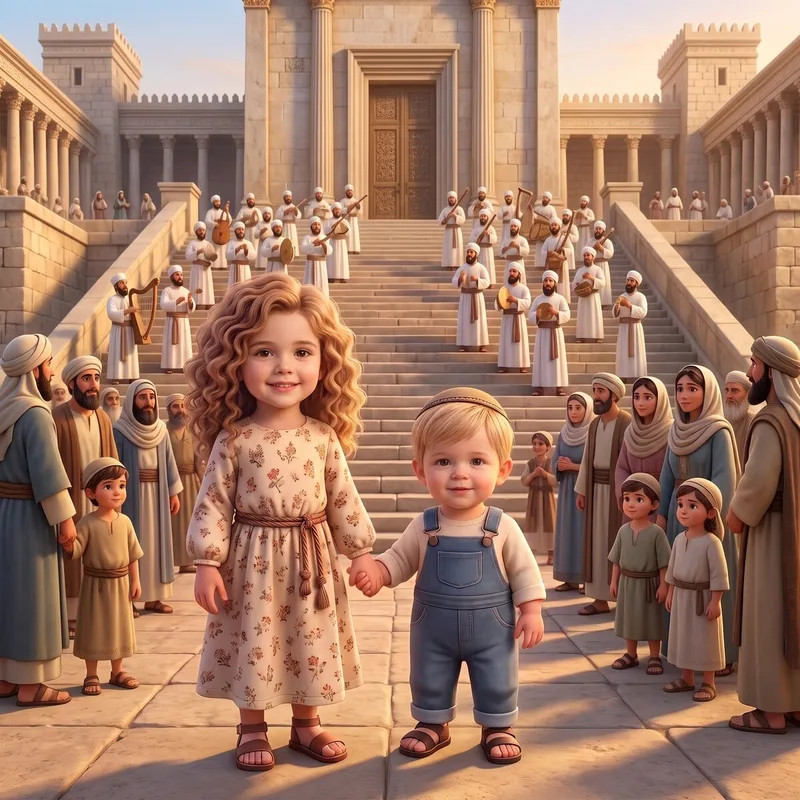
Torah Tale makes a personalized storybook of this story, from the Kesuvim collection, with your child as the hero. Their name and their likeness, from one uploaded photo, appear on every page, illustrated in high-resolution 3D animated-film style. Up to eight children can appear in the same book, ages 0 to 18.
The book comes in three formats: a 6x6 board book with rounded safety corners (ages 0-4), an 8x8 softcover (ages 4-8) and an 8x8 hardcover (ages 5-18). A matching coloring book is an optional add-on, meant for weekdays, never for Shabbos or Yom Tov. If you add parents, grandparents and other relatives, they appear with the children on a closing family page in every format.

Softcover 8″×8″

Hardcover 8″×8″

Board book 6″×6″

Coloring book 8.5″×11″
Every book ends with a discussion page of 10 questions mixing comprehension with middos: what happened, and what it asks of the child. That page turns the story from something read to a child into something talked about at the table. Every book is written with careful rabbinical guidance and strict tznius, and reviewed by our team before it goes to print.
Creating a book takes about five minutes. You need a free account and a few short questions: each child's name, boy or girl, age and one photo, any siblings, the story, your community (asked once), the language (English, Hebrew or Yiddish) and the format. When you are ready, you can create the book for the child who will hear the song of the Leviim.
Frequently asked questions
What is the story of the Leviim singing in Sefer Divrei HaYamim?
Dovid HaMelech brought the Aron to Yerushalayim and placed it in a tent he had prepared for it. He told the heads of the Leviim to appoint singers with instruments, and Heman, Asaf and Eisan led them with cymbals. Dovid also appointed Leviim to serve before the Aron, to remember, thank and praise Hashem.
How do I explain the Leviim singing to a 4-year-old?
Keep it to one picture: the Aron came to Yerushalayim, and the Leviim had the special job of singing thank you to Hashem. Sing the line Hodu laHashem ki tov together and let your child clap along. A child this age does not need names or details, only the feeling that thanking Hashem is happy.
What is the lesson of the Leviim singing in Divrei HaYamim?
One lesson is hakaras hatov: thanking Hashem out loud, with simcha. A second is achdus, because in Shlomo's time the pasuk says the trumpeters and singers were as one, making one sound. A third is that each person has a role, and that doing your role with joy matters.
Where does Hodu laHashem ki tov appear in Tanach?
In Sefer Divrei HaYamim the words appear in the psalm Dovid entrusted to Asaf and his brothers, and again when Shlomo's Beis HaMikdash was dedicated. They also appear in Sefer Ezra when the foundation of the second Beis HaMikdash was laid. The words are also found in Sefer Tehillim.
Is this story in Torah Tale's Kesuvim collection?
Yes, Sefer Divrei HaYamim - The Leviim Sing is a story in the Kesuvim collection. Your child appears as the hero, with their name and likeness illustrated in 3D animated-film style. Every book ends with a discussion page of 10 questions about the story.
Can we read this story on Shabbos?
Reading a storybook is entirely appropriate on Shabbos, and this story fits well with singing at the Shabbos table. Keep Shabbos activities to reading, talking and singing. Anything that involves drawing, coloring or writing should be saved for a weekday.