Sefer Divrei HaYamim for Kids: Dovid, Shlomo & the Story of the Malchus
Sefer Divrei HaYamim tells the story of the malchus: Dovid gathers everything for the Beis HaMikdash, Shlomo builds it, and the kings of Yehuda come after. Here is the story, the lesson, and how to talk about it with a 4-year-old, an 8-year-old and an 11-year-old.
Published by Torah Tale.
Create this book for your child
Sefer Divrei HaYamim is the sefer in Kesuvim that tells the story of the malchus: Dovid HaMelech gathers everything for the Beis HaMikdash, his son Shlomo builds it, and the kings of Yehuda come after. Children connect with it because it is a story about a king who gave away his own treasures for Hashem, and about a house that all of Yisrael was waiting for.
What is Sefer Divrei HaYamim about?
The name means "the words of the days." It is a sefer in Kesuvim, and in the usual printed order it is the last sefer in Tanach. It opens with a list of names that begins with Adam, then Sheis, then Enosh, and moves through the generations toward Yisrael.
After the list, the sefer turns to the malchus. The story centers on Dovid HaMelech and his wish for a Beis HaMikdash, then Shlomo HaMelech who builds it, and then the kings of Yehuda who followed them.
What happens in the story of the malchus?
Here is the story in the order the sefer tells it, in words a child can follow.
- Dovid becomes king. After the death of Shaul, all of Yisrael came to Dovid at Chevron and made him king. Dovid then took Yerushalayim as his city.
- The Aron comes to Yerushalayim. Dovid wanted the Aron HaBris near him. The pesukim tell us the Aron was carried by the Levi'im, and Dovid and all of Yisrael rejoiced with songs and instruments.
- Hashem's promise. Through the navi Nasan, Hashem promised that Dovid's family would endure.
- Dovid prepares and gathers the people. Dovid gave gold, silver, wood and stone for the Beis HaMikdash, and the leaders gave willingly too. The pasuk says the people rejoiced because they had given with a whole heart.
- Shlomo asks for wisdom. At Givon, Shlomo asked Hashem for wisdom to lead the people, and Hashem gave him wisdom and more.
- The Beis HaMikdash is built and dedicated. After Shlomo's tefillah, fire came down from heaven onto the korbanos, and the glory of Hashem filled the house, so that the kohanim could not enter.
After Shlomo the kingdom was divided, and the sefer follows mainly the kings of Yehuda. It tells how kings such as Chizkiyahu and Yoshiyahu brought the people back to Hashem. Chizkiyahu sent letters to Yisrael to come to Yerushalayim for Pesach. Some laughed at the invitation, but others humbled themselves and came.
The very last pesukim describe Koresh, king of Paras, inviting Yidden to go up to Yerushalayim and build the Beis HaMikdash. The final word of the sefer is "veya'al," let him go up. The same words open Sefer Ezra, which you can read about in Sefer Ezra for Kids: Return to Yerushalayim.
Why did Dovid not build the Beis HaMikdash?
Children often ask this, and the pesukim answer it directly. In Divrei HaYamim, Dovid tells the people that Hashem said he would not build a house for His name, because Dovid was a man of wars and had shed blood. Hashem said that Dovid's son would be a man of rest, and his name would be Shlomo.
What is striking is what Dovid does next. He does not sit back. He prepares gold, silver, copper, iron, wood and stones, and he gives from his own treasures on top of it. He then tells Shlomo to be strong and do the work.
What is the lesson for children?
At the gathering, Dovid praised Hashem and said: "כי ממך הכל ומידך נתנו לך" - everything comes from You, and from Your own hand we have given to You. That one sentence is the heart of the story for a child. The toys, the tzedakah money and the talents we have are all gifts, and giving back to Hashem is a simcha.
A second lesson is doing your part fully even when someone else will finish. Dovid prepared everything, and Shlomo built. A child who sets the Shabbos table, even though a sibling will light the candles, or who helps with a project a bigger brother will complete, can understand this.
For more on Shlomo's side of the story, see Shlomo HaMelech's Wisdom for Kids.
How do I explain Divrei HaYamim to a 4-year-old, an 8-year-old and an 11-year-old?
Age 4: Use only the pictures. Dovid HaMelech wanted a beautiful house for Hashem. Hashem said Shlomo would build it, so Dovid gathered everything Shlomo needed. Ask: "What can you give to Hashem?"
Age 8: Add the reason Dovid could not build, and how he still gave with all his heart. Explain that the people gave willingly and were happy. Ask what it feels like to give something you care about.
Age 11: Talk about leadership and generations. Dovid prepared what he would never see completed, Shlomo asked for wisdom first, and later kings such as Chizkiyahu led the people back to Hashem. Ask what it takes for a leader to inspire others, and when you can read the pesukim together, Dovid's words in the last chapters are worth finding.
You can read about Chizkiyahu's tefillah in Chizkiyahu's Tefillah for Kids.
What can we talk about at the Shabbos table?
These are talking questions only, so they work for Shabbos and Yom Tov with no props.
- Why do you think Dovid gave his own treasures, when he knew Shlomo would build?
- What does "everything comes from You" teach us about our toys and our tzedakah money?
- How did the people feel when they gave with a whole heart?
- Shlomo could have asked for anything. Why do you think he asked for wisdom?
- What is something small you can prepare for someone else this week?
On a weekday, a child can put a coin in the tzedakah box with a happy heart, like Dovid and the people. That is a concrete way to act on the story.

Softcover 8″×8″

Hardcover 8″×8″

Board book 6″×6″

Coloring book 8.5″×11″
What is Torah Tale's book of this story like?
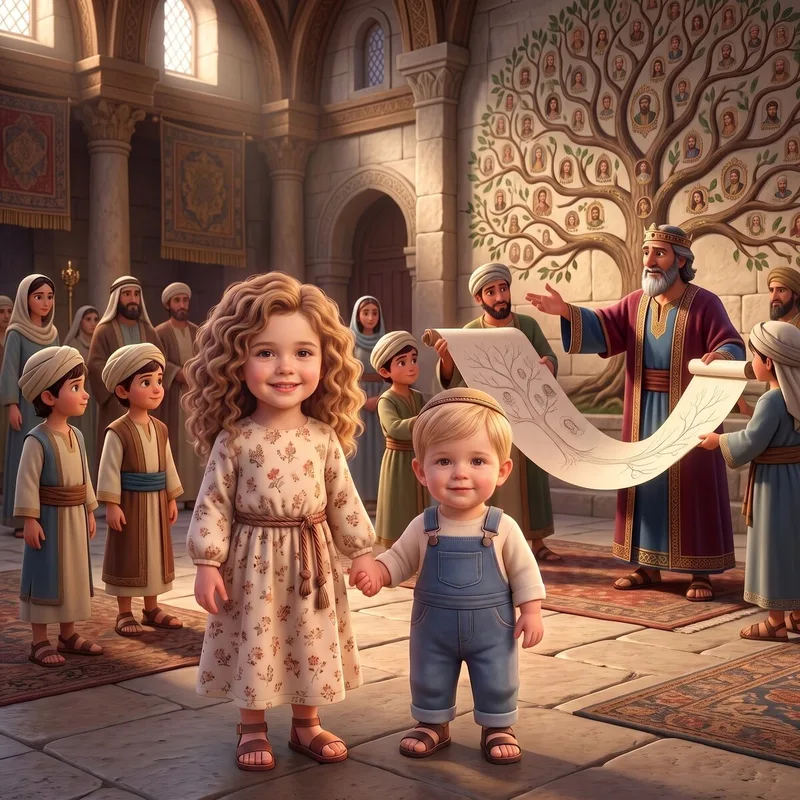
Torah Tale's book for this story comes from the Kesuvim collection, and your child is the hero of it. Your child's name and likeness, made from one uploaded photo, appear on every page in a high-resolution 3D animated-film style. Up to eight children can appear in the same book, ages 0 to 18, so siblings can share one story.
Every book ends with a discussion page of ten questions that mix comprehension with middos, so the story becomes something talked about at the table. Softcover and hardcover books open with a dedication page. If you add parents, grandparents and other relatives, they appear with the children on a closing family page in every format. The book is written with careful rabbinical guidance and strict tznius, and reviewed by our team before it goes to print.
There are three formats. The board book is 6x6 with rounded safety corners, for ages 0-4. The softcover is 8x8, for ages 4-8, and the hardcover is 8x8, for ages 5-18. A matching coloring book at 8.5x11 in black-and-white line art can be added, and since coloring is melacha, it is a weekday activity, perhaps for an afternoon before Shabbos. The storybook itself is a good one to read at the Shabbos table.
How do I order it?
You create a free account and answer a few short questions: each child's name, boy or girl, age and one photo, any siblings, the story, your community (asked only once), the language and the printed format. Languages are English, Hebrew and Yiddish. The whole flow takes about five minutes.
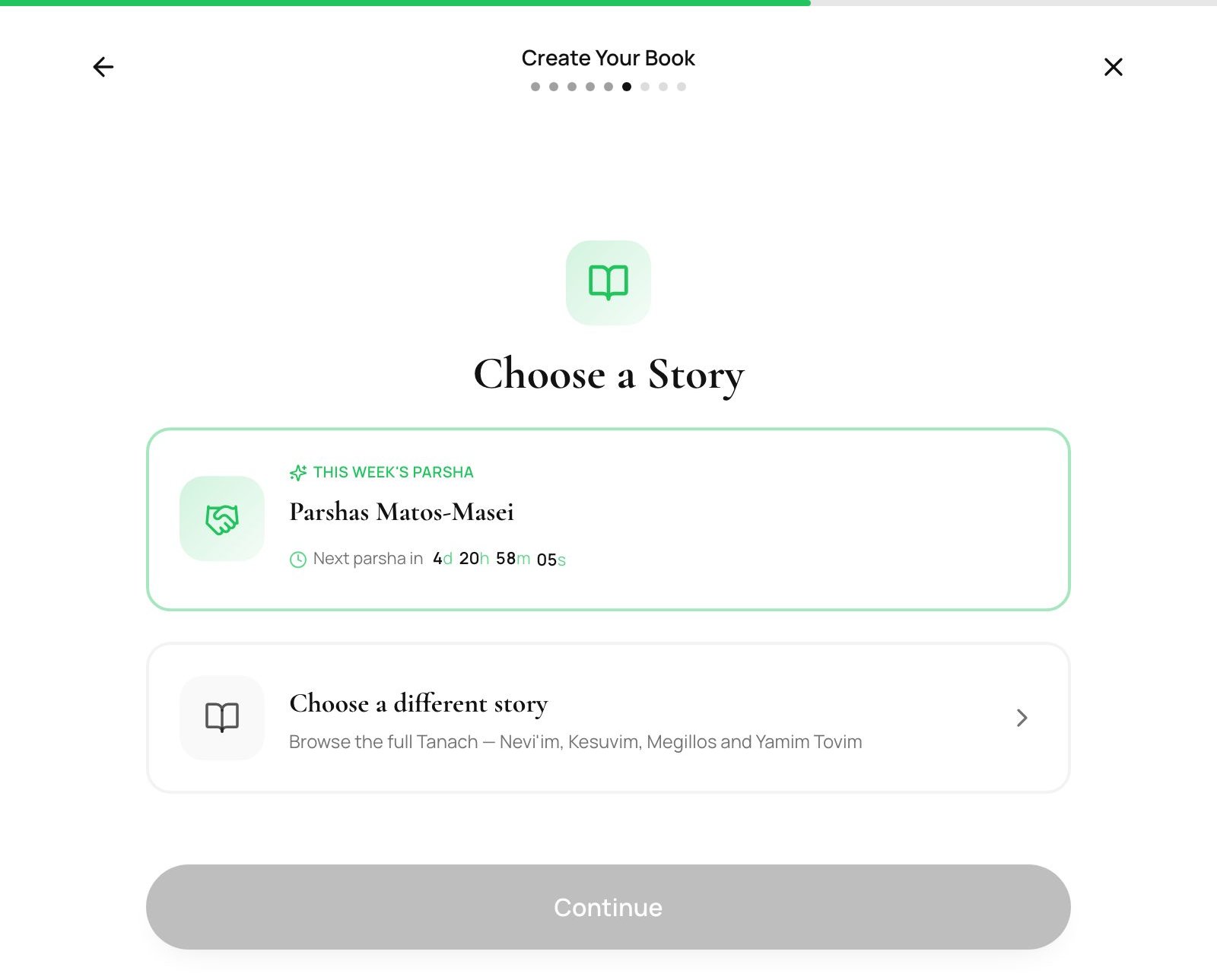
You can order a single book, or a collection subscription on a Monthly or Yearly plan. Shipping options and rates are on the pricing page. When you are ready, you can create the book and choose this story from the Kesuvim collection.
Frequently asked questions
What is Sefer Divrei HaYamim about, in simple words for children?
Sefer Divrei HaYamim begins with a long list of names starting with Adam, and then tells the story of the kings of Yisrael. Dovid HaMelech gathers materials for the Beis HaMikdash, Shlomo HaMelech builds it, and the sefer follows the kings of Yehuda after them. It is called Divrei HaYamim, the words of the days, because it records what happened in those years.
Why did Dovid HaMelech not build the Beis HaMikdash?
The Torah tells us in Divrei HaYamim that Hashem told Dovid he would not build the house, because he was a man of wars and had shed blood. Dovid accepted this and prepared gold, silver, wood and stone for his son Shlomo, whom Hashem had said would build it. Children can learn from how Dovid kept giving with all his heart even though the final job was not his.
What is the lesson of the malchus story for kids?
One lesson is that a king serves Hashem, and everything we have, from money to talents, is a gift from Hashem that we give back with a happy heart. Another is that we can do our part fully even when someone else will finish the job. Dovid's words at the gathering, 'כי ממך הכל ומידך נתנו לך', put it in one sentence.
How do I explain Divrei HaYamim to a 4-year-old?
Keep it to a few pictures: Dovid HaMelech wanted a beautiful house for Hashem, Hashem said his son Shlomo would build it, and so Dovid gathered everything Shlomo would need. Then Shlomo built it, and the whole people were happy. Ask your child what they would like to give to Hashem, such as tzedakah, a nice tefillah or a kind act.
Can we read the Torah Tale book on Shabbos?
Yes, reading a storybook is entirely appropriate on Shabbos and Yom Tov, and the discussion page at the end of the book gives you ten questions to talk about at the table. Coloring is melacha, so the optional coloring book is for weekdays, such as erev Shabbos or a weekday afternoon.
Which Torah Tale format suits which age?
The board book is 6x6 with rounded safety corners for ages 0-4, the softcover is 8x8 for ages 4-8, and the hardcover is 8x8 for ages 5-18. Your child's age is one of the few short questions when you create the book. A matching coloring book at 8.5x11 can be added as a weekday activity.