Chizkiyahu's Tefillah for Kids: The Letter Spread Before Hashem
A king gets a threatening letter, takes it to Beis Hashem and spreads it out before Hashem. Here is the story from Sefer Yeshayahu, its lesson, and how to tell it to a 4-year-old, a 7-year-old and a 10-year-old.
Published by Torah Tale.
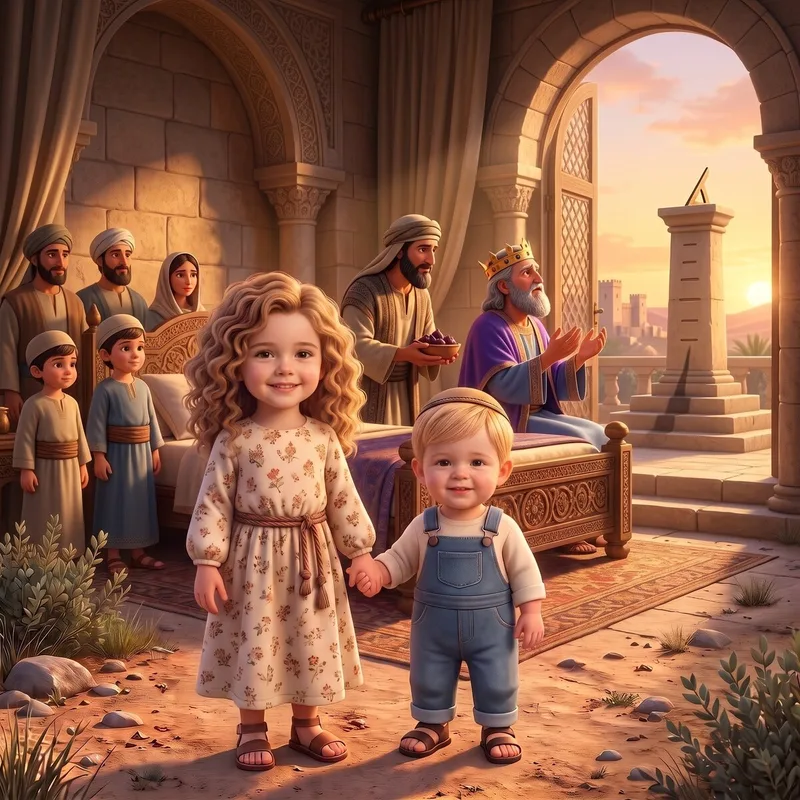
Create this book for your child
Chizkiyahu's tefillah is the story of a king who received a threatening letter, took it to Beis Hashem, spread it out and davened. It is told in Sefer Yeshayahu, chapters 37 and 38, and it lands with children because the king's first move is one any child can copy: he tells Hashem exactly what is wrong.
What is the story of Chizkiyahu and Sancheriv in Sefer Yeshayahu?
Chizkiyahu was king of Yehuda. Sancheriv, king of Ashur, came up against the fortified cities of Yehuda and sent his messenger Rav Shakeh to Yerushalayim with a large force.
Rav Shakeh stood outside the city and called out in Yehudis, the language of the people, so that everyone on the wall could hear him. He told them not to trust Chizkiyahu when he said that Hashem would save them.
Chizkiyahu's officials, Elyakim, Shevna and Yoach, asked him to speak Aramis instead, and he only spoke louder. The people on the wall stayed silent. The pasuk tells us that this was because the king had commanded, "Do not answer him."
Chizkiyahu tore his clothes, covered himself in sackcloth and went into Beis Hashem. He sent Elyakim, Shevna and the elders of the kohanim to Yeshayahu, asking him to daven for the remnant that was left. Yeshayahu sent back an answer: do not be afraid of these words, Sancheriv will hear a report and return to his own land.
What did Chizkiyahu do with Sancheriv's letter?
Sancheriv then heard that Tirhakah, king of Kush, had set out to fight him. He sent messengers to Chizkiyahu again, this time with a letter that repeated the mockery of Hashem.
The pasuk is very specific about what the king did. He took the letter from the messengers, read it, went up to Beis Hashem and spread it out before Hashem.
Then he davened. He said that Hashem alone is the Elokim of all the kingdoms of the earth and that Hashem made the heavens and the earth. He asked Hashem to hear the words Sancheriv had sent to mock the living Elokim.
He ended with a request for more than his own safety: save us, so that all the kingdoms of the earth will know that You alone are Hashem.
Yeshayahu sent word that Hashem had heard, because Chizkiyahu had prayed about Sancheriv. Hashem said He would protect the city for His own sake and for the sake of Dovid His servant. The malach of Hashem struck the camp of Ashur, and the threat to Yerushalayim was over. Sancheriv left and returned to Nineveh. For young children it is enough to say that Hashem sent the army home.
What happened when Chizkiyahu became ill?
The sefer then tells that in those days Chizkiyahu became deathly ill. Yeshayahu came to him with Hashem's message to put his house in order, because he would not live.
Chizkiyahu turned his face to the wall and prayed. He reminded Hashem that he had walked before Him with truth and a whole heart, and he wept bitterly.
Hashem told Yeshayahu to go back to the king: "I have heard your tefillah, I have seen your tears," and fifteen years would be added to his life. As a sign, the shadow on the steps of Achaz went back ten steps.
The Gemara in Berachos (10a) brings Chizkiyahu's own answer to Yeshayahu, that even with a sharp sword resting on his neck, a person should not hold back from asking for rachamim. Chizkiyahu's song of thanks follows in the same chapter. In it he says that a father makes Hashem's truth known to his children (Yeshayahu 38:19), a line any parent reading this to a child can take personally.
What is the lesson of Chizkiyahu's tefillah?
The simplest lesson is that we bring our troubles to Hashem, all of them, and in detail. Chizkiyahu did not keep the letter to himself or only talk to people about it. He went to Beis Hashem, opened it up and davened.
A second lesson is that tefillah and action go together. Chizkiyahu told the people to stay quiet, sent to the navi and then davened. A third is that a tefillah can care about more than ourselves: he asked that all would know Hashem alone is Hashem.
The last is not to give up. When Yeshayahu told him the decree, Chizkiyahu still turned to Hashem, and the sefer tells that Hashem answered him. It is a good companion to Chana's tefillah at Shiloh, another story of a person pouring out their heart.
How do I explain Chizkiyahu's tefillah to a 4-year-old, a 7-year-old and a 10-year-old?
For a 4-year-old: "The king got a scary letter. So he went to Beis Hashem, opened it up and told Hashem all about it. Hashem heard him." Then ask when your child could talk to Hashem.
For a 7-year-old: add the details: the loud messenger, the people who stayed silent on the wall, the king who tore his clothes and the letter spread out in Beis Hashem. Ask what the difference is between worrying about a problem and davening about it.
For a 10-to-12-year-old: compare the two tefillos. The first was about Yerushalayim and Hashem's name, the second was about his own life and was said with tears, and Hashem answered both. Talk about why Chizkiyahu kept davening after Yeshayahu told him the decree, and what that means for how we daven for our own needs.
What can we ask at the Shabbos table about Chizkiyahu's tefillah?
Reading a story at the table is a lovely Shabbos activity, and these questions need only talking:
- Why do you think the people on the wall stayed silent?
- Why did Chizkiyahu go to Beis Hashem and not only send to Yeshayahu?
- What does it mean to spread a problem out before Hashem?
- What did Chizkiyahu ask for besides saving himself?
- How did he daven when he was ill?
- What is something small you could tell Hashem about this week?
Children who find it hard to say what they feel often find it easier when a king in a story did it first. For more of Yeshayahu's own words, there is also the glowing coal and "Hineni, send me".
What is the Torah Tale book of Chizkiyahu's tefillah like?
Torah Tale makes personalized Torah storybooks for Jewish children, and this story is in the Nevi'im collection, under Sefer Yeshayahu. Your child's name and, from one uploaded photo, their likeness appear on every page, illustrated in 3D animated-film style. Up to eight siblings, ages 0 to 18, can appear in the same book. If you add parents and grandparents, they appear with the children on a closing family page in every format.
Every book ends with a discussion page of 10 questions mixing comprehension with middos, which helps turn the book into something talked about at the table and not only read aloud. The books are written with careful rabbinical guidance and strict tznius, and reviewed by our team before they go to print.

Softcover 8″×8″

Hardcover 8″×8″

Board book 6″×6″

Coloring book 8.5″×11″
There are three formats. The 6"x6" board book with rounded safety corners is for ages 0-4. The 8"x8" softcover photo book is for ages 4-8, and the 8"x8" hardcover photo book is for ages 5-18. An optional matching coloring book is a weekday activity, good for erev Shabbos or an afternoon during the week, and never for Shabbos or Yom Tov themselves. The books themselves are perfect for reading on Shabbos.
To make this book, you open a free account and answer a few short questions: each child's name, boy or girl, age and one photo, any siblings, the story, your community (asked once), the language and the format. The languages are English, Hebrew and Yiddish. The whole thing takes about five minutes. When you are ready, create the book and choose Sefer Yeshayahu from the Nevi'im collection.
Frequently asked questions
What is the story of Chizkiyahu's tefillah?
Sancheriv, king of Ashur, sent his messenger Rav Shakeh and a large force against Yerushalayim, and then sent a threatening letter that mocked Hashem. Chizkiyahu took the letter, went up to Beis Hashem, spread it out before Hashem and davened. Through Yeshayahu, Hashem answered that He would protect the city, and Sancheriv returned to Nineveh.
Where is Chizkiyahu's tefillah in Tanach?
It is in Sefer Yeshayahu, chapter 37 for the letter and chapter 38 for Chizkiyahu's illness and recovery. The same events are also told in Sefer Melachim. Chizkiyahu's song of thanks after he recovered is in chapter 38 as well.
What is the lesson of Chizkiyahu's tefillah?
The lesson is that a Yid brings his troubles straight to Hashem, in tefillah, and keeps davening even when the situation looks hopeless. Chizkiyahu also asked that Hashem save Yerushalayim so that all the kingdoms would know that Hashem alone is Hashem. Children can learn that a good tefillah can ask for help and also care about Hashem's name.
How do I explain Chizkiyahu's tefillah to a 5-year-old?
Keep it to one picture: a king got a scary letter, so he went to Beis Hashem, opened it up and told Hashem all about it. Then say that Hashem heard him and took care of everything. You can add that when we are scared, we can talk to Hashem too, just like Chizkiyahu.
Why did Chizkiyahu spread the letter out before Hashem?
The pasuk simply tells us that he took the letter, read it, went up to Beis Hashem and spread it out before Hashem. For children, it is a clear picture of showing Hashem the whole problem instead of keeping it inside. We should not add more reasons as if the pasuk said them.
Is there a Torah Tale book about Chizkiyahu's tefillah?
Yes, it is a story in the Nevi'im collection, under Sefer Yeshayahu. The child's name and likeness appear on every page in 3D animated-film style, and the book ends with a discussion page of 10 questions mixing comprehension with middos.