Keeping Kosher (כשרות) for Kids: How to Explain Kashrus at Home
A parent's guide to teaching kashrus to children aged 3 to 12: what the Torah says about kosher food, why we separate milk and meat, simple scripts for each age and Shabbos-table questions.
Published by Torah Tale.
Create this book for your child
Keeping kosher (kashrus) means eating only the foods the Torah permits, prepared the way halacha requires, and keeping milk and meat apart. Children understand it best as something Hashem asked of us at every meal, not as a list of rules, and they meet it daily in the kitchen, the lunchbox and the supermarket. The Torah Tale book on keeping kosher belongs to the Mitzvos collection, which is set in everyday life today, with your child as the hero.
What does keeping kosher mean for a child?
Kosher means fit or proper. For a child, keeping kosher comes down to a few simple ideas: some foods are permitted and some are not, the food has to come from a reliable source, and milk and meat are kept separate.
The reason we keep kosher is that Hashem commanded it. Chazal teach that a person should not say 'I have no desire to eat that,' but rather 'I would like to, but what can I do, my Father in Heaven has decreed it.' That is a helpful frame for children, because it makes kashrus about listening to Hashem and not about whether a food looks yucky.
What does the Torah say about kosher food?
The main source is Vayikra chapter 11, in Parshas Shemini, and it is repeated in Devarim 14. The Torah tells us that a kosher land animal has split hooves and chews its cud. It names animals that have only one of the signs: the camel, the shafan and the arnevet chew their cud but do not have split hooves, and the chazir has split hooves but does not chew its cud.
A kosher fish has fins and scales. For birds, the Torah does not give signs but lists the forbidden kinds by name. In the same section the Torah connects these mitzvos to being holy, and that is the idea to give a child: we eat the way Hashem asked us to eat, because we are His children. You can read more about the animals and the signs in Parshas Shemini for Kids.
Why don't we eat milk and meat together?
The Torah says not to cook a kid in its mother's milk, and the pasuk appears three times: Shemos 23:19, Shemos 34:26 and Devarim 14:21. Chazal learn the halachos of milk and meat from these pesukim, and this is why many homes keep separate dishes and utensils for milchig and fleishig.
A child does not need the details to start. It is enough to say that Hashem told us to keep milk and meat apart, so we have separate dishes, and we wait between a meat meal and a milk food. How long to wait varies by family minhag, so ask your rav what your family should follow.
How do I explain keeping kosher at different ages?
Ages 3-4: one sentence and one habit
- The sentence: 'Hashem told us what to eat, and we do what Hashem says.'
- The habit: before eating, say the bracha out loud together. See Making a Bracha for Kids for how to teach it.
- The object: show them the hechsher on a package and say 'this means it is okay for us.'
Ages 5-7: the signs, the dishes and asking first
- Let them sort the dishes by milchig and fleishig, using whatever way your home marks them, such as colors.
- Teach them to find the hechsher on a snack before opening it.
- Practice one polite sentence for friends' houses: 'I need to ask first.' Having words ready makes it easy to say.
Ages 8-12: the why and the real situations
- Talk about doing a mitzvah because Hashem commanded it, using the words of Chazal above.
- Look at real situations together: a school trip, camp, a birthday party, an airport. What would you do, and whom would you ask?
- Give them real responsibility, such as reading the label and checking the hechsher before they bring something home. For a question that comes up, they should know to ask a rav.
What is the personalized Torah Tale book on keeping kosher like?
Keeping Kosher is a story in the Mitzvos collection, set in everyday life today. Your child's name and likeness, taken from one uploaded photo, appear on every page, illustrated in 3D animated-film style. Up to eight children, ages 0 to 18, can appear in the same book, so siblings can share the story. The book is written with careful rabbinical guidance and strict tznius, and our team reviews it before it goes to print.
Every book ends with a discussion page of 10 questions that mix comprehension with middos: what happened, and what it asks of the child. If you add parents and grandparents, they appear with the children on a closing family page in every format. The book comes in English, Hebrew or Yiddish, and in three formats: a 6x6 board book with rounded safety corners (ages 0-4), an 8x8 softcover (ages 4-8) and an 8x8 hardcover (ages 5-18).

Softcover 8″×8″

Hardcover 8″×8″

Board book 6″×6″

Coloring book 8.5″×11″
What can we talk about at the Shabbos table?
Reading is entirely appropriate on Shabbos, so a book about kashrus fits the Shabbos table well. These questions need only talking:
- Which of our dishes are for milchig and which are for fleishig, and how do we know?
- What do you say when a friend offers you a snack and you are not sure about it?
- Why do we look for a hechsher before we eat something new?
- Which bracha do we say before this food, and why do we say it?
- How does it feel to eat what Hashem asked us to eat?
The discussion page at the end of the book gives you ten more questions on the story itself, so the conversation does not depend on what you thought of ahead of time.
What can we do this week, on a weekday?
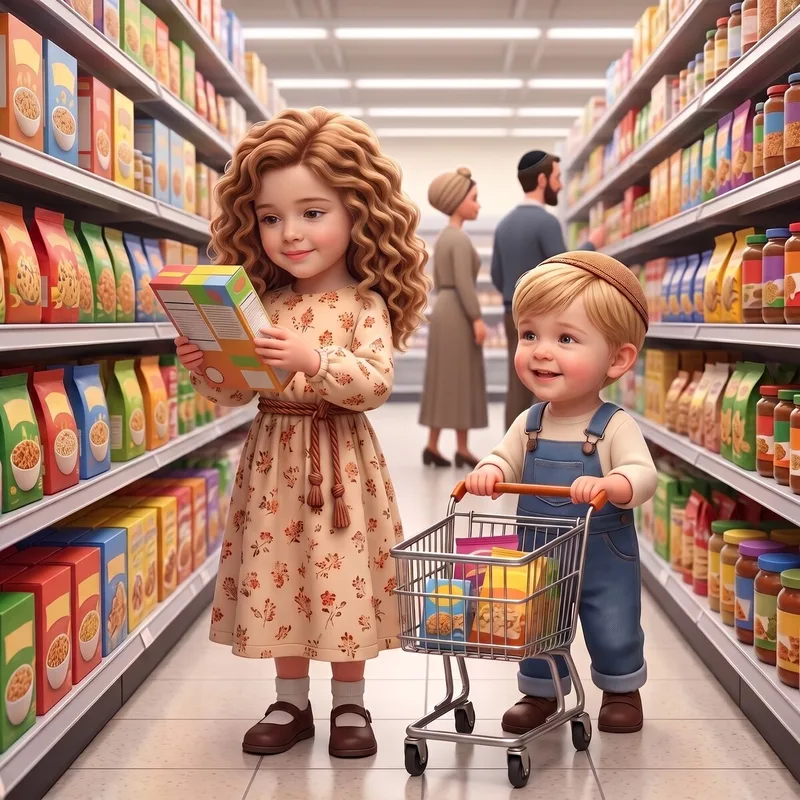
On a weekday afternoon or erev Shabbos, take your child to the supermarket for a hechsher hunt. Give them a small list of items and have them find the hechsher on each package before it goes in the cart. Younger children can point to the symbol, and older ones can read it aloud.
The optional matching coloring book (8.5x11, black-and-white line art) is a one-time add-on to a book and is for weekdays only. Coloring is melacha, so keep it for a weekday afternoon or before Shabbos, and never for Shabbos or Yom Tov. After the meal, you can teach bentching as the natural end to a kosher meal.
When you are ready, create the book. It takes about five minutes: a free account and a few short questions about each child's name, boy or girl, age and photo, any siblings, the story, your community, the language and the printed format.
Frequently asked questions
How do I explain keeping kosher to a 4-year-old?
Keep it to one sentence a child can repeat: Hashem told us which foods to eat, and we are Hashem's children, so we eat what He told us. Point to a hechsher on a package and say that it means the food is okay for us. Let them help with simple, safe jobs such as saying the bracha out loud before eating.
Why can't we eat milk and meat together?
The Torah says three times not to cook a kid in its mother's milk, in Shemos 23:19, Shemos 34:26 and Devarim 14:21. Chazal learn the halachos of milk and meat from these pesukim, and that is why many homes keep separate dishes. For how long to wait between meat and milk, follow your family minhag and ask your rav.
What are the signs of a kosher animal in the Torah?
In Vayikra 11 the Torah says a kosher land animal has split hooves and chews its cud, and a kosher fish has fins and scales. The Torah names animals that have only one of the two land signs, such as the camel and the pig. For birds, the Torah lists the forbidden kinds by name.
What should my child do at a friend's house if they are not sure about the food?
Teach your child to say politely that they need to ask first, and to wait for you or a grown-up to answer instead of guessing. Practice the exact words at home so it feels easy and not embarrassing. For specific situations, ask your rav.
What is in the Torah Tale book about keeping kosher?
It is a personalized Torah storybook from the Mitzvos collection, set in everyday life today, with your child's name and likeness illustrated in 3D animated-film style. Every book ends with a discussion page of 10 questions mixing comprehension with middos. It comes in a 6x6 board book with rounded safety corners (ages 0-4), an 8x8 softcover (ages 4-8) or an 8x8 hardcover (ages 5-18).