Iyov's Three Friends for Kids: Elifaz, Bildad & Tzofar
Iyov's three friends came to comfort him, sat with him in silence for seven days, and then said the wrong things. Here is the story, the lesson about comforting someone, and how to explain it to your child.
Published by Torah Tale.
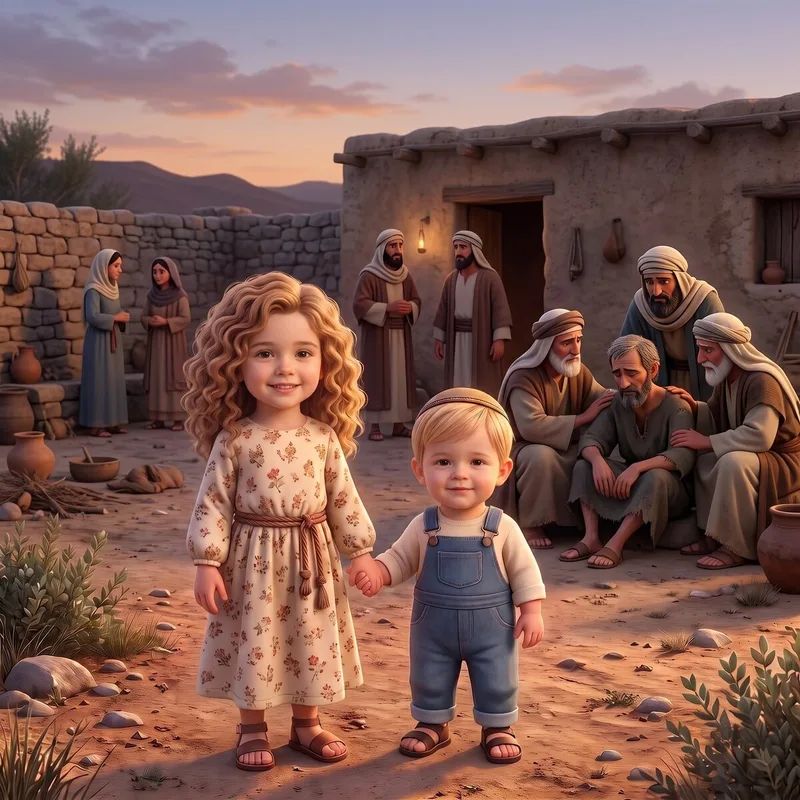
Create this book for your child
Iyov's three friends are Elifaz HaTeimani, Bildad HaShuchi and Tzofar HaNa'amasi, and their story in Sefer Iyov is about what to do when someone you care about is hurting. It lands with children because it begins with something they understand: friends who come, sit close and stay quiet. It then shows how even good friends can say the wrong thing.
What happens when Iyov's three friends come?
Sefer Iyov, which is part of Kesuvim, opens by telling us that Iyov was complete and upright, one who feared Hashem and turned away from evil. Then came a great test: Iyov lost what he had and became very ill. When talking with children, you can say simply that Iyov was very sad and in a lot of pain.
The pasuk tells us that three friends heard about everything that had come upon Iyov. They agreed together to go to him, and each one came from his own place, to console him and to comfort him (Iyov 2:11).
When they saw Iyov from far away, they did not recognize him. They raised their voices and wept, and each one tore his robe. Then they sat down on the ground with him for seven days and seven nights. The pasuk says that no one spoke a word to him, because they saw that his pain was very great (2:13).
What did the three friends say after the silence?
Chapter 3 begins with Iyov opening his mouth to speak, and only then do the friends answer. Much of the sefer after that is a back-and-forth between Iyov and Elifaz, Bildad and Tzofar.
The friends' main message is that suffering must be connected to something Iyov did wrong, and that he should look for what he needed to correct. Iyov does not accept this. He insists, with great pain, that he has been faithful. In one place he calls them menachamei amal (16:2), words that mean something like troublesome comforters.
For children, you can put it this way: the friends came with a good heart, but when they started explaining why Iyov was suffering, they made him feel worse and not better.
Why did Hashem say the friends were wrong?
Near the end of the sefer, Hashem answers Iyov, and then Hashem turns to Elifaz. The pasuk says that Hashem's anger was aroused against Elifaz and his two friends, because they had not spoken rightly as Iyov, Hashem's servant, had (42:7).
They are told to bring seven bulls and seven rams, and that Iyov, Hashem's servant, will pray for them. The pasuk tells us that Hashem restored Iyov's fortunes when he prayed for his friends. He was then given twice as much as he had before (42:10).
This ending is worth pointing out to children. Iyov was not silent about his pain and he was not shy to speak honestly. Yet at the end, he is the one who davens for the friends who hurt him.
What is the lesson for children?
There are two middos here, and both are very practical.
- Being there. The friends' best moment is the seven days of sitting beside Iyov in silence. A child does not need the right words to be a good friend to someone who is sad. Coming, sitting and listening already is kindness.
- Not blaming. We do not know why someone else is going through a hard time, and it is not our place to guess and tell them it is their fault. This connects directly to being careful with our words, which you can explore in our article on guarding my tongue.
It also connects to visiting someone who is sick. The friends' sitting and caring is a model for how a child can visit a grandparent, a classmate or a neighbor.
There is a halachic echo as well. Chazal learn from this episode that when comforting a mourner, one waits for the mourner to speak first. If your child asks about visiting a house of mourning, this is a good moment to say that we follow the guidance of Chazal, and to ask your rav about the details.
How do I explain Iyov's friends to a 4-year-old and an 8-year-old?
Age 4: Keep it to the heart of the story. "Iyov was very sad and having a hard time. His three friends came to be with him. They sat next to him and didn't say anything, because they saw he was hurting." Then ask, "What do you do when a friend is sad?" Do not go into the details of what Iyov went through.
Age 8: Add the second part. "After a while the friends started to say that Iyov must have done something wrong. But that was not right, and Hashem told them so. Iyov davened for them anyway." Ask, "What is the difference between telling a friend 'I'm here' and telling a friend 'it's your fault'?"
Older children, around 10 to 12, can handle a harder question. Why do people want to explain someone else's pain? Because it can feel scary when things happen that we do not understand. It is a good moment to say that Sefer Iyov is a deep sefer, and that we learn it with our parents and teachers. For more on the main story of Iyov and his emunah, see Sefer Iyov for Kids.
What can we ask at the Shabbos table?
These questions are for talking and listening only, which makes them a fit for the Shabbos table.
- What did the three friends do right when they first came to Iyov?
- Why do you think they sat quietly for seven days?
- When someone is sad, what is something kind to say? What is something better left unsaid?
- Iyov davened for the friends who hurt his feelings. Is that easy or hard? Why?
- Is there someone we know who could use a visit this week?
A parent can also share a moment when someone simply came and sat with them. Children remember those stories.
What is a personalized Torah Tale book of this story like?
Torah Tale's book of Sefer Iyov is part of the Kesuvim collection. Your child is the hero: their name and, from one uploaded photo, their likeness appear on every page in 3D animated-film style. Every book is written with careful rabbinical guidance and strict tznius, and is reviewed by our team before it goes to print.

Softcover 8″×8″

Hardcover 8″×8″

Board book 6″×6″

Coloring book 8.5″×11″
Every book ends with a discussion page of 10 questions about the story, mixing comprehension with middos: what happened, and what it asks of the child. For a story like this one, that page is where the conversation about being a good friend can happen, and the book can be read at the Shabbos table.
The formats are a softcover photo book 8"x8" (ages 4-8), a hardcover photo book 8"x8" (ages 5-18), and a board book 6"x6" with rounded safety corners (ages 0-4). Softcover and hardcover books open with a dedication page. An optional matching coloring book is a weekday activity, for erev Shabbos or a weekday afternoon, never for Shabbos itself. If you add parents and grandparents, they appear with the children on a closing family page in every format.
Creating a book needs a free account and a few short questions: each child's name, boy or girl, age and one photo, any siblings, the story, your community (asked once), the language and the format. Books are available in English, Hebrew and Yiddish.
Ready to make it? You can create the book in about five minutes.
Frequently asked questions
Who were Iyov's three friends?
They were Elifaz HaTeimani, Bildad HaShuchi and Tzofar HaNa'amasi. Sefer Iyov tells us that they heard about everything that had happened to Iyov, agreed together to go, and each came from his own place to comfort him.
What did Iyov's friends do wrong?
After sitting with Iyov in silence, they began to explain his suffering by saying he must have sinned. At the end of the sefer, Hashem tells Elifaz that he and his two friends did not speak rightly, and they are told to bring korbanos while Iyov prays for them.
What is the lesson of Iyov's three friends for children?
The friends teach two things: being present with someone who is hurting is itself a great kindness, and we should not guess why someone is suffering or blame them for it. For a child, this becomes simple: sit with a sad friend, listen, and be careful with your words.
How do I explain Iyov's friends to a 4-year-old?
Keep it very simple: Iyov was very sad and had a hard time, and his three friends came to be with him. They sat quietly next to him because they saw he was hurting. You can end with the question, what can we do when a friend is sad?
Is it a halacha that a comforter waits for the mourner to speak first?
Yes, the halacha is that those who come to comfort a mourner do not begin the conversation until the mourner speaks, and Chazal learn this from the way the friends and Iyov act in Sefer Iyov. For the details of how to act when visiting a house of mourning, ask your rav.
Is there a Torah Tale book about Sefer Iyov?
Yes. Sefer Iyov is part of the Kesuvim collection, and the book stars your child, with their name and likeness from one uploaded photo, in 3D animated-film style. Every book ends with a discussion page of 10 questions mixing comprehension with middos.