Sefer Iyov for Kids: Iyov's Emunah, the Test & How to Explain It
Sefer Iyov is the story in Kesuvim of a righteous man who loses nearly everything and still says Hashem's name is blessed. Here is how to retell it, what it teaches, and how to explain it to a child of 4 to 5, 7 to 8 or 10 to 12.
Published by Torah Tale.
Create this book for your child
Sefer Iyov is the story in Kesuvim of a righteous man who loses nearly everything and still holds on to Hashem. Children connect with its heart because it is simple: Iyov says that Hashem gave, Hashem took, and the name of Hashem is blessed, and at the end he davens for people who hurt him. It is also a deep sefer, so how you tell it depends on the age of your child.
What happens in Sefer Iyov?
The sefer opens in Eretz Utz, where there lived a man named Iyov. The sefer calls him tam, yashar, yerei Elokim and sar mera. He had seven sons and three daughters, and large flocks and herds. After his children held their feasts, he would offer korbanos for them, worried that they might have sinned in their hearts.
The pesukim then describe a test. The Satan says that Iyov serves Hashem only because he has been blessed. Chazal teach (Bava Basra 16a) that the Satan is the yetzer hara and the malach hamaves. Hashem permits a test, with limits.
In one day, messenger after messenger comes to Iyov with terrible news. His animals are gone, and then the news comes about his children. Iyov tears his robe and shaves his head, and he falls to the ground. Then he says: Hashem nasan, Hashem lakach, yehi shem Hashem mevorach. The pasuk tells us that in all this Iyov did not sin.
The test continues. Iyov becomes very ill and sits among ashes. Hashem had permitted the illness but told the Satan to spare Iyov's life. Iyov says that if we accept the good from Hashem, we should accept the hard as well.
Who were Iyov's three friends?
Three friends, Eliphaz, Bildad and Tzofar, hear what happened and come to comfort him. The pasuk says that when they saw how great his pain was, they sat down with him on the ground for seven days and seven nights, and no one spoke a word.
Afterward come long conversations. Iyov pours out his pain and his questions, and the friends insist that his suffering must have a cause in something he did. Then Hashem answers from the storm, asking Iyov about the creation of the world. Iyov replies that he had spoken of things beyond his understanding.
Hashem then tells Eliphaz that the friends had not spoken rightly, and that they should bring korbanos and Iyov would daven for them. Iyov davens for his friends, and Hashem restores him. He has seven sons and three daughters again and twice what he had before, and he lives to see four generations.
What is the lesson of Sefer Iyov for children?
The first lesson is emunah that does not depend on understanding. Iyov did not know the reason for what happened to him, and he still kept his words clean and his trust in Hashem. For a child, this can be as small as I am disappointed, and Hashem is still good.
The second is how to be with someone who is hurting. The friends did well when they simply sat with Iyov. The pasuk says that Hashem later said they had not spoken rightly, so from this we learn to be very careful about telling a person why they are suffering. Children can learn this as a very practical middah: sometimes the kindest thing is to be there and say little.
The third is that Iyov davened for the friends who had caused him pain. The pasuk ties his recovery to that tefillah. You can show a child that tefillah for another person is a strong way to answer being hurt.
How do I explain Sefer Iyov to a 4-year-old, an 8-year-old and a 10-year-old?
The sefer has painful parts, and you know your child best. Choose how much of the story to tell, and if you are unsure, ask your rav or your child's teacher.
- Ages 4 to 5: Iyov loved Hashem very much. Hard things happened to him, and he still said that Hashem is good. Then Hashem helped Iyov, and he had a happy family again. That is enough, and you can leave out the sad details.
- Ages 7 to 8: Add that this was a test, and that Iyov was allowed to be very sad and still trusted Hashem. Tell about the three friends who sat quietly for seven days and nights, and about Iyov davening for them at the end.
- Ages 10 to 12: Add Iyov's questions and the friends' mistaken certainty that they knew why it happened. Talk about Hashem answering from the storm and about Iyov saying he had spoken beyond his understanding. These are deep topics that Chazal and the meforshim discuss at length, so learning them with a rav or teacher is a good idea.
What do I say when my child asks why good people suffer?
It is fine to say that we do not always know. The pesukim do not record Hashem telling Iyov the reason. What they do show is that Hashem is close to a person who calls out, and that Iyov's questions did not push him away.
You can also tell a child that Hashem sees far more of the world than we do, and that we see only a small piece. Then turn to what we can do: visit, listen, give tzedakah and daven. Our article on bikur cholim for kids goes into how a child can be a real comfort to someone who is sick.
What can we talk about at the Shabbos table?
Reading is appropriate on Shabbos, and so is talking. These questions need nothing but conversation:
- What did Iyov say when he heard the bad news?
- How did Iyov show he still trusted Hashem?
- What did the three friends do the first seven days, and why was it kind?
- When someone is sad, what is a good thing to say, and what is a good thing not to say?
- Who can we daven for this week, even someone who was not nice to us?
For another Kesuvim sefer that teaches through short sayings, you may enjoy Sefer Mishlei for kids.
What is a personalized Torah Tale book of Sefer Iyov like?
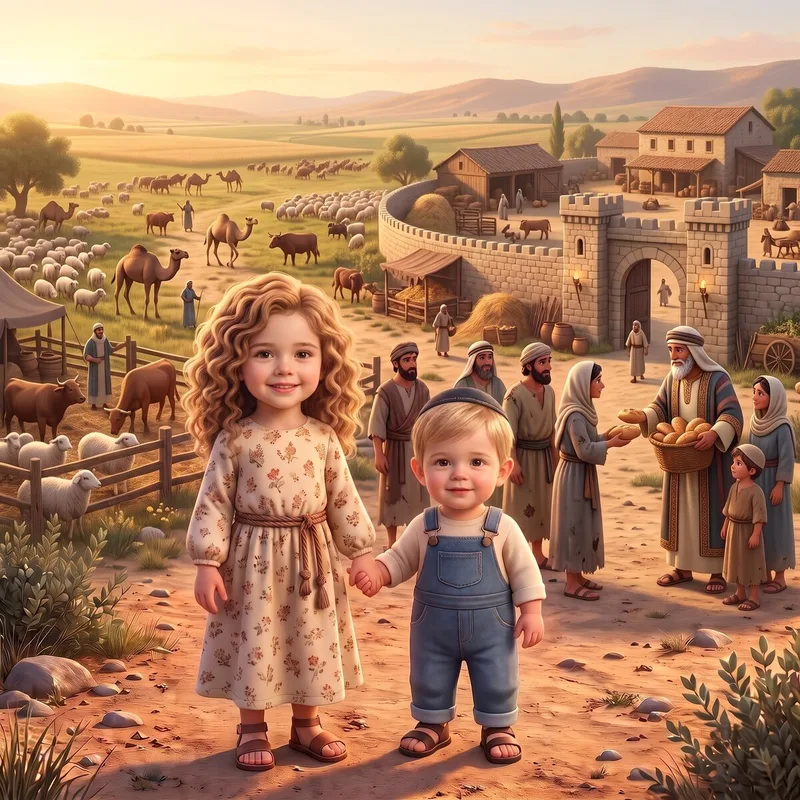
Sefer Iyov - A Test of Emunah is in the Kesuvim collection. Your child's name and likeness, from one photo you upload, appear on every page in 3D animated-film style. Up to eight children can appear in the same book.
Every book ends with a discussion page of 10 questions that mix comprehension with middos, asking what happened and what it asks of your child. That page is a natural starting point at the table. Every book is written with careful rabbinical guidance and strict tznius and reviewed by our team before it goes to print.

Softcover 8″×8″

Hardcover 8″×8″

Board book 6″×6″

Coloring book 8.5″×11″
The child's age is one of the short questions when you create the book. The softcover 8"x8" is for ages 4-8 and the hardcover 8"x8" is for ages 5-18. If you add parents and grandparents, they appear with the children on a closing family page in every format.
When you are ready, you can create the book. It takes a free account and a few short questions: each child's name, boy or girl, age and one photo, any siblings, the story, your community (asked once), the language and the format.
Frequently asked questions
What is the story of Iyov for kids?
Iyov was a man in Eretz Utz whom the sefer calls tam, yashar, yerei Elokim and sar mera, one who was complete, upright, God-fearing and turned away from evil. He was tested with the loss of his possessions and then with illness, and he kept his emunah in Hashem. In the end Hashem restored what he had lost, and Iyov lived to see grandchildren and great-grandchildren.
What is the lesson of Sefer Iyov?
One lesson is that emunah does not depend on understanding everything, as Iyov said that Hashem gave and Hashem took and the name of Hashem is blessed. A second lesson is how to be with a person who is hurting: the friends were at their best when they sat in silence, and the pasuk says Hashem later told them they had not spoken rightly. A third is that Iyov davened for the friends who had hurt him.
How do I explain Sefer Iyov to a 5-year-old?
Keep it short and warm: Iyov loved Hashem very much, hard things happened to him, and he still said Hashem is good and trusted Him. Then Hashem helped Iyov and gave him a happy family again. You know your child best, so you can leave out the sad details and focus on trusting Hashem.
Why do good people suffer, according to Sefer Iyov?
The pesukim do not record Hashem giving Iyov a reason for his suffering. Hashem answered from the storm by pointing to the vastness of the world He made, and Iyov answered that he had spoken of things beyond his understanding. With a child, it is honest to say that we do not always know why, and that Hashem sees far more than we do.
Is there a Torah Tale book about Sefer Iyov?
Yes. Sefer Iyov - A Test of Emunah is in the Kesuvim collection, and your child appears on every page with their name and likeness in 3D animated-film style. The book ends with a discussion page of 10 questions mixing comprehension with middos, and it is written with careful rabbinical guidance and strict tznius.