Eishes Chayil for Kids: Mishlei 31 & How to Explain It
Eishes Chayil closes Sefer Mishlei with twenty-two pesukim about work, chesed and wise words. Here is what it says, the lesson for children, and how to explain it at ages 4, 7 and 11.
Published by Torah Tale.
Create this book for your child
Eishes Chayil is the closing passage of Sefer Mishlei, Mishlei 31:10-31, twenty-two pesukim in praise of a woman whose days are full of work, chesed, wisdom and yiras Hashem. Many families sing it on Friday night before Kiddush, so children often know the tune long before they know the words. It lands with children because it is made of things they can see at home: someone up early, food on the table, a hand open to a person in need.
What is Eishes Chayil and where is it from?
Sefer Mishlei is part of Kesuvim, and its first pasuk calls it the Mishlei of Shlomo ben Dovid. Eishes Chayil is the last passage in the sefer. The words mean a woman of chayil, which is strength and capability, and the pasuk opens with a question: who can find such a woman?
The passage is an acrostic. The first pasuk (31:10) begins with an aleph, the second with a beis, and so on, until the last pasuk (31:31) begins with a tav. That makes a good hook for a child who is learning the aleph-bais.
The meforshim also learn the passage as a mashal for the Torah. Your rav or your child's teacher can tell you which explanation your family follows.
What happens in Eishes Chayil, told for children?
There is no plot here. It is a picture of a whole day, and then a whole life, one pasuk at a time. These are the pictures children remember most:
- Her husband's heart trusts her, and she does him good all the days of her life (31:11-12).
- She works with wool and flax, and her hands are willing (31:13).
- She is like merchant ships, bringing her food from far away (31:14).
- She rises while it is still night and gives food to her household (31:15).
- She spreads out her palm to the poor and reaches out her hands to the needy (31:20).
- She opens her mouth with wisdom, and the Torah of chesed is on her tongue (31:26).
- She watches over the ways of her household and does not eat the bread of idleness (31:27).
- Her children rise up and call her fortunate, and her husband praises her (31:28).
Near the end, the passage says that what truly earns praise is yiras Hashem (31:30). The last pasuk (31:31) says to give her from the fruit of her hands, and let her own deeds praise her in the gates.
What is the lesson of Eishes Chayil for kids?
The first lesson is that greatness is built from ordinary acts done with care. Nobody in this passage does anything dramatic. She feeds people, works, gives and speaks kindly, again and again.
The second is chesed with an open hand, which the pasuk shows in a very physical way. The third is the way she speaks: wisdom, and the Torah of chesed on her tongue. If your child is working on careful speech, Guarding My Tongue is a natural companion.
The last lesson is about everyone else in the picture. Her children and her husband say thank you out loud, which is hakaras hatov in action. Our article on saying thank you at home has ideas for practicing it.
How do I explain Eishes Chayil to a 4-year-old, a 7-year-old and an 11-year-old?
Around age 4: use one sentence. Eishes Chayil is a song that says thank you for all the kind things a mother does. Then ask your child to name two things someone did for them today. Concrete actions work better than anything abstract.
Around age 7: tell your child about the aleph-bais pattern, and let them listen for the pesukim as you sing. Ask which picture they like best, and what the woman in that picture is doing for other people. A child this age enjoys finding that the pesukim really do follow the letters in order.
Around age 11: ask why the passage opens with a question, and why it ends by saying her own deeds praise her. Talk about the difference between being praised by others and doing things worth praising. You can also mention that the meforshim learn the passage as a mashal for the Torah, as long as you say clearly that this is an explanation of the meforshim and not the pshat of the words.
What is the Torah Tale Eishes Chayil book like?
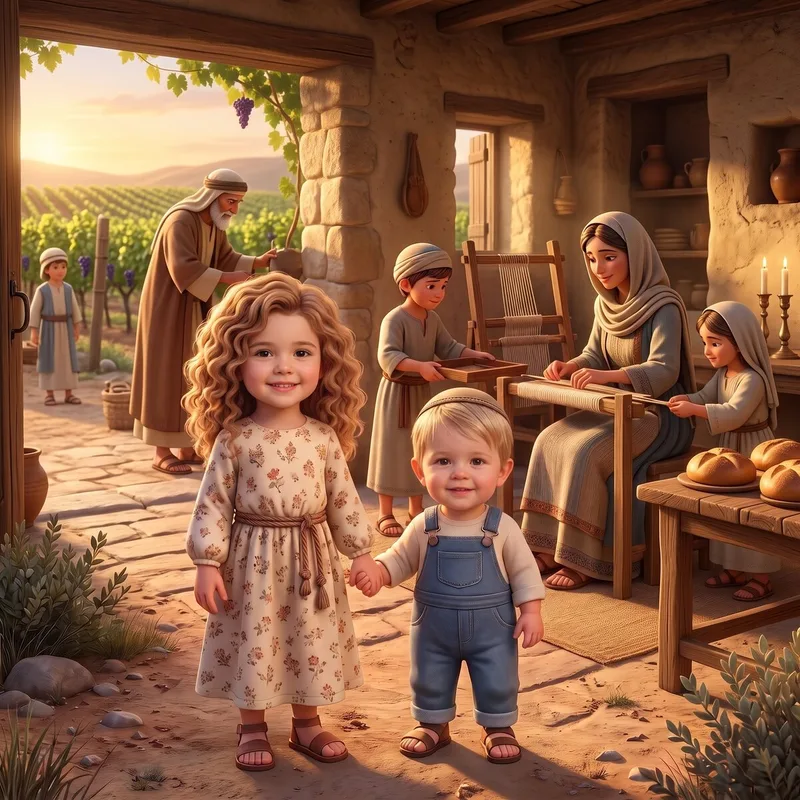
Sefer Mishlei - Eishes Chayil is in the Kesuvim collection. Your child's name and likeness, taken from one uploaded photo, appear on the pages in high-resolution 3D animated-film style. Up to eight siblings can appear in the same book, ages 0 to 18. The book is written with careful rabbinical guidance and strict tznius and is reviewed by our team before it goes to print.
It suits sons and daughters alike, because the whole family says the passage and every child can learn from its middos. If you add parents, grandparents or other relatives with their photos, they appear with the children on a closing family page in every format.

Softcover 8″×8″

Hardcover 8″×8″

Board book 6″×6″

Coloring book 8.5″×11″
There are three formats. The board book is 6x6 with rounded safety corners, for ages 0-4. The softcover is 8x8, for ages 4-8, and the hardcover is 8x8, for ages 5-18. The softcover and hardcover open with a dedication page. An optional matching coloring book, 8.5x11 in black-and-white line art, can be added to a one-time order.
Every book ends with a discussion page of 10 questions, mixing comprehension with middos. That page turns Eishes Chayil from something read to a child into something the family talks about together, and it is worth reading aloud at the table.
What questions can we ask at the Shabbos table?
Reading the storybook on Shabbos is exactly right, and these questions need nothing but talking:
- Which of the pictures in Eishes Chayil have you seen someone do in our home?
- Why do you think the passage says her hands are willing?
- What does it mean to have the Torah of chesed on your tongue?
- Who in our family opens their hand to someone who needs help?
- What is one thing someone did this week that we haven't thanked them for yet?
For a weekday activity, ask each child on a weekday afternoon to think of something to thank someone for, and say it again at the Shabbos table. If you add the coloring book, keep it for erev Shabbos or a weekday afternoon, never for Shabbos itself. If you're still choosing a story, Sefer Mishlei for Kids and Learn from the Ant cover other parts of the sefer.

To order, create the book. You need a free account and will answer a few short questions: each child's name, boy or girl, age and one photo, any siblings, the story, your community (asked once), the language and the format. Choose Kesuvim in the story picker and then Eishes Chayil. The whole thing takes about five minutes.
Frequently asked questions
What is Eishes Chayil about?
Eishes Chayil is Mishlei 31:10-31, the last passage in Sefer Mishlei. It praises a woman of strength and ability who works willingly, looks after her household, gives to the poor and speaks with wisdom. It ends by saying that her own deeds praise her, and that what is truly praised is yiras Hashem.
Why do we say Eishes Chayil on Friday night?
Saying or singing Eishes Chayil before Kiddush is a minhag in many homes. It gives the family a moment to express appreciation for the work that goes into Shabbos and the home. Customs differ between families, so ask your rav if you want to know the practice that suits yours.
How do I explain Eishes Chayil to a 4-year-old?
Keep it to one sentence: Eishes Chayil is a song that says thank you for all the kind things a mother does, like making food, helping people and speaking nicely. Then ask your child to name two things someone did for them today. Little children understand a list of concrete actions much better than an explanation of the whole passage.
What is the lesson of Eishes Chayil for children?
The passage shows hard work done for others, chesed toward people who need help, and words that are both wise and kind. It also shows children and a husband expressing appreciation out loud. A child can take from it that real greatness is made of ordinary acts done with care, day after day.
Is Eishes Chayil only for girls?
No. It is a passage that the whole family says and learns from. Boys and girls both learn from its middos of hard work, chesed and careful speech, and the pesukim themselves describe the children rising up to call her fortunate.
What is the Torah Tale Eishes Chayil book?
It is a personalized storybook from the Kesuvim collection, named Sefer Mishlei - Eishes Chayil, starring your child with their name and likeness in 3D animated-film style. It is written with careful rabbinical guidance and strict tznius, and it ends with a discussion page of 10 questions. It comes as a 6x6 board book (ages 0-4), an 8x8 softcover (ages 4-8) or an 8x8 hardcover (ages 5-18).