Learn from the Ant for Kids: Mishlei 6 and Working Without Being Told
Three pesukim in Sefer Mishlei send a person to watch an ant: she has no officer, no overseer and no ruler, and she still gathers her food in the summer. Here is how to retell it for children aged 3-4, 6-7 and 9-12, what it asks of them, and questions to use at the Shabbos table.
Published by Torah Tale.
Create this book for your child
Learn from the Ant is built on three pesukim in Sefer Mishlei (6:6-8), where Shlomo HaMelech turns to someone who does not want to get up and work and tells him something surprising: go look at an ant. Watch her ways, and become wise. It lands with children because the teacher in the story is smaller than their fingernail, carries more than her own size, and never once needs to be reminded.
What does "Lech el nemalah" actually say in Sefer Mishlei?
The pasuk is short enough that most children can learn it by heart: לך אל נמלה עצל ראה דרכיה וחכם - go to the ant, lazy one, see her ways and become wise (Mishlei 6:6).
The next pasuk adds the detail that does all the work. The ant has no officer, no overseer and no ruler standing over her. There is nobody to check on her, nobody to report to, and nobody to be upset if she stops. The pasuk after that says she prepares her bread in the summer and gathers her food at the time of the harvest, storing in the season when there is something to gather for the season when there will not be.
The pesukim that follow turn to the person being spoken to: how long will you lie there, a little sleep, a little slumber, a little folding of the hands to rest, and then poverty arrives like a traveler. Sefer Mishlei is in Kesuvim, and its way of teaching is exactly this - one picture, drawn quickly, that you cannot unsee.
What is the lesson of the ant for children?
There are really three lessons stacked inside one small insect, and children can hold all three.
- Zerizus. The ant does not wait to be asked, and she does not stop in the middle. She starts, she carries, she comes back for more.
- Doing right when nobody is checking. No officer, no overseer, no ruler. This is the line to say out loud to an older child, because it describes exactly the moments that test them: the homework nobody saw, the mess nobody will trace back to them.
- Preparing now for later. Summer is not harvest, and the ant works in both. A child who sets out their clothes on Thursday night, or helps with Shabbos cooking on Wednesday, is doing what the pasuk describes.
Chazal looked closely at this creature too. The Gemara in Eruvin (100b) teaches that had the Torah not been given, we could have learned not to steal from the ant, together with other middos we could have learned from other creatures. The point is not that animals replace Torah. It is that the world Hashem made is full of quiet teachers, and a wise person is willing to learn from a very small one.
How do I explain it at different ages?
Ages 3-4. One sentence: "The ant carries her food home all by herself, and nobody has to tell her. Shlomo HaMelech said we should learn from her." Then name something the child already did on their own that day. Toddlers love that the ant is tiny and strong at the same time, which is how they would like to be described.
Ages 6-7. Teach the pasuk itself, seven words, and then ask the real question: who tells the ant what to do? When they answer that nobody does, you have the whole idea. At this age it is worth giving the flip side too, the person in the pesukim who keeps saying "just a little more sleep", because children recognize him instantly.
Ages 9-12. Go into hishtadlus and bitachon together. The ant works, and Hashem provides. Mishlei is not telling us that effort creates the bread, it is telling us that a person is meant to do his part properly and not sit with folded hands waiting. Older children can also be asked what it means that a whole sefer of chochmah stops to look at an insect, and what that says about where chochmah can be found. If this is a sefer your child is enjoying, our broader piece on Sefer Mishlei for kids and the one on Shlomo HaMelech's listening heart are natural next reads.
What a personalized Learn from the Ant book is like
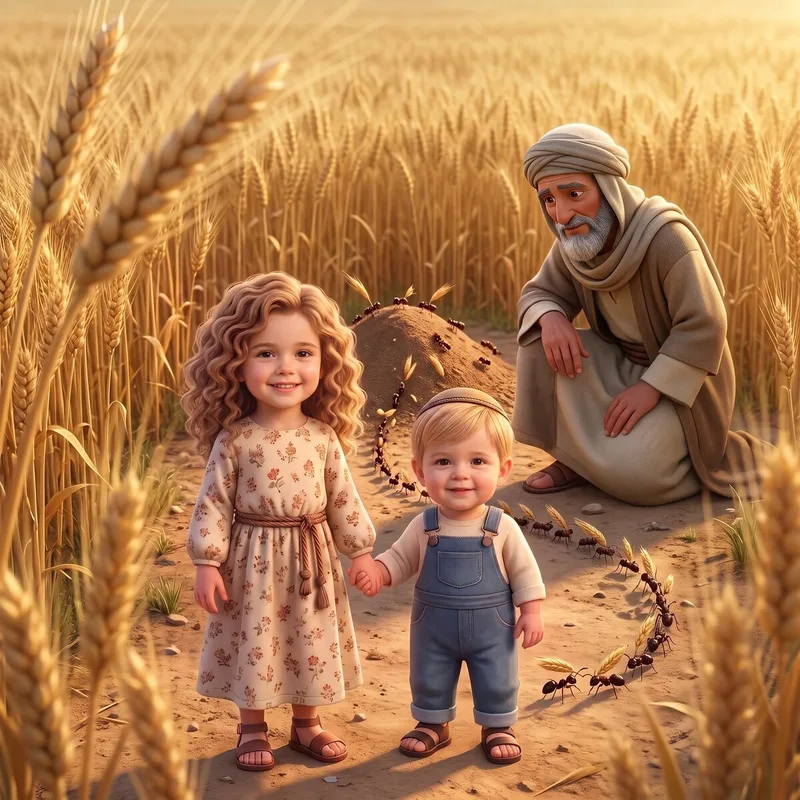
Torah Tale prints this story as a personalized book from the Kesuvim collection, with your child as the one who bends down to watch the ant, follows her trail, and hears Shlomo HaMelech's words about her ways. The child's name and their likeness, built from one uploaded photo, appear on every page, illustrated in high-resolution 3D animated-film style. Up to eight siblings can be in the same book, ages 0 to 18.

Softcover 8″×8″

Hardcover 8″×8″

Board book 6″×6″

Coloring book 8.5″×11″
There are three formats: a 6x6 board book with rounded safety corners for ages 0-4, an 8x8 softcover for ages 4-8, and an 8x8 hardcover for ages 5-18. The softcover and hardcover open with a dedication page. If you add parents and grandparents with their photos, they appear with the children on a closing family page, in every format. Every book ends with a discussion page carrying ten questions about the story, mixing comprehension with middos, which is what turns it from a book read to a child into a conversation at the table.
Five questions for the Shabbos table
This story is built for talking, and reading it at the Shabbos table or on a long Yom Tov afternoon fits it perfectly. Five questions to open with:
- Who tells the ant what to do? What does the pasuk say she does not have?
- Name one thing you did this week that nobody asked you to do.
- Why does the ant gather food in the summer when there is plenty around?
- What is the hardest job in our house to start? What makes starting hard?
- If Shlomo HaMelech could send us to watch one other thing Hashem made, what do you think we would learn from it?
The fifth one usually produces the best answers, and it is worth letting a child defend a strange choice.
A weekday activity: the ant walk and the erev Shabbos list
On a weekday afternoon, take five minutes outside and look for a line of ants near a wall or a crack in the pavement. Watch one ant the whole time rather than the group, and see how many times she goes back. That single ant is the pasuk, live.
Then, during the week or on erev Shabbos, sit with a child and write out a short list of their own "summer work" - the things done early so that later is calm. Clothes laid out, toys off the floor, a bracha learned by heart, a table set before candle lighting. Writing is a weekday activity, so this belongs to Thursday or Friday afternoon, not to Shabbos itself. If you add the optional matching coloring book in 8.5x11 black-and-white line art, that is a weekday or erev Shabbos activity too, never on Shabbos or Yom Tov. For the connection between preparing during the week and the day it is all for, our Shabbos story for kids is a good companion.

How to order this story
Learn from the Ant can be ordered as a single book, or as part of a collection subscription to Nevi'im & Kesuvim. The collection runs on one of two plans: Monthly, four books a month in one delivery, billed monthly, or Yearly, the whole collection paid once with $30 off, still four books a month until it is done, and only that collection's own books. Subscriptions pay US standard shipping of $9.99 per box of four books. For a one-time order, US standard shipping is $5.99, free on orders of $75 or more, and arrives in about 12 business days counted from the order. We ship worldwide, with rates shown at checkout.
Creating the book takes about five minutes. It needs a free account and a few short questions: each child's name, boy or girl, age and one photo, any siblings, the story, your family's community, the language (English, Hebrew or Yiddish) and the printed format. Every book is written with careful rabbinical guidance and strict tznius and reviewed by our team before it goes to print.
Ready to put your child next to that small, determined teacher? Create the book and see how quickly "nobody has to tell the ant" becomes a line your family uses.
Frequently asked questions
What is the story of the ant in Mishlei?
In Sefer Mishlei 6:6-8, Shlomo HaMelech turns to a person who does not want to get up and work and tells him to go to the ant, look at her ways, and become wise. The pesukim point out that the ant has no officer, no overseer and no ruler telling her what to do, and she still prepares her food in the summer and gathers it in at harvest time. The pesukim that follow describe someone who keeps saying a little more sleep, a little more folding of the hands, and what that costs him in the end.
What is the lesson of 'Go to the ant' for children?
The lesson is zerizus: doing what needs to be done, on time, without waiting to be told and without someone checking. The ant works when nobody is watching her and prepares in the warm season for the season when there will be nothing to gather. For a child that translates into getting dressed before being called three times, packing a bag the night before, and finishing a job once it is started.
Where is Mishlei found in Tanach?
Sefer Mishlei is part of Kesuvim, the third section of Tanach, and it opens by telling us it is the mishlei of Shlomo ben Dovid, melech Yisrael. It is a sefer of wisdom rather than a sefer of events, which is why its lessons are given as short, sharp pictures like the ant, rather than as a long narrative.
How do I explain the ant in Mishlei to a 4-year-old?
Say it in one sentence: the ant works hard and carries her food home even though nobody tells her to, and Shlomo HaMelech said we should learn from her. Then make it concrete with something the child did that day on their own, like putting shoes away without being asked. Young children connect to the ant immediately because she is small and they are small, and she carries something bigger than she is.
Does the ant in Mishlei mean we should not rely on Hashem?
No. Mishlei is teaching hishtadlus, the effort a person is meant to put in, while the parnassah itself comes from Hashem. The ant does her small work faithfully, and Hashem is the One who provides what she gathers. Children can hold both ideas together: we do our part properly, and we thank Hashem for the results.
Which Torah Tale format fits this story?
It depends on the child's age, which is one of the short questions when you create the book. The 6x6 board book with rounded safety corners is for ages 0-4, the 8x8 softcover for ages 4-8 and the 8x8 hardcover for ages 5-18. Every format ends with a discussion page of ten questions, and if you add relatives they appear on a closing family page, and the softcover and hardcover open with a dedication page.