Dovid Prepares the Beis HaMikdash for Kids: Divrei HaYamim & Shlomo
Dovid HaMelech wanted to build the Beis HaMikdash, was told his son would build it, and gave everything to prepare. Here is the story, the lesson, and how to talk about it with a 3-4 year old, a 6-8 year old and a 10-12 year old.
Published by Torah Tale.
Create this book for your child
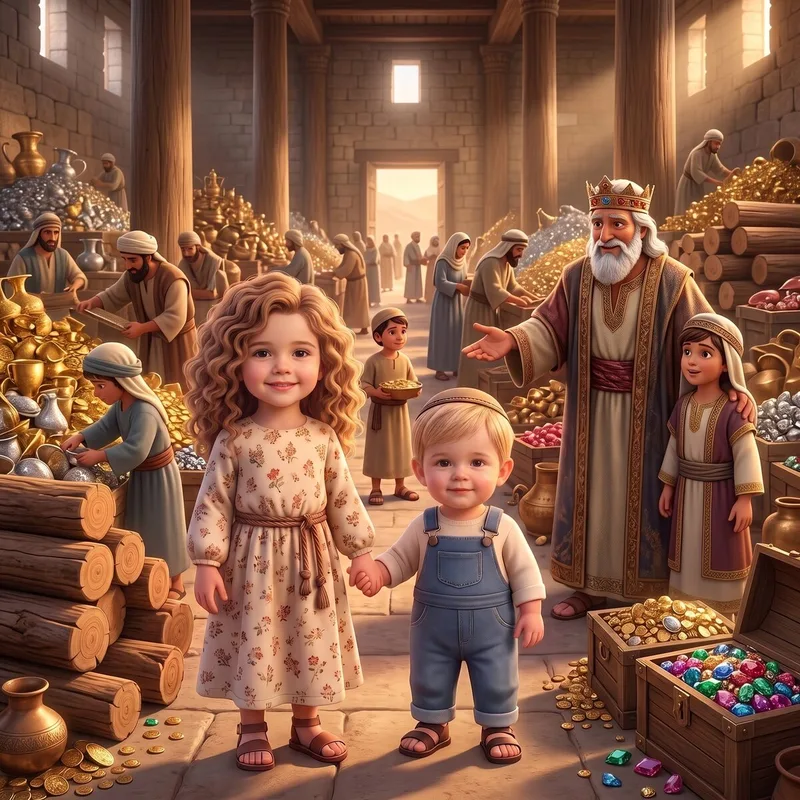
Dovid Prepares the Mikdash is the story, told in Sefer Divrei HaYamim, of how Dovid HaMelech gathered stone, iron, copper, cedar, gold and silver for a Beis HaMikdash that his son Shlomo, and not he, would build. It lands with children because it starts with a feeling they know well, wanting to do a big thing yourself, and the pesukim show what Dovid did with that wish: he put everything he had into helping someone else succeed.
What happens in the story of Dovid preparing the Beis HaMikdash?
Dovid was king, and Yerushalayim was his city. He wanted to build a house for Hashem, and Hashem sent Nasan HaNavi to tell him that it would be his son who would build it (Divrei HaYamim I 17).
Dovid bought the threshing floor of Ornan the Yevusi, and he insisted on paying the full price for it. There he built a mizbeach, and said, 'This is the house of Hashem Elokim' (22:1). He understood that this place would be the home of the Beis HaMikdash.
Then he got to work. The pesukim tell us that Dovid gathered the geirim living in Eretz Yisrael and appointed them as stonecutters to hew stones for the house. He prepared iron in abundance for the nails of the doors and for the clamps. He prepared copper beyond weighing, and cedar beyond counting, brought to him by the Tzidonim and the Tzorim.
Why so much? Dovid explained: 'Shlomo my son is young and tender, and the house to be built for Hashem must be exceedingly great.' So he said, 'I will prepare for him,' and the pasuk says he prepared in great abundance before his death (22:5).
Later, Dovid gathered all the leaders of Yisrael in Yerushalayim. The pasuk says the king rose to his feet and called out, 'Listen to me, my brothers and my people' (28:2). He gave Shlomo the plans for the building, and told him that it was all in writing, from the hand of Hashem, who gave him the understanding to see every detail of the plan (28:19).
Why wasn't Dovid allowed to build the Beis HaMikdash himself?
The pasuk answers this directly. Dovid tells Shlomo that the word of Hashem had come to him: 'You have shed much blood and fought great wars, you shall not build a house for My name' (22:8). In the next pasuk, Shlomo is described as an ish menuchah, a man of rest, and Hashem says that He will give peace and quiet to Yisrael in his days.
For a young child, there is a gentle way to say it: the Beis HaMikdash was to be built in a time of peace, and the pasuk connects Shlomo's name to shalom. The pesukim do not say that Dovid did anything wrong, and we should not add that. They simply explain what the Beis HaMikdash was meant to be.
What matters most for children is what Dovid does next. He does not stop caring about the Beis HaMikdash. He turns the wish into work.
What is the lesson for children?
Four things stand out in the pesukim, and each one is easy for a child to understand:
- You can take part in a mitzvah even if someone else finishes it. Dovid prepared knowing that he would not be the one to build. It is a good picture for any child who helps with something they will not get to finish. For another story about planting for those who come later, see Choni and the Carob Tree.
- Give from your own. After all the materials he had prepared, Dovid said he also gave from his own treasure of gold and silver, because he so desired the house of his God (29:3).
- Give willingly. The leaders and the people also gave, and the pasuk says they rejoiced, because they gave to Hashem with a whole heart (29:9).
- It all comes from Hashem. In his bracha before the whole assembly, Dovid says, 'Ki mimcha hakol u'miyadcha nasanu lach' - everything is from You, and from Your own hand we have given to You (29:14). Giving is not losing something. It is returning a small part of what we were given.
How do I explain it to a 3-year-old, a 7-year-old and an 11-year-old?
Ages 3 to 4. One picture is enough: 'Dovid wanted to build a house for Hashem. Hashem said Shlomo would build it. So Dovid got all the stones and wood ready to help Shlomo.' Then ask, 'What can you get ready to help your baby brother (or sister, or friend)?' Small answers count: bringing the napkins, or putting out the cups.
Ages 6 to 8. This age can hold the reason and the ending. Tell them that Dovid could not build because of the wars he had fought, that Shlomo would be a man of peace, and that Dovid prepared anyway. Then ask, 'Why did Dovid say Shlomo is young?' and 'What did Dovid give from his own treasure?' Children this age also enjoy the list of materials, so count them on your fingers together.
Ages 10 to 12. Older children can think about how hard it is to hear 'not you' and what Dovid did with it. They can also notice the shape of the story: Dovid first gives, then the leaders give, then he says 'everything is from You.' Ask what changes when you remember that what you are giving was never really yours. The wider picture, from Dovid to Shlomo and the kingdom, is in Sefer Divrei HaYamim for Kids: Dovid, Shlomo and the Story of the Malchus.
What is a personalized Torah Tale book of this story like?
Torah Tale makes a personalized book of this story, found under the Kesuvim category in the story picker. Your child's name and, from one uploaded photo, their likeness appear on every page, illustrated in high-resolution 3D animated-film style. Up to eight children, ages 0 to 18, can appear in the same book, so siblings can share one story. If you add parents and grandparents, they appear with the children on a closing family page in every format.
Every book ends with a discussion page of ten questions about the story, mixing comprehension with middos: what happened, and what it asks of the child. For a story like this one, that is where the talk about giving, preparing and willingness can begin. Every book is written with careful rabbinical guidance and strict tznius, and reviewed by our team before it goes to print.

Softcover 8″×8″

Hardcover 8″×8″

Board book 6″×6″

Coloring book 8.5″×11″
There are three formats: a 6x6 board book with rounded safety corners (ages 0-4), an 8x8 softcover photo book (ages 4-8) and an 8x8 hardcover photo book (ages 5-18). The softcover and hardcover open with a dedication page. A matching coloring book is an optional add-on, and it is for the weekday only.
What can we talk about at the Shabbos table, and what can we do on a weekday?
Reading is just right for Shabbos, and so is talking. Here are questions that need nothing but a table and a few minutes:
- What did Dovid want to build, and who was going to build it instead?
- What did Dovid gather to get ready? Can anyone remember all the materials?
- Why did Dovid say that Shlomo was young and the house must be very great?
- Is it hard to get ready for something that someone else will do? What helps?
- Dovid gave from his own treasure. What is something of yours that you could share?
- What does it mean that 'everything is from You'?
For the weekday, a few ideas. Put a coin in the tzedakah box every weekday for a week, or just before Shabbos, and let your child choose who it will help. Let your child set out the plates for a guest on erev Shabbos, so that they take part in preparing for someone else. If you ordered the coloring book, it belongs on a weekday afternoon, or during Chol HaMoed, and not on Shabbos or Yom Tov, since coloring is melacha.
When you are ready, create the book. It takes about five minutes: a free account and a few short questions, covering each child's name, boy or girl, age and one photo, any siblings, the story, your community (asked once), the language and the format. Books can be ordered in English, Hebrew or Yiddish. The same theme of giving to Hashem's house continues in Giving Tzedakah for Kids.
Frequently asked questions
Why couldn't Dovid HaMelech build the Beis HaMikdash?
In Divrei HaYamim I 22:8, Dovid tells Shlomo that the word of Hashem came to him: he had shed much blood and fought great wars, so he would not build the house. The next pasuk says Shlomo would be a man of peace and quiet. For young children it is enough to say that the Beis HaMikdash was to be built in a time of peace, by Shlomo.
What did Dovid prepare for the Beis HaMikdash?
The pesukim in Divrei HaYamim I 22 tell us that Dovid had stonecutters hew stones, and that he gathered iron for nails and clamps, copper in great amounts, and cedar brought by the Tzidonim and Tzorim. He also prepared gold and silver, and gave plans to Shlomo. In chapter 29 he gave from his own treasure on top of all that.
How do I explain Dovid preparing the Mikdash to a 4-year-old?
Keep it to one picture: Dovid wanted to build a house for Hashem, Hashem said that Shlomo would build it, so Dovid got all the stones and wood ready to help Shlomo. Then ask your child what they could get ready to help a brother, sister or friend. A short story and one simple question is plenty at this age.
What is the lesson of Dovid preparing the Beis HaMikdash?
One lesson is that you can fully take part in a mitzvah even when someone else will be the one to finish it. Another is giving wholeheartedly, as the people did when they gave willingly in Divrei HaYamim I 29. Dovid also says there that everything comes from Hashem, and that what we give is already His.
Is there a personalized children's book about Dovid preparing the Mikdash?
Yes. Torah Tale has a personalized book of this story in its Kesuvim collection, with your child's name and likeness, from one uploaded photo, on every page in 3D animated-film style. It is available as a 6x6 board book with rounded safety corners (ages 0-4), an 8x8 softcover (ages 4-8) or an 8x8 hardcover (ages 5-18), and it ends with a discussion page of ten questions.