Choni and the Carob Tree for Kids: Taanis 23a & Planting Ahead
Choni sees a man plant a carob tree and sleeps for seventy years. Here is the story from Taanis 23a, its lessons, and how to tell it to a 4, 7 or 10-year-old.
Published by Torah Tale.
Create this book for your child
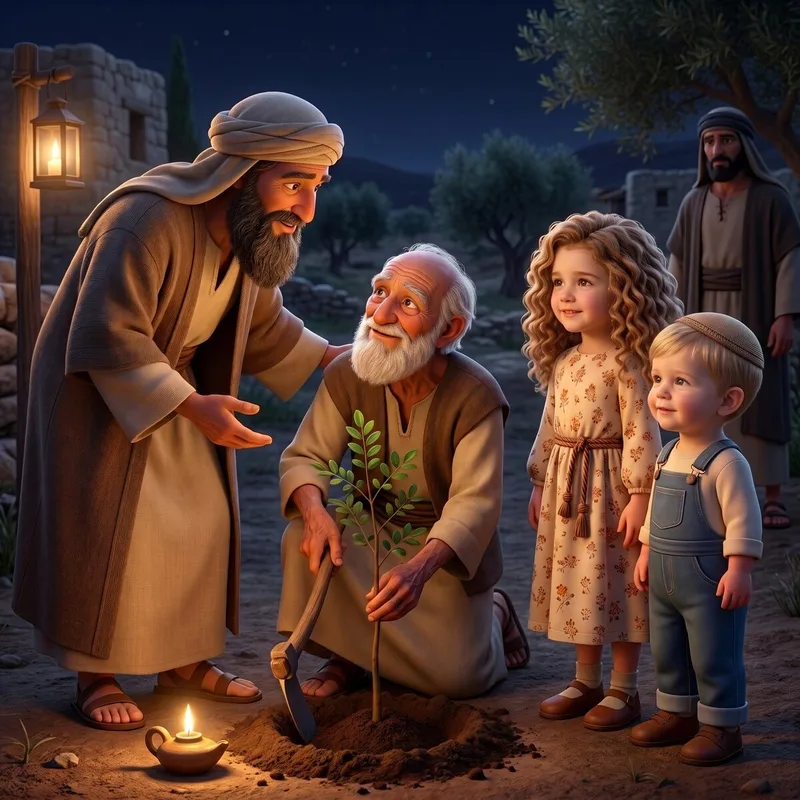
Choni and the Carob Tree is a story from the Gemara in Maseches Taanis (23a). Choni sees a man planting a carob tree that will take seventy years to bear fruit, falls asleep, and wakes seventy years later to find that tree full of fruit and the planter's grandson gathering it. Children hold on to it because it starts with something they can picture, a tree, and asks a question they can answer: why would anyone plant something he may never eat from?
What happens in the story of Choni and the carob tree?
The Gemara tells that Choni was walking on the road when he saw a man planting a carob tree. He asked how many years it would take until the tree gave fruit. The man answered, seventy years. Choni asked him, are you sure you will live seventy years?
The man answered that he had found a world with carob trees already in it. Just as his fathers had planted for him, so he plants for his children.
Then Choni sat down to eat bread, and sleep came over him. The Gemara says a rocky formation closed around him and hid him from sight, and he slept for seventy years.
When he woke, he saw a man gathering fruit from the carob tree. Choni asked, are you the one who planted it? The man said, I am his grandson. Choni understood that he had slept seventy years. The Gemara adds that he also saw his donkey had given birth to herds.
Choni went to his house and asked whether the son of Choni HaMe'agel was alive. They told him his son was no longer alive, but his grandson was. He said, I am Choni HaMe'agel, and no one believed him.
He went to the beis midrash and heard the scholars say that their learning was as clear to them as in the days of Choni HaMe'agel, because whenever he came to the beis midrash he would resolve any difficulty they had. He said, I am he. They did not believe him and did not give him the honor he deserved.
Choni was distressed. He davened to Hashem for mercy and passed away. Rava said that this is why people say, או חברותא או מיתותא, “Either friendship or death.”
Where is Choni and the carob tree in the Gemara?
The story is in Maseches Taanis 23a. Right before it, the Gemara brings the words of Rabbi Yochanan: all the days of this tzaddik, he was troubled by the words היינו כחולמים, “we were like dreamers” (Tehillim 126). Could a person really sleep seventy years in a dream? The Gemara then goes on to the day Choni was walking on the road.
This is also the Choni of the Mishnah in Taanis (3:8), who is known for praying for rain. This article is only about the carob tree story in the Gemara, and we are telling it as the Gemara does, without adding details of our own.
What is the lesson of Choni and the carob tree?
The first lesson comes from the planter's own words. He found a world with carob trees, and as his fathers planted for him, he plants for his children. From this we can learn to notice how much we enjoy because someone before us prepared it, and to do something now that will help those who come after us.
A second lesson comes from the ending. Choni was a person whose Torah was spoken of with respect, and when he came back nobody knew him. The Gemara closes with Rava's saying about friendship. We can learn from this how much a person needs a chaver, and how much it matters to welcome someone who feels like a stranger.
If your children already know the carob tree from Tu B'Shvat and the carob planter, this is a good story to connect it to. Rabbi Shimon bar Yochai also has a carob tree in his story, but that is a different story, told in Rabbi Shimon bar Yochai for Kids.
How do I explain Choni and the carob tree to a 4-year-old, a 7-year-old and a 10-year-old?
- Around age 4: Keep it to the tree. A man planted a tree for his grandchildren, Choni slept a very long time, and when he woke the tree was big and full of fruit. Then ask, who planted something for you? You know your child best, so you can decide whether to tell the sadder ending now or a little later.
- Around age 7: Tell the planter's answer in your own words, and let your child be the one to say why Choni asked it. Then tell how Choni came home and nobody knew him, and ask how that would feel. If your child is ready, tell that the Gemara says he davened and passed away, and Rava's saying about friendship.
- Around age 10: Start with Rabbi Yochanan's question about היינו כחולמים. Then talk about the scholars: they praised Choni's Torah and still did not recognize the man in front of them. What does it mean to have a chavrusa, someone who knows you?
What questions can we ask at the Shabbos table about Choni?
These are all for talking, with no pencils or paper needed:
- Why did the man plant a tree that would take seventy years?
- What did Choni answer, and what did the man say back?
- How did Choni understand that he had slept seventy years?
- Who planted something for us, such as a tree, a house or a siddur?
- What would you want to plant for your grandchildren?
- How would it feel to come home and have nobody know you? What can we do when someone feels like a stranger in our class or shul?
What is a good weekday activity for this story?
On a weekday afternoon, plant a seed or a small plant in a pot with your children, and tell them it is for whoever will enjoy it later. Planting is not for Shabbos or Yom Tov, so this is a weekday activity. Let each child choose what to call the plant, and check on it together over the next weeks.
What is the Torah Tale book of Choni and the Carob Tree like?
It is a personalized book from our Midrash & Aggadah collection, which holds the stories Chazal tell, each from its named source in the Gemara or Midrash. Your child's name and, from one uploaded photo, their likeness appear on every page, illustrated in 3D animated-film style. Up to eight children can appear in the same book.

Softcover 8″×8″

Hardcover 8″×8″

Board book 6″×6″

Coloring book 8.5″×11″
There are three formats: a 6x6 board book with rounded safety corners (ages 0-4), an 8x8 softcover photo book (ages 4-8), and an 8x8 hardcover photo book (ages 5-18). The softcover and hardcover open with a dedication page. An optional matching coloring book in black-and-white line art is a weekday activity only, for an afternoon or erev Shabbos, never for Shabbos or Yom Tov. The storybook itself is right for reading at the Shabbos table or on a long Yom Tov afternoon.
Every book ends with a discussion page of ten questions that mix comprehension with middos, so the story becomes something the family talks about together. If you add parents and grandparents with their photos, they appear with the children on a closing family page in every format, which suits a story about one generation planting for the next. Every book is written with careful rabbinical guidance and strict tznius, and reviewed by our team before it goes to print.

To order, you create a free account and answer a few short questions: each child's name, boy or girl, age and one photo, any siblings, the story, your community (asked once), the language and the format. Books are available in English, Hebrew and Yiddish, and the whole flow takes about five minutes.
Ready to make it? You can create the book and choose Choni and the Carob Tree from the Midrash & Aggadah category.
Frequently asked questions
What is the story of Choni and the carob tree?
The Gemara in Taanis 23a tells that Choni saw a man planting a carob tree that would take seventy years to bear fruit. Choni then fell asleep, and a rocky formation hid him from view for seventy years. When he woke, he saw the planter's grandson gathering the fruit, and he realized how long he had slept.
Where does the story of Choni and the carob tree come from?
It comes from Maseches Taanis 23a. Just before the story, the Gemara brings Rabbi Yochanan's words that this tzaddik was troubled all his days by the words 'we were like dreamers' in Tehillim 126. The carob tree story follows.
What is the lesson of Choni and the carob tree?
The planter says it himself: he found a world with carob trees, and as his fathers planted for him, he plants for his children. From this we learn to be grateful for what earlier generations prepared and to prepare something for those who come after us. The ending, and Rava's saying about friendship, can also lead to a talk about belonging and welcoming others.
How do I explain Choni and the carob tree to a young child?
For a 4-year-old, keep it simple: a man planted a tree for his grandchildren, Choni slept a very long time, and when he woke the tree was big and full of fruit. You know your child best, so you can decide whether to tell the sadder ending now or when your child is a little older. Then ask who planted trees or made other good things for your family.
Is there a personalized book of Choni and the carob tree?
Yes. Torah Tale has a personalized book of this story in its Midrash & Aggadah collection, with your child's name and, from one uploaded photo, their likeness in 3D animated-film style. It comes as a 6x6 board book with rounded safety corners (ages 0-4), an 8x8 softcover (ages 4-8) or an 8x8 hardcover (ages 5-18), and every book ends with a discussion page of ten questions.