Tu B'Shvat for Kids: The New Year of the Trees & the Carob Planter
Tu B'Shvat is the Rosh Hashanah of the trees. Here is how to explain it to a 3-year-old, a 7-year-old and an 11-year-old, with the carob planter's story, fruit-table questions and a personalized book for your child.
Published by Torah Tale.
Create this book for your child
Tu B'Shvat, the 15th of Shvat, is the Rosh Hashanah for trees, and it is one of the easiest days of the year to teach a child. There is fruit to hold, a bracha to say, and a simple idea underneath: everything big started small and grew with care. This article explains what the day is, the Gemara's story children remember, and how to say it at different ages.
What is Tu B'Shvat and why is it called the New Year of the Trees?
The Mishnah in Maseches Rosh Hashanah lists four new years. One of them is the new year for trees. Beis Shamai says it is the 1st of Shvat, and Beis Hillel says it is the 15th, and we follow Beis Hillel. The name Tu B'Shvat simply spells out the date: tu is the letters tes and vav, which make fifteen.
The date matters for halachos that depend on a fruit's age, such as maasros and orlah, which is why the Mishnah gives it a new year of its own. The reason given in the Gemara is that by this time most of the year's rain in Eretz Yisrael has already fallen. Winter still looks bare, but the trees have started.
One practical note for this year: according to the calendar, 15 Shvat 5787 falls on Shabbos, January 23, 2027. Please confirm with your luach. On Shabbos, tasting fruit and talking at the table is exactly right, while planting and crafts wait for a weekday.
What is the story of Tu B'Shvat for children?
Tu B'Shvat does not have one story the way Purim or Pesach does. It has the Mishnah that gives the day its name, the pesukim that praise the fruits of Eretz Yisrael, and a well-loved account in the Gemara (Taanis 23a) that children remember.
In that account, Choni HaMe'agel was walking along the road when he saw an old man planting a carob tree. He asked how many years it would take to bear fruit, and the man answered seventy. Choni asked whether he expected to live seventy years to eat from it. The old man answered that he had found a world with carob trees already in it, and just as his fathers had planted for him, so he was planting for his children.
That is the part to tell a child. The old man was not planting for himself. He was giving a gift to someone he might never see enjoy it.
Why do we eat fruit on Tu B'Shvat?
The widespread minhag is to eat fruits on the day, especially the ones the Torah praises in Eretz Yisrael. The pasuk in Devarim 8:8 lists them: wheat, barley, grapes, figs, pomegranates, olives and date honey. Many families put out several fruits and say a bracha on each: Borei pri ha'eitz on fruit that grows on a tree, with Borei pri hagafen on grape juice or wine.
For children, this is the heart of the day. The bracha turns snacking into hakaras hatov. If you have a fruit your family has not yet eaten this season, ask your rav about Shehecheyanu. On Tu B'Shvat we also omit Tachanun, which gives the day a lighter feeling.
For more on teaching a child to say thank you, see Saying Thank You for Kids.
What is the lesson of Tu B'Shvat for kids?
There are three lessons a parent can pick from, depending on the child.
- Gratitude. Every apple and date is a gift from Hashem, and a bracha is how we notice it.
- Looking ahead. The carob planter teaches us to do good now for people who will benefit later. In Devarim 20:19-20 the Torah forbids destroying fruit trees even in time of war, and the halacha of bal tashchis is learned from this, so caring for what grows is a mitzvah, not only a nice idea.
- Growing from roots. A tree stays strong because of what is underground. For a child, roots can be tefillah, learning and good habits that nobody sees.
Tehillim also compares a tzaddik to a tree: Tehillim 1 describes a person who delights in Torah as a tree planted by streams of water. That image makes a good conversation with an older child. You can find a related theme in The Shmita Year for Kids, which is also about the land and trusting Hashem.
How do I explain Tu B'Shvat to a 3-year-old, a 7-year-old and an 11-year-old?
Ages 3 to 4. Say one sentence: "Today is the birthday of the trees, and we thank Hashem for fruit." Then hold a fruit, smell it, say Borei pri ha'eitz slowly together, and eat it. That is the whole lesson, and it sticks because it is tasted.
Add a simple picture: a seed, a small tree, a big tree with fruit. Ask, "Who helps the tree grow?" and let your child answer that Hashem sends the rain and sun.
Ages 6 to 7. Tell the story of the old man and the carob tree in your own words, then ask, "Why did he plant it if he would not eat from it?" Children this age often find the answer themselves. Connect it to something real, such as the trees and gardens other people planted that your family enjoys.
Ages 9 to 11. Talk about the question behind the day: what makes a tree, or a person, grow? Compare it to the way a person keeps growing in Torah and middos over years. You can also bring in the halachic side, that the day counts as a new year for the age of fruit, and that the Torah protects fruit trees even in war.
What is a personalized Tu B'Shvat book like?
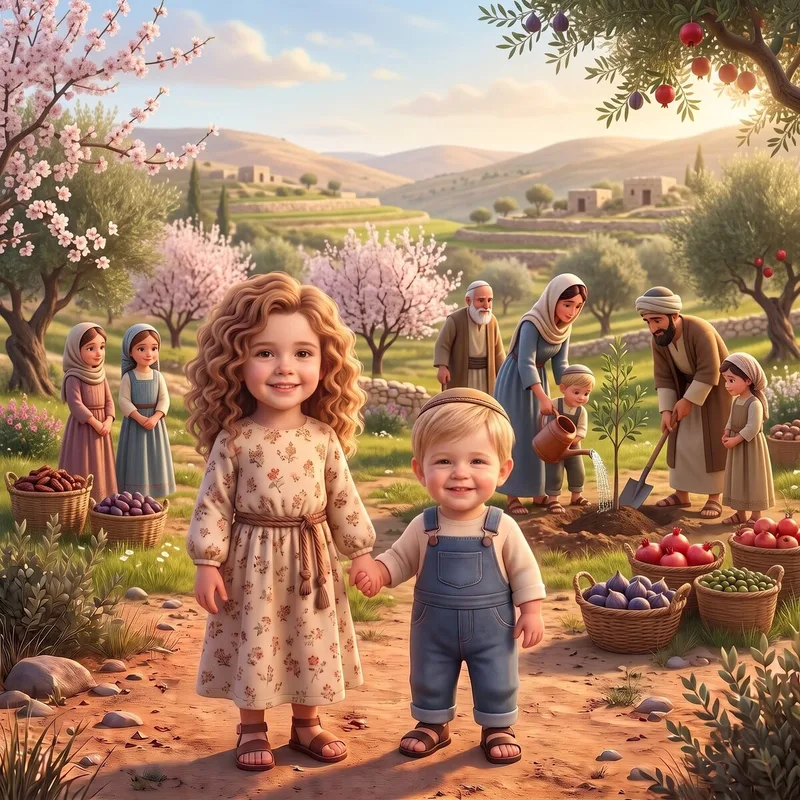
Torah Tale makes a Tu B'Shvat storybook in the Holidays collection, starring your child. Their name and, from one uploaded photo, their likeness appear on every page, illustrated in 3D animated-film style. Seeing themselves in the story makes the holiday personal rather than a name on the calendar.
The book ends with a discussion page of 10 questions that mix comprehension with middos. It asks what happened, and what it asks of the child. That page is what carries the book from bedtime to the table. If you add parents, grandparents or other relatives with their photos, they appear with the children on a closing family page, in every format. Softcover and hardcover books open with a dedication page.

Softcover 8″×8″

Hardcover 8″×8″

Board book 6″×6″

Coloring book 8.5″×11″
There are three formats: a 6x6 board book with rounded safety corners for ages 0-4, an 8x8 softcover for ages 4-8, and an 8x8 hardcover for ages 5-18. Up to eight siblings can appear in the same book. There is also an optional matching 8.5x11 coloring book in black-and-white line art. It is a weekday activity only, for the days before Tu B'Shvat or any ordinary afternoon, never for Shabbos or Yom Tov. The storybook itself is a gift that works on Shabbos, since reading is always appropriate. If Tu B'Shvat falls on Shabbos, it is a lovely book to read at the table.
What can we do at the table and during the week for Tu B'Shvat?
Put out a few fruits, make the brachos together, and ask questions that get children talking. Here are some to try:
- Which fruit are you most looking forward to, and what is the bracha on it?
- Who planted the trees we enjoy today?
- Why did the old man plant a tree he would not eat from?
- What is something small that you can start now that will grow over time?
- What are the roots in your day that nobody sees?
On a weekday, you can plant a seed or herb in a pot, or draw a tree with fruits that each stand for a good middah. These are weekday activities only. If the day falls on Shabbos, do them before or after. You can also tell the carob story to a grandparent when you next see them, and ask what they planted for you.
Tu B'Shvat comes in the cold of winter, which is the point: the growth is happening before we can see it. When you are ready, create the book. It takes about five minutes, with a free account and a few short questions: each child's name, boy or girl, age and one photo, any siblings, the story, your community (asked once), the language and the printed format. Languages are English, Hebrew and Yiddish.
Frequently asked questions
What is Tu B'Shvat in simple words for a child?
Tu B'Shvat is the 15th of Shvat, the birthday of the trees. We eat fruit, make brachos and thank Hashem for the food that grows from the ground. It is a day to notice that every fruit began as something small and grew with time.
Why do we eat fruit on Tu B'Shvat?
The Mishnah calls this day the new year for trees, and the widespread minhag is to mark it by eating fruits and saying a bracha on them. Many people include the fruits Eretz Yisrael is praised for in the Torah, such as grapes, figs, pomegranates, olives and dates. Eating them with a bracha is a way of saying thank you to Hashem.
What is the lesson of Tu B'Shvat for kids?
One lesson is gratitude: the fruit on our table is a gift, so we say a bracha. Another is patience and caring for the future, as in the Gemara's story of the old man who planted a carob tree for his children. A third is that growth takes roots, and for a child roots can mean learning, tefillah and kind habits.
How do I explain Tu B'Shvat to a 3-year-old?
Keep it to one sentence and something to hold: 'Today is the birthday of the trees, and we thank Hashem for fruit.' Let your child look at, smell and taste a fruit, and say the bracha Borei pri ha'eitz together. Little ones learn the day through the fruit in their hand.
Can we plant trees or do Tu B'Shvat crafts on Shabbos?
No. Planting, drawing, coloring and crafts are melacha, so do them on a weekday before or after. Eating fruit, singing, reading a book and talking at the Shabbos table are all fine. When Tu B'Shvat falls on Shabbos, ask your rav about any question on how to mark the day.
Is there a Tu B'Shvat book for kids with my child in it?
Yes. Torah Tale makes a personalized Tu B'Shvat book in the Holidays collection, with your child's name and likeness illustrated in 3D animated-film style. Every book ends with a discussion page of 10 questions about the story, mixing comprehension with middos.