Rabbi Shimon bar Yochai for Kids: The Cave, the Carob Tree & the Myrtle
Rabbi Shimon bar Yochai hid in a cave to learn Torah, then learned what Torah asks of us in the world. Here is the story from the Gemara, the lesson, and how to tell it to a 4-year-old, ages 6 and 7, and ages 9 to 12.
Published by Torah Tale.
Create this book for your child
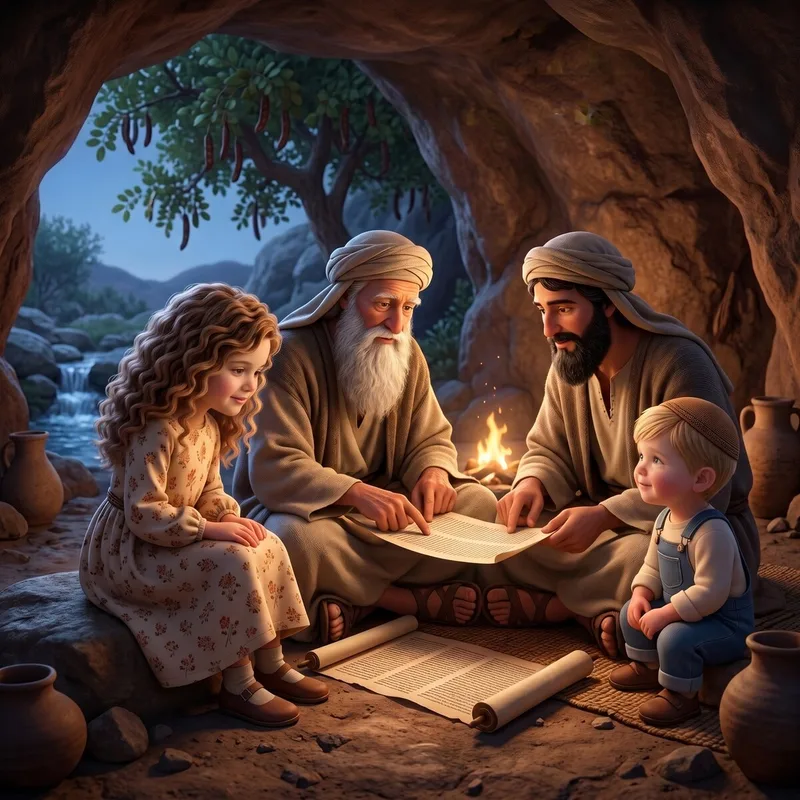
Rabbi Shimon bar Yochai was a Tanna and a talmid of Rabbi Akiva, and the Gemara tells us that he spent twelve years hidden in a cave with his son, Rabbi Elazar, learning Torah. Children connect with this story because it has a cave, a tree that appeared just for them, a spring of water, and a quiet Friday afternoon scene that makes a very big idea feel small and warm.
Who was Rabbi Shimon bar Yochai?
Rabbi Shimon bar Yochai lived in the time of the Tannaim, the Sages of the Mishnah. He learned from Rabbi Akiva, whose own story of starting to learn at forty is told in our article on Rabbi Akiva for kids. He is often called Rashbi, from the first letters of his name.
Many Yidden remember him on Lag BaOmer, the 18th of Iyar, and celebrate in his zechus by minhag. A child who has seen bonfires on Lag BaOmer is often glad to learn who the day is connected with.
What happened in the cave?
The Gemara in Maseches Shabbos (33b) tells us that the Roman government decreed against Rabbi Shimon, and he went into hiding with his son, Rabbi Elazar. They found a cave and stayed there to learn Torah.
The Gemara says that a carob tree and a spring of water were created for them. They ate from the tree and drank from the spring, so they could spend the whole day learning.
The Gemara adds a detail children love: to save their clothes from wearing out, they sat covered in sand up to their necks while they learned. When it was time to daven, they put their clothes on. They stayed in the cave for twelve years.
What happened when they came out?
The Gemara tells us that Eliyahu HaNavi came to the entrance of the cave and announced that the emperor had died and the decree was canceled. Rabbi Shimon and Rabbi Elazar came out.
Outside, they saw people plowing and sowing. After twelve years of learning Torah all day, they said that these people were putting aside eternal life and busying themselves with temporary life. The Gemara says that wherever they looked was burned. A bas kol, a heavenly voice, asked whether they had come out to destroy Hashem's world, and told them to go back to the cave. They stayed another twelve months.
Then the bas kol told them to come out. This time Rabbi Elazar still struck, but Rabbi Shimon healed. He said to his son, 'You and I are enough for the whole world.'
Then comes the part many children remember best. On erev Shabbos, as the sun was about to set, they saw an old man running with two bundles of myrtle. They asked him what they were for, and he said, 'To honor Shabbos.' When they asked why two, he said that one was for zachor and one was for shamor. Rabbi Shimon said to his son, 'See how dear the mitzvos are to Yisrael.' The Gemara says that their minds were calmed.
What is the lesson for children?
There is more than one lesson here, so pick the one that fits your child.
- Torah is worth giving everything for. Rabbi Shimon and his son spent twelve years doing nothing but learning and davening.
- Learning Torah changes how we look at people. The Gemara shows that Rabbi Shimon had to be sent back and learn more before he came out ready to heal.
- No mitzvah is small. The old man in the story is not a great scholar. He is simply running home with myrtle for Shabbos, and Rabbi Shimon sees how precious that is to Hashem.
The lesson about Shabbos fits well with the Shabbos story for kids, if you want a companion read.
How do I explain it to a 4-year-old, ages 6 and 7, and ages 9 to 12?
A 4-year-old. Tell it as a picture story: a cave, a carob tree, a spring, and a father and son learning Torah together. Finish with the old man and the myrtle. Skip the fire completely, since the cave and the Shabbos ending are enough.
Ages 6 and 7. Add the twelve years and Eliyahu HaNavi coming to say the decree was over. You can mention that when Rabbi Shimon and Rabbi Elazar came out, they were upset, and Hashem sent them back to learn more. Then ask what they might have learned from the old man.
Ages 9 to 12. These children can handle the real question: how can someone love Torah so much and still need to learn how to look at people who work in the world? You can tell it straight from the Gemara in Shabbos 33b-34a, including the bas kol and the twelve months. Ask them where they see the change between the first time out of the cave and the last.
What can we ask at the Shabbos table?
Rabbi Shimon's story has a Shabbos ending, so it is a natural fit for the table. These are talking questions only, with no writing or drawing needed.
- Why do you think Hashem created a carob tree and a spring for Rabbi Shimon and Rabbi Elazar?
- What did Rabbi Shimon say about the people who were plowing and sowing, and why did the bas kol send him back?
- Why was the old man with the myrtle running?
- What mitzvah do you do that looks small, but is really precious to Hashem?
- What does it mean that Rabbi Shimon healed?
Each Torah Tale book ends with a dedicated discussion page of ten questions that mix comprehension with middos, so the book itself gives you this kind of conversation. It turns the story from something read to a child into something talked about at the table.
What is a personalized book about Rabbi Shimon bar Yochai like?
In a Torah Tale book, your child is the hero. Their name and, from one uploaded photo, their likeness appear on every page, illustrated in 3D animated-film style. Up to eight children can appear in the same book, ages 0 to 18. The Rabbi Shimon bar Yochai book is part of the Stories of Tzaddikim category, written with careful rabbinical guidance and strict tznius, and reviewed by our team before it goes to print.

Softcover 8″×8″

Hardcover 8″×8″

Board book 6″×6″

Coloring book 8.5″×11″
There are three formats. The 6"x6" board book with rounded safety corners is for ages 0-4. The 8"x8" softcover photo book is for ages 4-8, and the 8"x8" hardcover photo book is for ages 5-18. Softcover and hardcover open with a dedication page. If you add parents, grandparents and other relatives with their photos, they appear with the children on a closing family page in every format.
You can also add a matching 8.5"x11" black-and-white coloring book. It is a weekday activity, for an afternoon during the week or erev Shabbos, never for Shabbos or Yom Tov. The storybook itself is exactly right to read on Shabbos. Languages are English, Hebrew and Yiddish.
If your child likes this story, you might also enjoy Rabbi Meir for kids, about another talmid of Rabbi Akiva.
Creating the book needs a free account and a few short questions: each child's name, boy or girl, age and one photo, any siblings, the story, your community (asked once), the language and the printed format. It takes about five minutes. When you are ready, you can create the book.
Frequently asked questions
Who was Rabbi Shimon bar Yochai?
Rabbi Shimon bar Yochai was a Tanna, one of the Sages of the Mishnah, and a talmid of Rabbi Akiva. He is known for the twelve years he and his son Rabbi Elazar spent hidden in a cave, learning Torah. Many Yidden also remember him on Lag BaOmer, the 18th of Iyar, by minhag.
Why did Rabbi Shimon bar Yochai hide in a cave?
The Gemara in Maseches Shabbos (33b) tells us that the Roman government decreed against him after he spoke about their rule. He and his son went into hiding, and in the cave they learned Torah for twelve years. A carob tree and a spring of water were created for them there.
What is the lesson of Rabbi Shimon bar Yochai and the cave?
One lesson is that Torah learning is precious, and also that a talmid chacham has to look at Hashem's world with patience. The Gemara shows Rabbi Shimon being sent back to the cave and coming out ready to heal. The scene with the myrtle shows how much Yidden love even a single mitzvah.
How do I explain Rabbi Shimon bar Yochai to a 4-year-old?
Keep it to the pictures: a cave, a tree with carobs, a spring, and a father and son learning Torah all day. Then add the happy ending, an old man running home for Shabbos with two bundles of myrtle. You can say, 'Rabbi Shimon saw how much Yidden love Shabbos, and it made him happy.'
Can my child read a Rabbi Shimon bar Yochai book on Shabbos?
Yes, reading a storybook is entirely appropriate on Shabbos and Yom Tov, and the myrtle scene fits well at a Shabbos table. Coloring, drawing and writing are melacha, so the optional matching coloring book is for a weekday afternoon or erev Shabbos.
How do I order a personalized book about Rabbi Shimon bar Yochai?
Start at torahtale.com/create with a free account and a few short questions: each child's name, boy or girl, age, one photo, any siblings, the story, your community (asked once), the language and the printed format. Languages are English, Hebrew and Yiddish. The whole flow takes about five minutes.