Dovid & Yonasan for Kids: A Friendship That Never Depended on Anything
Yonasan, the king's son, loved Dovid like himself and stood by him when his own father turned against Dovid. Here is the story, the lesson, and how to share it with your child.
Published by Torah Tale.
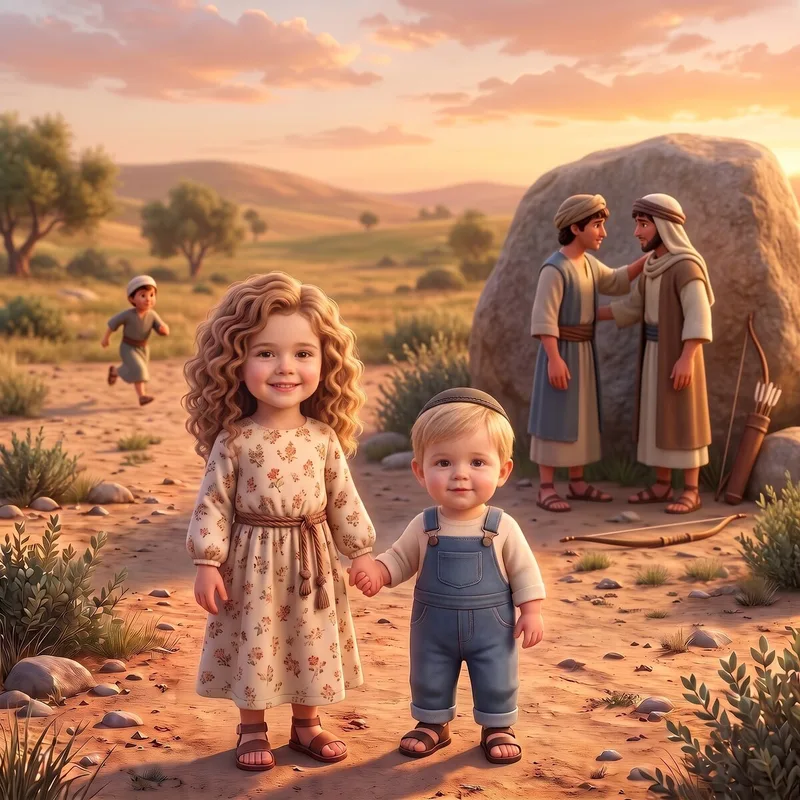
Create this book for your child
The story of Dovid and Yonasan, told in Sefer Shmuel, is a well-known account of friendship in Tanach. Yonasan, the king's son, loves Dovid as his own soul, speaks up for him, warns him, and makes a bris with him. Children connect to it because it is about a friend who stays loyal even when staying loyal costs him something.
What happens in the story of Dovid and Yonasan?
After Dovid's victory over Golyas (you can read that story in Dovid & Golyas for Kids), Dovid finished speaking with King Shaul. The pasuk tells us that the soul of Yonasan was bound up with the soul of Dovid, and that Yonasan loved him as his own soul (Shmuel I 18:1). Yonasan made a bris with Dovid, and he took off his me'il and gave it to Dovid, along with his clothes, his sword, his bow and his belt (18:3-4).
Then trouble began. When the women sang the praises of Dovid after the battles, Shaul became angry and kept a watchful eye on him. One day, while Dovid was playing music for him, Shaul threw his spear, and Dovid stepped aside.
Yonasan told Dovid to hide, and he spoke well of Dovid to his father. He reminded Shaul that Dovid had risked his life for Yisrael, and Shaul swore that Dovid would not be put to death (Shmuel I 19:4-6). The peace did not last.
Dovid came to Yonasan and said there was only a step between him and death. They made a plan around the Rosh Chodesh meal, where Dovid's seat would be empty. Yonasan would find out how Shaul reacted, and he would tell Dovid with a signal. If he called to the boy fetching the arrows that they were on this side of him, there was shalom. If he called that they were beyond him, Hashem was sending Dovid away.
Shaul reacted with anger, and Yonasan asked his father why Dovid should be put to death and what he had done. Yonasan understood that his father had decided to harm Dovid. The next morning he went out to the field with a boy, shot an arrow beyond him, and called that it was beyond him.
Dovid came out from his hiding place and bowed to Yonasan three times. They kissed and wept, and Dovid wept even more. Yonasan said, "Go in peace," for the two of them had sworn in the name of Hashem.
Later Yonasan came to Dovid at Choresh and strengthened his hand in Hashem. He told Dovid not to be afraid because Shaul would not find him. He said that Dovid would be king over Yisrael and that he, Yonasan, would be second to him (Shmuel I 23:16-18).
What is the lesson of Dovid and Yonasan's friendship?
Pirkei Avos teaches that love that depends on something ends when that thing ends, while love that does not depend on anything never ends. As its example of love not dependent on anything, the Mishnah gives the love of Dovid and Yonasan.
The pesukim show what this looked like in practice. Yonasan gave Dovid his own clothes and weapons, and he spoke up for Dovid in front of his father. He also told Dovid the truth when it was hard to hear.
It also cost him. Shaul said to Yonasan that as long as the son of Yishai lived, neither Yonasan nor his kingdom would be established (20:31). Still, Yonasan told Dovid that he would be king and he would be second.
There is a second part. Years later, in Shmuel II chapter 9, Dovid asked whether anyone was left of the house of Shaul so that he could do chesed for Yonasan's sake. He brought Mefivoshes, Yonasan's son, to eat at his table always. The pasuk in chapter 21 says that Dovid spared Mefivoshes because of the oath the two of them had sworn in the name of Hashem.
How do I explain Dovid and Yonasan to a 4-year-old and a 9-year-old?
For a child of three or four, one idea is enough: Yonasan was a good friend. Show how he gave Dovid his special clothes, and ask, "Who helps you when something is hard?" There is no need to go into Shaul's anger beyond saying that the king was upset with Dovid and Yonasan helped his friend stay safe.
For a child of six to eight, the arrows are the hook. Children love a secret signal. Tell it as a story with the plan, the field, the arrow and the goodbye, then ask what they would be willing to do for a friend and whether it would still be easy if it cost them something.
For a child of nine to twelve, bring in more of the text. Yonasan was the king's son, and the pasuk records Shaul's words that Dovid's life threatened Yonasan's own kingdom. Read the Mishnah in Pirkei Avos together and ask what love that does not depend on anything looks like. You can add Mefivoshes as the chapter showing that a bris between friends continues for the next generation.
What questions can we ask at the Shabbos table about Dovid and Yonasan?
A story is easy to read aloud on Shabbos, and these questions need only talking:
- What did Yonasan give Dovid, and why do you think he gave it?
- Why did Yonasan speak up for Dovid in front of his father?
- Why did they need a secret signal with the arrows?
- Yonasan told Dovid that Dovid would be king. What does it take to be happy for a friend's success?
- How did Dovid keep his promise to Yonasan years later?
- Who is a friend who stays with you when things are hard, and how can you be that friend this week?
What is a personalized book of Dovid and Yonasan like?
Torah Tale's Dovid and Yonasan book is in the Nevi'im collection. Your child's name and, from one uploaded photo, their likeness appear on every page, illustrated in 3D animated-film style. Up to eight children can appear in one book, ages 0 to 18, so siblings can share it.

Softcover 8″×8″

Hardcover 8″×8″

Board book 6″×6″

Coloring book 8.5″×11″
There are three formats. The 6x6 board book with rounded safety corners is for ages 0-4. The 8x8 softcover photo book is for ages 4-8, and the 8x8 hardcover photo book is for ages 5-18. Softcover and hardcover open with a dedication page. If you add parents and grandparents with their photos, they appear with the children on a closing family page in every format.
Every book ends with a discussion page of 10 questions that mix comprehension with middos: what happened, and what it asks of the child. That is what turns the book from something read to a child into something talked about at the table. Each book is written with careful rabbinical guidance and strict tznius, and reviewed by our team before it goes to print.
Creating one takes a free account and a few short questions: each child's name, boy or girl, age and one photo, any siblings, the story, your community (asked once), the language and the format. Languages are English, Hebrew and Yiddish. If you want help with the steps, see how to create a personalized Torah storybook.
What can we do with the story during the week?
Pick a friend for your child to do something for. A child can make a card for a friend on a weekday afternoon, or deliver something small before Shabbos. Talk about how Yonasan gave Dovid something of his own.
The optional matching coloring book is 8.5"x11" in black-and-white line art. It is a weekday activity, for erev Shabbos, a weekday afternoon or Chol HaMoed, and never for Shabbos or Yom Tov. The storybook itself is right for Shabbos and Yom Tov.
If your child enjoyed this story, continue with the story of the birth of Shmuel and Chana's tefillah, which comes first in Sefer Shmuel. When you are ready, you can create the book starring your own child.
Frequently asked questions
What is the lesson of Dovid and Yonasan?
The main lesson is loyal friendship that does not depend on what a person can give you. Pirkei Avos points to the love of Dovid and Yonasan as love that does not depend on anything, and so it never ends. Yonasan also teaches us to stand up for a friend, to tell the truth, and to be happy for another person's success.
Where is the story of Dovid and Yonasan in Tanach?
It is in Sefer Shmuel, in Nevi'im. The friendship begins in Shmuel I chapter 18, continues through chapters 19 and 20 with the arrows, and returns in chapter 23 when Yonasan strengthens Dovid at Choresh. Dovid keeps the bris years later in Shmuel II, chapter 9.
How do I explain Dovid and Yonasan to a 4-year-old?
Keep it to one idea: Yonasan was a real friend who helped Dovid when Dovid was in trouble. You can say that Yonasan gave Dovid his own special clothes, and that when Dovid had to go away, they said goodbye and promised to look after each other. Then ask who helps your child when something is hard.
What was the arrow signal between Dovid and Yonasan?
Dovid hid in the field while Yonasan found out whether King Shaul meant him harm. Yonasan told Dovid beforehand that he would shoot arrows and call out to the boy who fetched them: if he called that the arrows were on this side of the boy, there was peace, and if he called that they were beyond the boy, Hashem was sending Dovid away. Yonasan shot an arrow beyond the boy and called that it was beyond him, so Dovid understood.
Why did Yonasan help Dovid against his own father?
The pesukim show that Yonasan first spoke well of Dovid to Shaul and reminded him what Dovid had done for Yisrael, and Shaul swore he would not harm him. Later Yonasan asked his father why Dovid should be killed and what he had done, and then understood that Shaul had decided to harm him. Yonasan tried for peace, and he would not abandon his friend to danger.