A Chanukas HaBayis (חנוכת הבית) for Kids: Dedicating a New Home
A chanukas habayis is the simcha of dedicating a new home to Hashem and Torah. Here is how to explain it to children, with ideas for ages 3-4, 5-7 and 8-12.
Published by Torah Tale.
Create this book for your child
A chanukas habayis is the simcha of dedicating a new home, a moment when a family thanks Hashem for their house and decides what will go on inside it. Children love it because it is concrete: boxes, a new door, a mezuzah, guests, singing and good food. It is also an easy way to teach them that a home is a place with a purpose.
What is a chanukas habayis?
The words mean the dedication of the house. When a family moves into a new home, they mark it with a gathering, often with relatives, neighbors and friends. There are different minhagim about how it is done, but the heart of it is the same everywhere: we thank Hashem and ask that this house be filled with Torah, tefillah and chesed.
For a child, this may be the first time they hear that a building can be dedicated. A house is not just where you sleep, it is where Shabbos is kept, where brachos are said, and where guests are welcome.
Where does the idea of dedicating a house come from?
The Torah itself speaks about it. In Parshas Shoftim, in the laws of going out to war, the pasuk asks who is the man who built a new house and has not yet dedicated it, and says he should go back to his home (Devarim 20:5). So the Torah already treats dedicating a house as something that matters.
The word chanukah, from the same root, is also used in the Torah for the dedication of the mizbeach in the Mishkan (Bamidbar 7:84, in Parshas Naso). And the title of Tehillim 30 is Mizmor Shir Chanukas HaBayis L'Dovid. Many people say this mizmor at a chanukas habayis, and we also say it each morning in tefillah.
What happens at a chanukas habayis, from a child's point of view?
Children usually see the following, though every family does it a little differently:
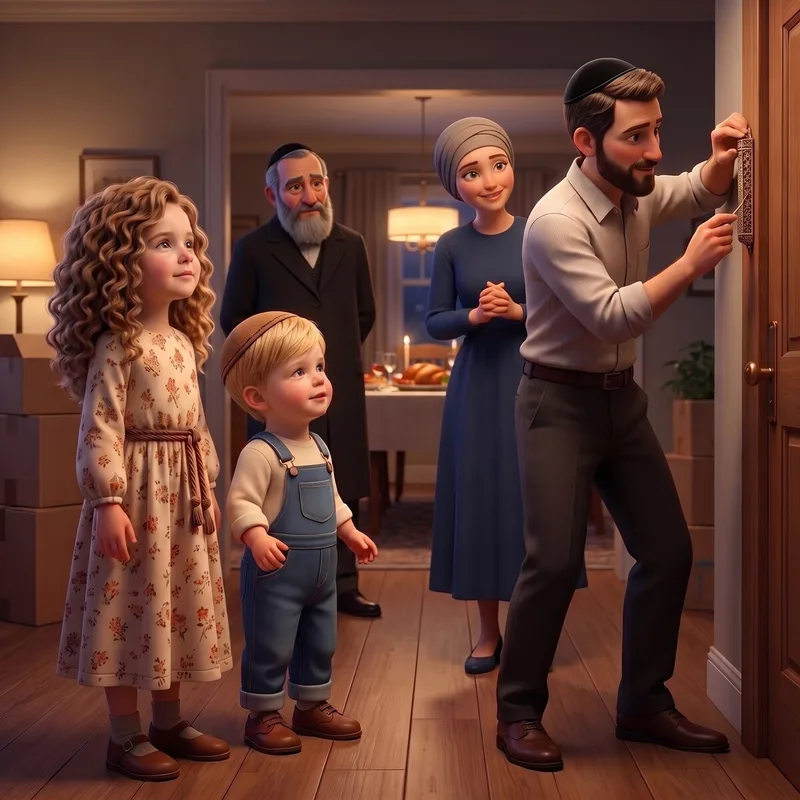
- The mezuzah. The Torah says to write the words of the Shema on the doorposts of your house (Devarim 6:9). The parchment is handwritten by a sofer, and affixing it is a defining moment for a new home. For exact timing and the bracha, ask your rav.
- Guests. Family and friends come to be happy with you. This is a lovely chance to show a child hachnasas orchim in action, like in our article on welcoming guests.
- Tehillim and a dvar Torah. Many families say Tehillim 30 and someone shares a short thought about the new home.
- Singing and a meal. The simcha is shared, and children remember the singing for a long time.
What is the middah behind a chanukas habayis?
The first middah is hakaras hatov. A new home is a gift, and we say thank you to Hashem before we start enjoying it. If your child is learning to say thank you, our article on teaching hakaras hatov goes well with this story.
The second is deciding who we want to be inside these walls. A family can say out loud, 'In our house we speak kindly, we make room for guests, we keep Shabbos.' Children take this seriously when they hear it from their parents.
How do I explain it to a 3-year-old, a 6-year-old and a 10-year-old?
Ages 3-4. Keep it to one sentence and something they can see. 'This is our new house. We say thank you to Hashem, we put up the mezuzah, and our friends come to sing with us.' Let them point to the mezuzah and give it a kiss when they pass it. A toddler cannot follow ideas, but they can feel that the day is special.
Ages 5-7. Add the idea of a promise. 'A house is just walls until we fill it with good things. What do we want to do in this house?' Children this age usually have a long list: Shabbos, guests, bentching. Write it down together on a weekday and read it back later.
Ages 8-12. Bring them to the pesukim. Show them Devarim 20:5 and the title of Tehillim 30, and ask why the Torah cares about dedicating a house at all. Older children can also take a small role in the simcha, like welcoming guests at the door or sharing a short thought.

Softcover 8″×8″

Hardcover 8″×8″

Board book 6″×6″

Coloring book 8.5″×11″
What is the Torah Tale book A Chanukas HaBayis like?
A Chanukas HaBayis is part of Torah Tale's Jewish Life collection, which covers the simchos and minhagim of a Yiddishe life. Like every Torah Tale book, it is personalized: your child's name and, from one uploaded photo, their likeness appear on every page, illustrated in high-resolution 3D animated-film style. Up to eight siblings, ages 0 to 18, can appear in the same book.
Every book ends with a discussion page of 10 questions about the story, mixing comprehension with middos: what happened, and what it asks of the child. If you add parents, grandparents and other relatives when you create the book, they appear with the children on a closing family page in every format. That works well for a story about a family and its home.
The formats are chosen by age: a board book with rounded safety corners, 6x6, for ages 0-4; an 8x8 softcover for ages 4-8; and an 8x8 hardcover for ages 5-18. The softcover and hardcover open with a dedication page, which makes the book a natural gift for a family that has just moved. An optional matching coloring book, in black-and-white line art, can be added as a one-time extra. It is for weekdays, such as a quiet afternoon during the week, and not for Shabbos or Yom Tov.
The book itself is written with careful rabbinical guidance and strict tznius, and reviewed by our team before it goes to print. Reading it at the Shabbos table, or on a Shabbos afternoon, is entirely appropriate.
What can we talk about at the Shabbos table?
These are for talking only, so no pens or paper are needed. You could start with a few of the following, adjusting to your child's age:
- What is the first thing you notice when you walk into our home?
- Why do we put a mezuzah on the door?
- Who would you like to invite to our house, and what would you want them to feel here?
- What is one thing we do in this house that makes it a Jewish home?
- What are we thankful to Hashem for about where we live?
- How can you help a guest feel at home when they come over?
If a family has not just moved, these questions are still worth asking. A chanukas habayis is really a question about any home: what is it for?
What if our home is not new?
Then you can still use the story. Children can talk about how they would want to dedicate their own rooms, their table, their doorway. The Beis HaMikdash was also dedicated and later rebuilt, and our article on building the second Beis HaMikdash shows how much Yidden cared about the place where Hashem's presence rests. A home is not the Mikdash, but the same love of a holy place is something children can learn from.
When you are ready, you can create the book. It takes about five minutes: a free account and a few short questions, covering each child's name, boy or girl, age and one photo, any siblings, the story, your community (asked once), the language and the format.
Frequently asked questions
What is a chanukas habayis?
A chanukas habayis is a gathering to dedicate a new home. Many families invite relatives and friends, say Tehillim, share a dvar Torah and sing together. Its purpose is to begin the home's life with Torah and simcha.
How do I explain a chanukas habayis to a 4-year-old?
You can say, 'This is our new house, and today we tell Hashem thank you for it.' Then point to what the child can see, like the mezuzah on the door and the people coming to be happy with you. Young children understand a simple picture of thanking, singing and welcoming guests.
Does a chanukas habayis have to include a mezuzah?
Putting up mezuzos is a central mitzvah of a new home, as the Torah says to write the words on the doorposts of your house (Devarim 6:9). The timing and the bracha depend on your situation, including whether the home is in Eretz Yisrael or outside it, so ask your rav. Many families gather for the simcha around the same time.
What is the lesson of a chanukas habayis for children?
The lesson is that a home is more than walls and furniture. We thank Hashem for it, and we decide what kind of home it will be: one with open doors for guests, kind words, Shabbos and Torah learning.
Can a child get a personalized book about a chanukas habayis?
Yes. Torah Tale makes A Chanukas HaBayis as a personalized storybook in the Jewish Life collection, with your child's name and likeness in 3D animated-film style. You can order it as a softcover (ages 4-8), a hardcover (ages 5-18) or a board book with rounded safety corners (ages 0-4), in English, Hebrew or Yiddish.