A Bracha on a Rainbow (ברכות הראייה) for Kids: Words & Meaning
When a child spots a rainbow, there is a bracha ready: zocher habris, v'ne'eman bivriso, v'kayam b'ma'amaro. Here are the words, their meaning, the source in Parshas Noach, and ways to teach it to a 3-4 year old, a 5-7 year old and an older child.
Published by Torah Tale.
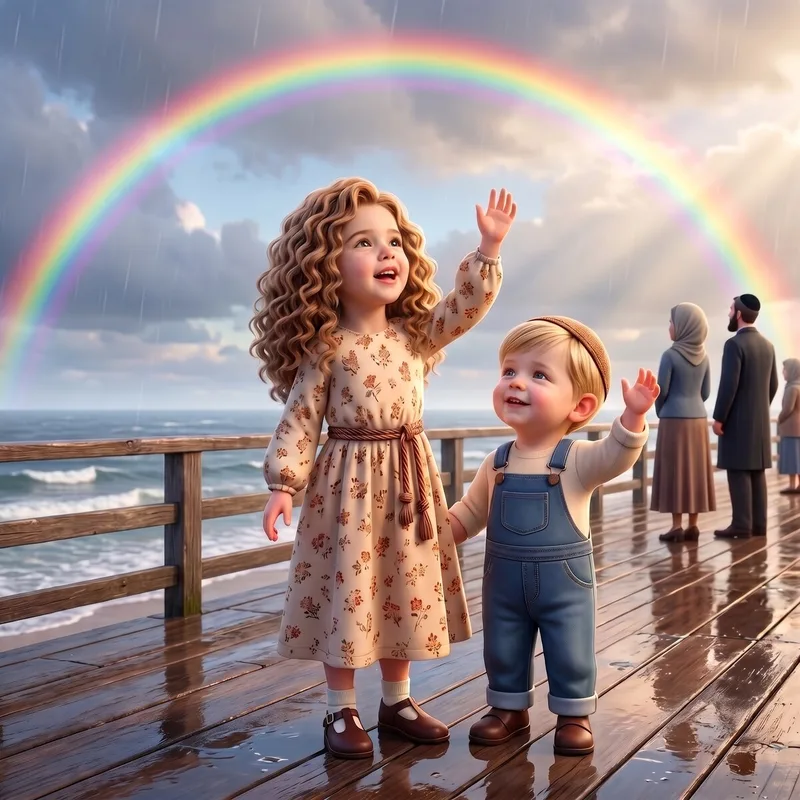
Create this book for your child
The bracha on a rainbow is said when you see one: zocher habris, v'ne'eman bivriso, v'kayam b'ma'amaro, thanking Hashem who remembers His covenant, is faithful to it and fulfills His word. Children take to it quickly because a rainbow is something they can spot themselves, and the bracha turns a moment of wonder into a mitzvah they do on their own.
What is the bracha on a rainbow, and what do the words mean?
The full bracha is a short one, and it is one of the birchos hareiyah, the brachos we say on seeing certain things. The source is in Maseches Berachos, and the halacha is brought in the Shulchan Aruch, Orach Chaim 229.
ברוך אתה ה' אלקינו מלך העולם, זוכר הברית, ונאמן בבריתו, וקיים במאמרו.
In English: Blessed are You, Hashem, our G-d, King of the world, who remembers the covenant, is faithful to His covenant, and fulfills His word. There are only a few phrases after the usual opening, so a young child can learn it a piece at a time.
Where does the rainbow come from in the Torah?
The story is in Parshas Noach. After the Mabul, the Torah tells us that Hashem set His bow in the cloud as a sign of the covenant between Him and the earth. The pasuk also says that when the bow appears in the cloud, Hashem will remember His covenant, and that there will never again be a flood to destroy all flesh (Bereishis 9:13-15).
That is why the words of the bracha speak about a covenant. For a child, the simplest way to put it is this: Hashem made a promise, and the rainbow reminds us that He keeps it. If your child is learning the whole parsha, see Parshas Noach for Kids, and for a midrash about life in the teivah, Noach Feeds Every Animal in the Teivah.
Should a child look at the rainbow for a long time?
Chazal teach in Maseches Chagigah that one should not stare at a rainbow. So the practice is to see it, say the bracha, and not keep gazing. It helps to tell children this ahead of time in a friendly way: we look, we say thank you, and then we let the rainbow be.
If you have a specific question, such as whether to say the bracha on a rainbow in a photo or a painting, ask your rav. Details like these are best answered by someone who can ask you follow-up questions.
How do I explain the bracha on a rainbow to a 3 to 4 year old, a 5 to 7 year old and an older child?
Ages 3 to 4. Use one sentence: when we see a rainbow, we say a bracha to thank Hashem for keeping His promise. Say the words with your child, a phrase at a time, and let them point out the colors you see before you say the bracha. Praise them for noticing, since the noticing is what starts the mitzvah.
Ages 5 to 7. Tell the short version of Noach: the water covered the earth, Noach came out of the teivah, and Hashem promised there would never be another flood. Then ask, 'What do you think a promise is for?' Children this age love to connect the story to their own promises and to the promises people make to them.
Ages 9 to 12. Go to the words themselves. Ask what 'remembers', 'is faithful' and 'fulfills His word' each add, and why Chazal gave us a bracha for a sight that is beautiful and also tied to a covenant. Older children can also learn about the other birchos hareiyah and why a bracha comes at the moment you see something, not later. For a wider look at why we say brachos at all, see Making a Bracha for Kids.
What is a personalized Torah Tale book about the bracha on a rainbow like?
It is in the Mitzvos collection, which is set in everyday life today, so the mitzvah is shown as something a child does in an ordinary day. Your child is the hero: their name and, from one uploaded photo, their likeness appear on every page in 3D animated-film style. You can include up to eight children, ages 0 to 18, in the same book.
The book is written with careful rabbinical guidance and strict tznius, and our team reviews it before it goes to print. Every book ends with a dedicated discussion page of ten questions that mix comprehension with middos, so the story turns into a conversation at the table. If you add parents, grandparents and other relatives with their photos, they appear with the children on a closing family page in every format.
The formats are a 6"x6" board book with rounded safety corners (ages 0-4), an 8"x8" softcover (ages 4-8) and an 8"x8" hardcover (ages 5-18). The softcover and hardcover open with a dedication page. An optional matching coloring book in black-and-white line art is a one-time add-on, and it is a weekday activity only: erev Shabbos, a weekday afternoon or Chol HaMoed. A page of rainbow colors on a weekday afternoon is a lovely way to bring the bracha back to mind.

Softcover 8″×8″

Hardcover 8″×8″

Board book 6″×6″

Coloring book 8.5″×11″
What questions can we ask at the Shabbos table?
Reading is entirely appropriate on Shabbos, and talking is even better. These questions need nothing but conversation:
- When did you last see a rainbow? Where were you?
- What does it mean that Hashem keeps His promises?
- Why do we say a bracha when we see a rainbow, and not only enjoy it?
- Why do we look at a rainbow only for a moment?
- Which promise would you like to keep this week?
Let the youngest answer first, and let an older sibling add the pasuk from Noach. Everyone at the table gets a turn, and the questions are open enough that a child of four and a child of eleven can answer the same one in different ways. A family that already has the book can read it aloud at the table and let the discussion page lead the conversation.
When you are ready for your child's own copy, create the book: it takes about five minutes, with a free account and a few short questions about each child, the story, your community, the language and the format.
Frequently asked questions
What bracha do you say when you see a rainbow?
You say Baruch Atah Hashem Elokeinu Melech HaOlam, zocher habris, v'ne'eman bivriso, v'kayam b'ma'amaro. It means that Hashem remembers the covenant, is faithful to His covenant and fulfills His word. The source is Maseches Berachos and it is brought in the Shulchan Aruch, Orach Chaim 229.
Why do we say a bracha on a rainbow?
The rainbow is the sign of the covenant Hashem made after the Mabul, that there would never again be a flood to destroy the earth. The Torah tells this in Parshas Noach. The words of the bracha thank Hashem for keeping that promise.
Should a child look at a rainbow for a long time?
Chazal teach in Maseches Chagigah that one should not stare at a rainbow. The practice is therefore to look just long enough to say the bracha. If your child has a question about the details, ask your rav.
How do I explain the bracha on a rainbow to a 4-year-old?
Keep it to one sentence: when Hashem makes a rainbow, we say a bracha to thank Him for keeping His promise. Let your child say the words with you, a phrase at a time, and point out that a rainbow is something we only see sometimes, which is why we stop to say thank you.
Is there a Torah Tale book about the bracha on a rainbow?
Yes, it is in the Mitzvos collection, which is set in everyday life today. Your child's name and likeness, made from one uploaded photo, appear throughout in 3D animated-film style, and every book ends with a discussion page of ten questions mixing comprehension with middos. You start at torahtale.com/create with a free account and a few short questions.
What if we are not sure whether to say the bracha in a particular situation?
For situations such as a rainbow seen in a picture, or any other specific question, ask your rav. This article gives the general bracha and its meaning, not a ruling on every case.