A Bar Mitzvah (בר מצווה) for Kids: What It Means & Why Thirteen
What a bar mitzvah is, why thirteen, what happens on the day, how to explain it to younger children, and what a personalized Torah Tale book about it is like.
Published by Torah Tale.
Create this book for your child
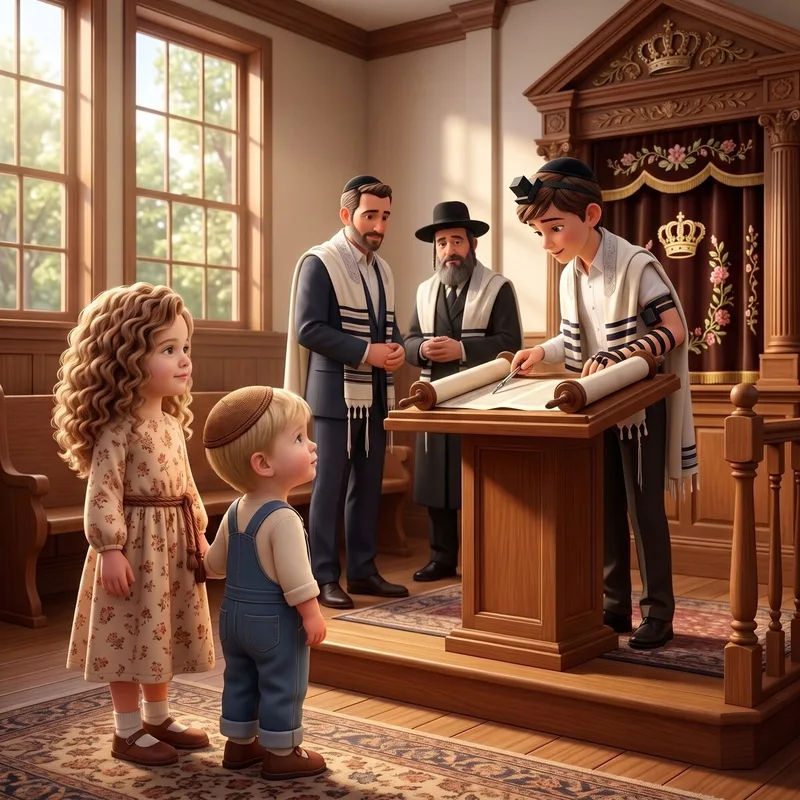
A bar mitzvah is the day a Jewish boy reaches the age of thirteen and becomes obligated in the mitzvos himself; a girl reaches the same point at twelve and is called a bas mitzvah. Children are drawn to it because it is a milestone they can see coming: an older brother starts to put on tefillin, a cousin is called up to the Torah, and the whole family gets dressed for a simcha. Torah Tale's A Bar Mitzvah, from the Jewish Life collection, puts your own child into that picture.
What is a bar mitzvah, in words a child understands?
You can say it like this: a bar mitzvah is when a boy turns thirteen and becomes responsible for the mitzvos himself. Until then, his parents are the ones responsible for teaching him and guiding him. After that, he is counted as a grown-up Yid when it comes to mitzvos.
It helps to tell children that the boy does not become bar mitzvah because of the party. He reaches that status by reaching the age, and the celebration marks it. That is a good thing for a child to hear, because it shows that the simcha is about taking on mitzvos, not about the food or the speeches.
A girl becomes a bas mitzvah at twelve, and families mark it in different ways. If you have both boys and girls at home, it is worth telling them that both reach this responsibility, each at the right age.
Why thirteen? What do Chazal and Rashi say?
Pirkei Avos (5:21) lists the stages of a person's life by age, and it says that at thirteen a person is ready for mitzvos. That is the source children can be shown: it is not an arbitrary number, it is what Chazal teach us.
Rashi on Parshas Toldos, on the words vayigdelu hane'arim, brings a Midrash about Yaakov and Eisav. While they were small, their deeds did not show what kind of people they would be. At thirteen, one went to the batei midrash and the other went to idol worship. We learn from this that thirteen is when a person's own choices begin to count. You can read more about that parsha in our article on Parshas Toldos for kids.
What happens at a bar mitzvah?
Customs differ between families and communities, so ask your rav about the details for your own son. Here is what children commonly see:
- Tefillin. A boy begins to wear tefillin around his bar mitzvah. Many families start some time before the date, and the timing differs between communities.
- An aliyah to the Torah. The boy is called up to the Torah. Many boys also lein, read the haftarah or give a devar Torah.
- A seudas mitzvah. The family and friends gather for a meal of simcha, with divrei Torah and singing.
For a child, the simplest picture is usually an older boy at shul, with his father or grandfather standing close by.
How do I explain a bar mitzvah to a 4-year-old, a 7-year-old and a 10-year-old?
Ages 3 to 4. Use one sentence and something visible: "When a boy is thirteen, he starts to keep the mitzvos like a big person, and we make a simcha." Point to a boy putting on tefillin or going up to the Torah at shul. Little children grasp what they can see.
Ages 6 to 8. This is the age for "why" questions. Tell them about Pirkei Avos and the number thirteen, and let them ask what changes. You can explain that mitzvos that were once their parents' job become the boy's own, and that this is a big responsibility and a big zechus.
Ages 9 to 12. Older children can think about what is being asked of them. Ask what mitzvah they would like to be especially careful with, and what a boy their age can already do now, before his bar mitzvah. They are often thinking about their own turn, and this is a good time to listen.
For a younger sibling, a bar mitzvah in the house is also a good time to talk about how each person's turn comes at the right time. Older siblings can show what they have learned, without any pressure on the younger ones.
What is a personalized Torah Tale book about a bar mitzvah like?
A Bar Mitzvah belongs to the Jewish Life collection, which covers the simchos and minhagim of a Yiddishe life. The story stars your child: the name and, from one uploaded photo, the likeness appear on every page, illustrated in 3D animated-film style. Up to eight children, ages 0 to 18, can appear in the same book, so brothers and sisters can share it.
Every Torah Tale book ends with a discussion page of ten questions about the story that mix comprehension with middos: what happened, and what it asks of the child. That page is what turns the book from something read to a child into something talked about at the table. Every book is written with careful rabbinical guidance and strict tznius, and is reviewed by our team before it goes to print. If you add parents, grandparents and other relatives with their photos, they appear with the children on a closing family page in every format.

Softcover 8″×8″

Hardcover 8″×8″

Board book 6″×6″

Coloring book 8.5″×11″
Choosing the format comes down to the child's age. The hardcover photo book, 8x8 for ages 5-18, fits a boy who is himself approaching his bar mitzvah, or a gift for the day. The softcover photo book, 8x8 for ages 4-8, suits a younger brother or cousin who wants to understand what is going on, and the board book, 6x6 with rounded safety corners for ages 0-4, is for the youngest. Softcover and hardcover books open with a dedication page, which is a natural place for a few words from a parent or grandparent.
If you are ordering for a date, remember that US standard shipping arrives in about 12 business days, counted from the order, and that the creation flow itself takes about five minutes. The story can be ordered in English, Hebrew or Yiddish, and the child's age is one of the few short questions you answer when you create it.
You can also add a matching coloring book, 8.5x11 in black-and-white line art. It is a weekday activity, for an afternoon or erev Shabbos, and never for Shabbos or Yom Tov itself. The storybook, on the other hand, is perfect to read on Shabbos.
What can we talk about at the Shabbos table?
Reading is fine on Shabbos, and so are these questions, which need only talking and listening. Choose the ones that fit the ages at your table.
- What does it mean that a boy is responsible for mitzvos himself?
- Which mitzvah do you already do that you are proud of?
- Why do you think Pirkei Avos says thirteen, and not twelve or fifteen?
- What was the best part of the last simcha you went to, and what mitzvah was it for?
- How can a bigger brother or cousin be a good example for the younger ones?
- What would you like to learn how to do when you are older?
For the youngest, you can turn the first question into a game: "Who here puts on tefillin? Who is still waiting?" Let a child who is not yet bar mitzvah tell what he is looking forward to.
If you are looking for a story about a different stage in a boy's life, you may like our articles on an upsherin and the first day in cheder. Both help children see that each milestone has its own place.
When you are ready, you can create the book with your child's name and photo, and give them a story that makes the simcha of taking on mitzvos feel like their own.
Frequently asked questions
What is a bar mitzvah, in simple words for a child?
A bar mitzvah is when a Jewish boy turns thirteen and is now responsible for keeping the mitzvos himself, like a grown-up Yid. Until then his parents are the ones responsible for teaching and guiding him. A girl reaches the same point at twelve and is called a bas mitzvah.
Why is a bar mitzvah at thirteen?
Pirkei Avos (5:21) lists the ages of a person's life and says that thirteen is the age for mitzvos. Rashi on Parshas Toldos also brings a Midrash that Yaakov and Eisav were not seen to differ in their deeds while they were small, but at thirteen one went to the batei midrash and the other to idol worship.
What happens at a bar mitzvah?
Many boys begin to wear tefillin, are called up to the Torah, and may lein or give a devar Torah, and the family makes a seudas mitzvah. Customs differ between families and communities, so ask your rav about the details for your son. The boy becomes bar mitzvah on his own at the right age, and the celebration marks it.
How do I explain a bar mitzvah to a 4-year-old?
Keep it to one sentence: when a boy is thirteen he starts to keep the mitzvos like a big person, and everyone makes a simcha. Point to something your child can already see, such as an older boy putting on tefillin or being called up to the Torah. Let your child ask questions and answer only what he asks.
Is there a Torah Tale book about a bar mitzvah?
Yes, A Bar Mitzvah is a story in the Jewish Life collection, which covers the simchos and minhagim of a Yiddishe life. Your child's name and likeness, from one uploaded photo, appear in 3D animated-film style, and the book ends with a discussion page of ten questions. Creating it takes a free account and a few short questions, and it can be ordered in English, Hebrew or Yiddish.