Avraham's Tent with Four Doors for Kids: Midrash & Lesson
Chazal describe Avraham Avinu's home as open on four sides so a guest from any direction would find a door at once. Here is the story, its lesson, and how to talk about it with a 3-4 year old, a 6-7 year old and a 9-12 year old.
Published by Torah Tale.
Create this book for your child
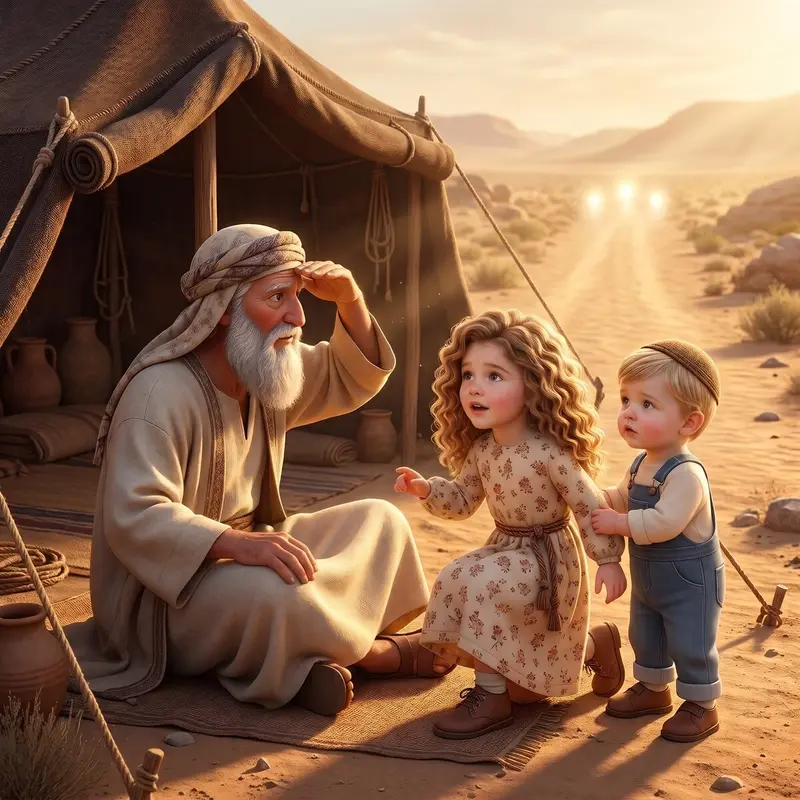
The Midrash of Avraham's tent with four doors describes Avraham Avinu's home as open on all four sides, so that a guest arriving from any direction would find an entrance right away. Children connect with it because it is easy to picture and easy to copy: a person who truly wants guests makes it easy for them to come in.
What does the Midrash say about Avraham's four doors?
In Avos DeRabbi Nasan, Chazal tell us that Avraham Avinu's house had an opening facing each of the four directions. The reason given is simple: so that guests coming from any side would not have to go around searching for the door.
The Midrash speaks of his house, and in the Torah we meet Avraham at the opening of his tent, so children usually hear it as the tent with four doors. This idea also fits the well-known words in Pirkei Avos (1:5), yehi veischa patuach lirvachah, let your house be open wide.
How do I tell the story to children?
Start with the pasuk, because it is the part we read in the Torah. In Parshas Vayeira, the Torah tells us that Avraham was sitting at the opening of his tent in the heat of the day. When he saw three men, he ran toward them and bowed. If your child knows Parshas Vayeira, you can link the two: Parshas Vayeira for Kids tells the full parsha.
Then add what Chazal tell us. Say it the way you would to a child: "Chazal teach that Avraham's home had a door facing every direction. Picture a traveler walking in from the north. Another comes from the south, one from the east and one from the west. Each one sees a door in front of him. Nobody has to walk around the whole house asking, 'Where is the way in?'"
The picture of the travelers is a way of telling it to a child. What the Midrash itself says is the doors, the four directions and the purpose: that guests should not need to search.
What is the lesson of the four doors?
The lesson is that chesed does not stop at being willing. Avraham's home was built so that welcoming people was part of the house itself. The guest does not have to work to be helped.
For a child, this turns into a very practical middah. Making someone feel welcome is more than saying "you can sit here" after they have been standing awkwardly. It is noticing who is on the edge of the room and making space before they have to ask.
If your child is also learning about welcoming guests in general, Welcoming Guests for Kids: Avraham's Tent covers the mitzvah of hachnasas orchim as a whole.
How do I explain it to a 3-4 year old, a 6-7 year old and a 9-12 year old?
Ages 3-4: Keep it to one picture. "Avraham's house had a door on every side. Whoever came, there was a door right there for them." Let your child point to the doors in your own home and say who might come through them. At this age, one clear image and one small question is enough.
Ages 6-7: Now add the reason: so nobody has to search for the entrance. Ask, "When is it hard for someone to find where they belong?" Children this age can usually name a new child in cheder, a classmate standing alone at recess, or a cousin who is shy at a family meal. Then ask what a "door" would look like there: a smile, an invitation, a seat saved.
Ages 9-12: Older children can handle the difference between pshat and Midrash. The pesukim in Vayeira tell us that Avraham ran to his guests. The four doors are a Midrash, a way Chazal paint his character. Ask what the Midrash teaches that the pasuk does not, and how a person can make chesed easier for the other side, so that the one receiving does not feel like a burden.
If your child has met Avraham's earlier story, Avraham and His Father's Idols is another Midrash about the same Avraham Avinu, and the two sit well side by side.
What can we ask at the Shabbos table?
Shabbos is a good time for this story, since a Shabbos meal is itself a home open to guests. These are questions for talking only, with nothing to write or prepare:
- Why do you think Avraham wanted a door on every side of his home?
- What is the difference between inviting someone and making them feel welcome?
- Who might be standing outside a "door" at school or in our neighborhood, even though they would love to come in?
- What is one small thing we could change in our home so a guest feels comfortable more quickly?
- How is a pasuk different from a Midrash? Which part of today's story came from which?
Let the youngest answer first. A simple answer like "so nobody gets lost" is already the heart of the story.

Softcover 8″×8″

Hardcover 8″×8″

Board book 6″×6″

Coloring book 8.5″×11″
What is a personalized Torah Tale book of this story like?
In the Torah Tale book, your child is the hero. Their name and, from one uploaded photo, their likeness appear on every page, illustrated in 3D animated-film style. Up to eight children can appear in the same book, ages 0 to 18. This story is in the Midrash & Aggadah collection, which tells the stories Chazal relate behind the pesukim, each from its named source.
Every book is written with careful rabbinical guidance and strict tznius, and is reviewed by our team before it goes to print. It ends with a discussion page of 10 questions about the story, mixing comprehension with middos, which turns the book from something read to a child into something talked about at the table. If you add parents and grandparents, they appear with the children on a closing family page in every format. Softcover and hardcover books open with a dedication page.
There are three formats, chosen by age: a 6"x6" board book with rounded safety corners (ages 0-4), an 8"x8" softcover (ages 4-8) and an 8"x8" hardcover (ages 5-18). A matching 8.5"x11" coloring book in black-and-white line art can be added to a one-time order. Reading the storybook is perfect for Shabbos and Yom Tov, while coloring is a weekday activity only.
What can we do on a weekday to live this story?
On a weekday afternoon or erev Shabbos, make Avraham's idea real at home. Walk around your front door and living room with your child and ask, "If someone new came tonight, what would they see first? Where would they put their coat? Would they know where to sit?" Then let your child choose one small change, like clearing a chair or setting out an extra place.
If you ordered the coloring book, a weekday is also the time to color a picture of a house with doors on every side, and to talk about the story while you do. Save the talking and questions, without the crayons, for Shabbos.
To see how the book is made, create the book in about five minutes. It takes a free account and a few short questions: your child's name, boy or girl, age and one photo, any siblings, the story, your community (asked once), the language and the format.
Frequently asked questions
What is the story of Avraham's tent with four doors?
It is a Midrash about Avraham Avinu's hachnasas orchim. Chazal describe his home as open to all four directions, so that a traveler arriving from the north, south, east or west would find a door right away and would not have to look for the way in. It is brought in Avos DeRabbi Nasan.
Is the tent with four doors in the Torah itself?
No. The Torah tells us in Parshas Vayeira that Avraham was sitting at the opening of his tent in the heat of the day and ran toward the guests when he saw them. The detail of the four doors comes from the Midrash, so it is best taught as 'Chazal tell us'.
What is the lesson of Avraham's four doors?
The lesson is that kindness thinks about the other person's side. Avraham did not just wait for guests to find him; the Midrash describes a home built so that no guest would be left wandering. Children can learn to ask, 'What would make this easier for them?'
How do I explain the four doors to a 4-year-old?
Keep it to one picture: Avraham's house had a door on every side, so whoever came from any direction could walk right in. Then ask your child where they would put a door, and who they would invite in. A short, simple retelling and one question is plenty at this age.
What is a good way to turn this story into a family conversation?
Use the Shabbos table. Retell the Midrash in a sentence, then ask what it means to make a guest feel welcome before they even knock. Every Torah Tale book ends with a discussion page of 10 questions about the story, mixing comprehension with middos, which is meant for exactly this kind of table conversation.