Yosef's Coffin in the Nile for Kids: Sotah 13a, Moshe & a Promise Kept
Chazal tell us that Yosef's coffin lay in the Nile until Moshe stood on the bank and called to him. Here is the story from Sotah 13a, how to tell it at ages 3 to 4, 6 to 7 and 9 to 12, and questions for the Shabbos table.
Published by Torah Tale.
Create this book for your child
The story of Yosef's coffin in the Nile is a midrash from Maseches Sotah 13a. Chazal tell us that the Egyptians placed Yosef's coffin in the Nile, and that when it was time to leave Mitzrayim, Moshe stood by the river and called to Yosef until the coffin rose. Children are drawn to it because it has a clear picture, a river, a coffin that rises and a promise that is finally kept, and because the question underneath is one they understand well: what do you do when you said you would?
What does the Torah itself say about Yosef's bones?
At the end of Sefer Bereishis, Yosef made Bnei Yisrael swear. He told them that Hashem would surely remember them, and that they should bring up his bones from Mitzrayim (Bereishis 50:25). Only after that, the Torah tells us, Yosef died at the age of 110 and was placed in an aron in Mitzrayim (50:26).
Many years later, when Yisrael were leaving, the pasuk says that Moshe took the bones of Yosef with him, because Yosef had made Bnei Yisrael swear (Shemos 13:19). Sefer Yehoshua tells us that Yosef's bones were buried in Shechem, in the plot of land Yaakov had bought (Yehoshua 24:32). The pesukim say nothing about the Nile. That part comes from Chazal.
What is the story of Yosef's coffin in the Nile?
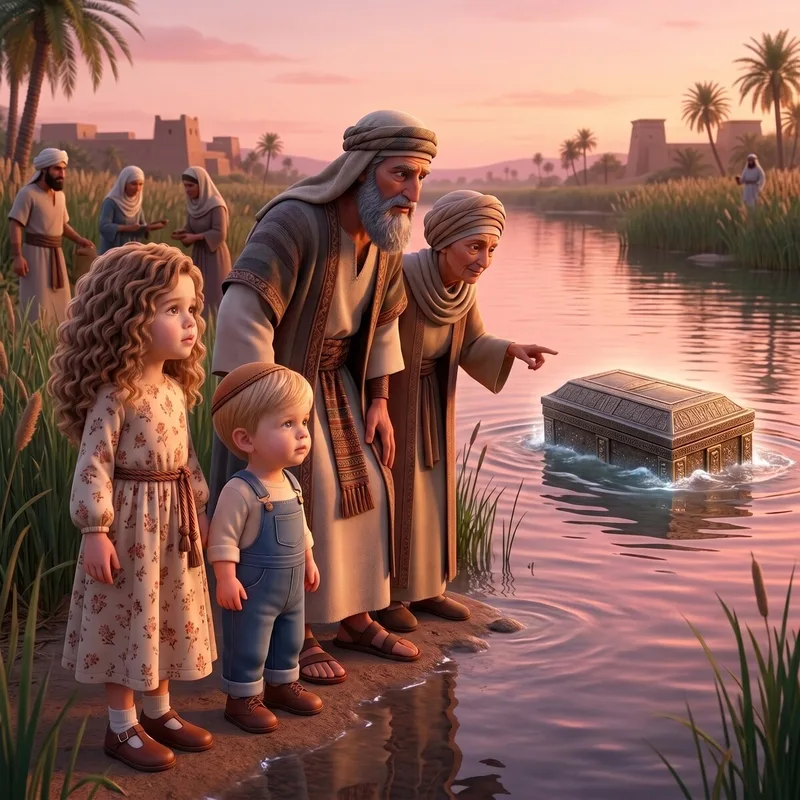
The Gemara in Sotah 13a asks how Moshe knew where Yosef was. It tells us that Serach bas Asher was still alive from that generation, and that she told Moshe what had been done. The Egyptians had made a metal coffin for Yosef and placed it in the Nile, so that the waters of the Nile would be blessed.
So Moshe went to the bank of the river and called out. In short, the Gemara has him say: Yosef, Yosef, the time has come that Hashem promised to redeem Yisrael, and the time of the oath you made them swear has come. If you show yourself, good. If not, we are free of your oath. Right then, Chazal tell us, Yosef's coffin floated up.
Children often ask whether Moshe was saying that Yosef might not come. It helps to say that Moshe was speaking about the oath itself, and that the promise was now ready to be kept. The coffin rose, and Moshe took it with him.
What does Chazal's story add about the two aronos?
The same passage in Sotah 13a tells us that, through the forty years in the midbar, two aronos traveled with Yisrael: Yosef's coffin and the Aron that held the Luchos. Passersby would ask about the two, and Yisrael would explain that one held a person who had passed away and the other was the Aron of Hashem's Torah.
When people were surprised that the two traveled together, the answer Chazal give is a short one: this one, Yosef, fulfilled what is written in that one. For a child who is ready for a bigger idea, this is a lovely line to sit with. It says that Yosef's life was a life of Torah.
What is the lesson of this midrash for children?
The first lesson is the simplest: a promise is a promise, even when it was made a very long time ago. Yosef's promise was handed down through all of Yisrael's years in Mitzrayim, and Moshe is the one who made sure it was kept.
The second lesson is stated by Chazal themselves. The Gemara in Sotah 13a says that while all of Yisrael were busy with the wealth of Mitzrayim, Moshe was busy with a mitzvah, and it connects this to the pasuk in Mishlei: the wise of heart takes mitzvos (Mishlei 10:8). In the language of a child: when everyone else is busy with something exciting, Moshe was busy with the thing that mattered.
From this we can draw a third thing, which is our own way of putting it: no one is ever forgotten. Yosef waited a long time, and he was remembered. If your child has ever worried about being left out, this is a gentle way into that conversation.
How do I explain it to a 3 or 4-year-old, a 6 or 7-year-old and a 9 to 12-year-old?
Ages 3 to 4: Tell it in three sentences. Yosef asked to be taken to Eretz Yisrael. Moshe stood by the river and called his name. The coffin came up, and Moshe took Yosef along. Let your child point to the river and to the coffin in the pictures, and stop there.
Ages 6 to 7: Add Serach bas Asher, who knew where the coffin was, and the idea of the promise: Yosef had made Bnei Yisrael promise, and Moshe kept it. Ask what it feels like when someone remembers a promise to you, and when someone forgets.
Ages 9 to 12: Separate the pasuk from the midrash. The Torah tells us about the oath and about Moshe taking the bones. Chazal tell us how Moshe found the coffin and what he said. Then talk about Moshe in Sotah 13a: Chazal say he was busy with a mitzvah while others were busy with wealth, and the pasuk in Mishlei describes him. What would it look like in our own day to choose the mitzvah first?
What is a personalized Torah Tale book of this story like?
Yosef's coffin in the Nile is a story in the Midrash & Aggadah collection, which brings the stories Chazal tell behind the pesukim, each from its named source in the Gemara or Midrash. In a Torah Tale book, your child's name and likeness, made from one uploaded photo, appear on every page, in 3D animated-film style. Up to eight siblings can appear in the same book.

Softcover 8″×8″

Hardcover 8″×8″

Board book 6″×6″

Coloring book 8.5″×11″
The book comes in three formats: a 6x6 board book with rounded safety corners for ages 0-4, an 8x8 softcover for ages 4-8, and an 8x8 hardcover for ages 5-18. Softcover and hardcover books open with a dedication page. If you add parents and grandparents, they appear with the children on a closing family page in every format. An optional matching coloring book is also available, and it is a weekday activity for erev Shabbos or a weekday afternoon, never for Shabbos.
Every book is written with careful rabbinical guidance and strict tznius, and reviewed by our team before it goes to print. Reading, on the other hand, is entirely appropriate for Shabbos, so a storybook is a good fit for the Shabbos table or a long Shabbos afternoon.
What can we talk about at the Shabbos table?
Every Torah Tale book ends with a discussion page of 10 questions that mix comprehension with middos. For the table, here are a few of your own, using only talking, no writing or drawing:
- What did Yosef ask Bnei Yisrael to promise before he passed away?
- Who told Moshe where the coffin was, and how did she know?
- Why do you think Moshe was busy with this mitzvah while others were busy collecting wealth?
- Is there a promise you made that is waiting to be kept?
- Why do you think the two aronos traveled together, and what does that tell us about Yosef?
If your child is working through the Torah, this midrash connects well to Parshas Vayechi, where Yosef makes the oath, and to Parshas Beshalach, where the pesukim tell us Moshe took the bones.
How can we make this story part of the week?
One simple idea is to pick one small promise each week and say it out loud, such as helping set the table, calling a grandparent, or being ready on time. On a weekday afternoon, ask your child which one they kept and which one was hard. This is our own idea for bringing the story home, not something from Chazal.
When you are ready, create the book for your child. It begins with a free account and a few short questions: each child's name, boy or girl, age and one photo, any siblings, the story, your community, the language and the format.
Frequently asked questions
Where does the story of Yosef's coffin in the Nile come from?
It comes from Chazal, in Maseches Sotah 13a. The Torah itself tells us only that Yosef made Bnei Yisrael swear to bring up his bones and that Moshe took them when they left Mitzrayim. The coffin in the Nile and Moshe's call to it are part of the midrash, not the pesukim.
How did Moshe know where Yosef was buried?
The Gemara in Sotah 13a tells us that Serach bas Asher, who was still alive from that generation, told Moshe. She explained that the Egyptians had made a metal coffin for Yosef and placed it in the Nile. This detail is from Chazal, not from the pesukim.
How do I explain this story to a 4-year-old?
Keep it to one picture and one idea: Yosef asked his family to take him to Eretz Yisrael, and many years later Moshe remembered and kept the promise. You can say, 'Moshe stood by the river and called Yosef's name, and the coffin came up.' Then ask, 'Why did Moshe want to keep Yosef's promise?'
What is the lesson of Yosef's coffin in the Nile?
One lesson is that a promise made to Yosef was still kept, long after it was made. Chazal in Sotah 13a also point out that Moshe was busy with this mitzvah while the rest of Yisrael were busy collecting wealth, and they connect it to the pasuk 'the wise of heart takes mitzvos'. For children, that can be put simply: when a mitzvah is waiting, we do it, even when everyone else is busy with something else.
Where was Yosef finally buried?
Sefer Yehoshua (24:32) tells us that Bnei Yisrael buried Yosef's bones in Shechem, in the plot of land that Yaakov had bought. It is the place the pesukim name, and it is where the bones that Moshe took out of Mitzrayim came to rest.