The Stones That Wanted Yaakov: Midrash for Kids (Chullin 91b & Rashi)
When Yaakov lay down at the place where he would dream of the ladder, Chazal tell us the stones each wanted to be his pillow. Here is the midrash, its source, and how to tell it to a 3-4 year old, a 6-7 year old and a 9-12 year old.
Published by Torah Tale.
Create this book for your child
The Stones That Wanted Yaakov is a midrash on Parshas Vayeitzei. When Yaakov lay down for the night, Chazal tell us, the stones around him each wanted him to rest his head on them, until they became one stone. Children take to it quickly because they know stones, and the idea that even a stone would want to take part in something good is easy for a child to hold.
What is the story of the stones that wanted Yaakov?
In the parsha, Yaakov leaves Be'er Sheva and heads toward Charan. The Torah tells us he came upon a place and stayed there for the night because the sun had set. Then comes the pasuk the midrash grows from: he took from the stones of the place, put them at his head and lay down there (Bereishis 28:11).
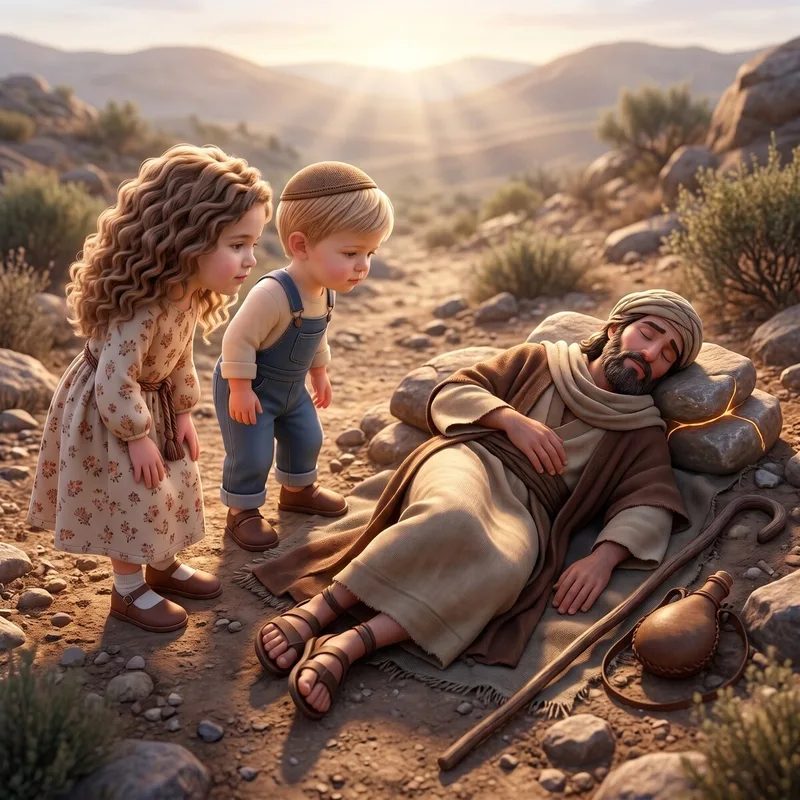
Chazal tell us that the stones did not simply lie there. They gathered, and each one said, 'Let this tzaddik rest his head on me.' Rashi brings the midrash that the stones began to quarrel with one another over who would have the honor. Hashem then made them into one stone, and Yaakov slept with his head on it.
After that Yaakov dreams of the ladder standing on the ground with its top in the heavens, and Hashem speaks to him. That is the heart of the parsha, and you can read more in our Parshas Vayeitzei article for kids.
Is this in the pesukim, or is it a midrash?
It is a midrash, and it is worth saying so plainly to children. The Torah tells us only that Yaakov took from the stones of the place, put them at his head and lay down. The stones gathering and wanting to be his pillow is from Chazal, in Chullin 91b, where Rabbi Yitzchak teaches it on this pasuk.
Rashi brings the midrash on the pasuk and connects it to the single stone the Torah speaks of afterward. When Yaakov wakes, the pasuk says he took the stone he had put at his head, stood it up as a matzeivah and poured oil on top of it (28:18). Saying 'the Torah tells us' for the pasuk and 'Chazal tell us' for the stones teaches children the difference between the two from an early age.
What is the lesson of the stones?
Chazal do not attach a lesson to the midrash in so many words, so what follows is what parents and teachers commonly draw from it, not a statement of the Gemara.
- Wanting a part in something good. Each stone wanted to be the one that served the tzaddik. A child can ask how eager they are to help, to carry the challah to the table or to open the door for a guest.
- Quarrels over honor do not help anyone. In the midrash the stones argued, and the argument ended when they became one stone. Siblings arguing over who sits next to Totty will know exactly what this means.
- Every small thing counts. A stone is about as small a helper as there is, and still the midrash gives it a voice and a wish.
Yaakov was far from home, with a stone under his head, and Hashem was about to promise him the land and his children. It is a gentle picture to give a child going to sleep in a bed that feels strange, such as at Bubby's house or on a trip.
How do I explain the stones to a 3-year-old, a 6-year-old and a 10-year-old?
Ages 3 to 4: Tell it in a few sentences. 'Yaakov was tired. All the stones wanted to be his pillow. Hashem made them into one big stone, and Yaakov went to sleep.' Let your child hold a smooth stone from outside while you tell it, and ask, 'Which stone would you want to be?'
Ages 6 to 7: Add the quarrel. 'Each stone said, let him rest on me. They argued, so Hashem made them one.' Ask what the stones should have done instead of arguing, and whether a family has ever argued over who gets to do a mitzvah. Make clear that this is what Chazal tell us, not a pasuk.
Ages 9 to 12: Show them the pasuk and the midrash side by side. Read 'ויקח מאבני המקום וישם מראשתיו וישכב במקום ההוא', then ask what in the words might have led Chazal to say the stones wanted him. Notice the later pasuk speaking of a single stone, and ask why the midrash says Hashem made them one.
What can we ask about the stones at the Shabbos table?
Talking is the right activity for Shabbos, and this midrash gives plenty to talk about. Here are six questions that need no book or paper:
- What does the Torah actually say about the stones, and what do Chazal add?
- Why do you think each stone wanted Yaakov on it?
- What was wrong with the stones quarreling, even over something good?
- When have we wanted the same job as someone else, and what did we do?
- Why do you think Hashem made one stone out of many?
- What is a small thing we can do this week that serves someone we love?
For younger children, pick one question and let everyone answer in turn. A child who says 'I would have let the other stone go first' has just told you something real about themselves.
What is a personalized book of the stones that wanted Yaakov like?
A Torah Tale book of this story is a storybook starring your child. Their name and, from one uploaded photo, their likeness appear on every page, illustrated in high-resolution 3D animated-film style. The story is one of the midrashim Chazal tell behind the pesukim, and every book is written with careful rabbinical guidance and strict tznius and reviewed by our team before it goes to print.
Every book ends with a discussion page of 10 questions about the story, mixing comprehension with middos: what happened, and what it asks of the child. This is what turns the book from something read to your child into something talked about at the table, and a book you read together is welcome on Shabbos.

Softcover 8″×8″

Hardcover 8″×8″

Board book 6″×6″

Coloring book 8.5″×11″
There are three formats, matched to age:
- A 6x6 board book with rounded safety corners, for ages 0-4.
- An 8x8 softcover photo book, for ages 4-8.
- An 8x8 hardcover photo book, for ages 5-18.
Softcover and hardcover open with a dedication page, and every format closes with the discussion page. If you add parents, grandparents or other relatives with their photos, they appear with the children on a closing family page in every format. Up to eight siblings can appear in one book.
An optional matching coloring book (8.5x11, black-and-white line art) can be added to a one-time order. It is a weekday activity, for erev Shabbos, an afternoon during the week, or Chol HaMoed, and never for Shabbos or Yom Tov, because coloring is melacha. For more of Yaakov's journey, see Parshas Toldos for kids for how he came to leave home.
How do I order it?
Creating a book takes about five minutes. You open a free account and answer a few short questions: each child's name, boy or girl, age and one photo, any siblings, the story, your community (asked once), the language (English, Hebrew or Yiddish) and the printed format. Our step-by-step guide to creating a personalized Torah storybook walks through each screen. Customers do not preview the book before printing, which is why the rabbinical guidance and our own review come first.
When you are ready to give your child a book where they are the one lying down to sleep at the place where Yaakov dreamed, you can create the book and choose the story.
Frequently asked questions
What is the midrash of the stones that wanted Yaakov?
The Torah says Yaakov took from the stones of the place and put them at his head. Chazal tell us in Chullin 91b that the stones gathered together and each one said that the tzaddik should rest his head on it. Rashi brings that they began to quarrel, and Hashem made them into one stone.
Is the story of the stones in the Torah or is it a midrash?
It is a midrash. The pasuk (Bereishis 28:11) says only that Yaakov took from the stones of the place, put them at his head and lay down. The stones wanting to be his pillow comes from Chazal, in Chullin 91b, and from Rashi on the pasuk.
What is the lesson of the stones that wanted Yaakov?
Chazal do not state a lesson in these words, but parents often draw two from the midrash. One is the wish to be part of something good, even in a small way. The other is that quarreling over who gets the honor ends when it becomes one stone together.
How do I explain the stones midrash to a 4-year-old?
Keep it short and gentle: Yaakov was tired and lay down to sleep, and the stones all wanted to be his pillow. Then Hashem made them into one stone, and Yaakov slept on it. You can ask which part your child liked best, and say that this is a story Chazal tell us.
Can I read this story to my child on Shabbos?
Yes, reading and telling stories is entirely appropriate on Shabbos. A Torah Tale book is a good one to read at the Shabbos table, and its closing page of 10 discussion questions gives you something to talk about. A coloring book, by contrast, is a weekday activity only, because coloring is melacha.