Taking Challah (הפרשת חלה) for Kids: How to Explain the Mitzvah at Home
Taking challah is the mitzvah of setting aside a small piece of dough, with a bracha, before baking. Here is how to explain it to your child, step by step, and questions to talk about at the Shabbos table.
Published by Torah Tale.
Create this book for your child
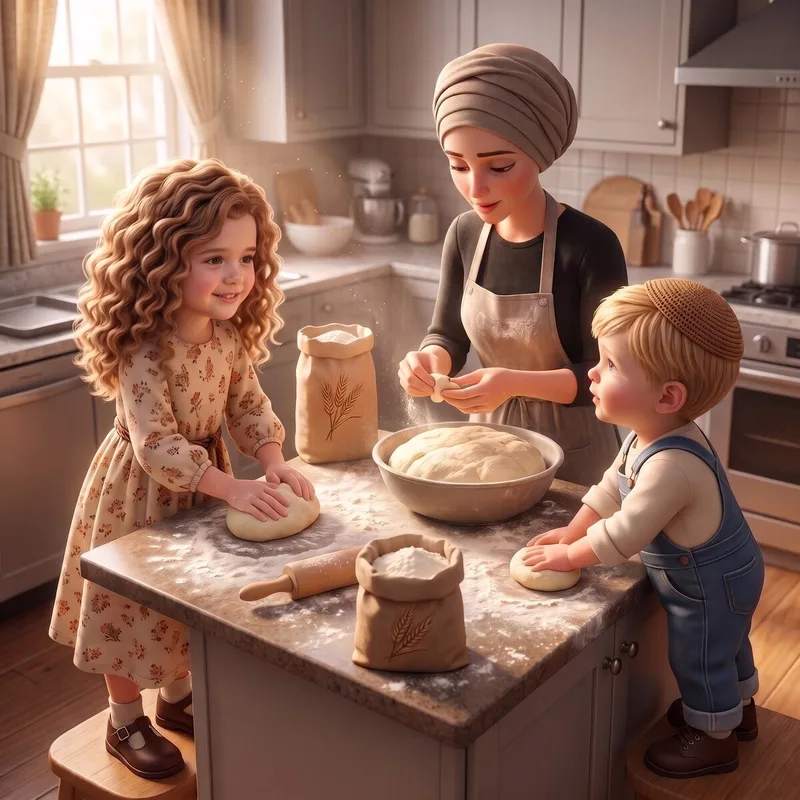
Taking challah (hafrashas challah) is the mitzvah of separating a small piece from dough before it is baked, saying a bracha, and setting that piece aside for Hashem. Children connect to it because it happens in the kitchen, with real dough and real hands, and they can see the one piece that is set apart from the rest.
Where does the mitzvah of taking challah come from?
The Torah gives this mitzvah in Sefer Bamidbar, chapter 15, in Parshas Shelach. When Bnei Yisrael come to the land and eat of its bread, the Torah tells us, they are to lift up a portion, the first of their dough, as a gift for Hashem. The mitzvah comes right after the story of the meraglim, which you can read about in Parshas Shelach for Kids.
In the days of the Beis HaMikdash, that portion was given to a kohen. Today the custom is to burn the piece that was separated, and many families wrap it in foil first. Yidden keep this mitzvah in their kitchens to this day, and your rav can answer any question about how it is done in your home.
What actually happens when a family takes challah?
The steps are simple enough for a child to follow along. This is the general picture, and your rav or a halacha guide will give you the exact details:
- The dough is made from flour of the five grains, wheat being the usual one, and it has to be a large enough batch. This is why many families bake a big batch for Shabbos.
- Once the dough is mixed together, and before it is baked, the bracha for taking challah is said.
- A small piece is taken from the dough, and the words harei zu challah are said over it.
- The piece is set aside and later burned, as described above.
- The rest of the dough is shaped and baked, and the challah is ready for the Shabbos table.
Many homes have a card with the bracha hanging in the kitchen. Who takes challah is also a question for your rav, though in many homes it is the mother or a daughter.
What is the lesson of taking challah for a child?
The lesson is that we give the first part to Hashem. The bread, the flour, the oven and the family around the table are all gifts, and before we enjoy them, we set something aside. It is one way of teaching a child hakaras hatov in a way they can see and smell.
There is a second lesson, too: Shabbos begins in the kitchen, days before it arrives. A child who has kneaded dough on a Thursday or a Friday morning understands that Shabbos is something a family prepares for together.
How do I explain taking challah to a 3-year-old and to an 8-year-old?
For ages 3 and 4, keep it to one sentence: "Before we bake the challah, we take a tiny piece for Hashem. It is the special piece." Let your child press the dough, watch the piece being taken, and say Amen after the bracha. If you want to talk about it more, use words they can picture: "First we give to Hashem, then we eat."
For ages 7 to 9, add the source. Tell them the mitzvah is in the Torah, in Parshas Shelach, and that in the days of the Beis HaMikdash the piece was given to a kohen. Then ask why they think the piece is taken before baking, and what else we give first, such as the first bracha, or tzedakah before a meal. Older children can also look at the words of the bracha in a siddur or a halacha guide.
One safety note for every age: the oven and the burning of the piece are for adults only. Children can help with the dough and stand back for the rest.
What is the Torah Tale book about taking challah like?
Taking Challah is part of the collection of mitzvos a child keeps, set in everyday life today, which you will find under Mitzvos in the story picker. Like every Torah Tale book, it stars your child: their name and, from one uploaded photo, their likeness appear on every page, illustrated in 3D animated-film style. Up to eight siblings, ages 0 to 18, can appear in the same book.
Every book is written with careful rabbinical guidance and strict tznius, and is reviewed by our team before it goes to print. If you add parents, grandparents and other relatives with their photos, they appear together with the children on a closing family page, in every format.
Every book ends with a discussion page of ten questions about the story, mixing comprehension with middos. That page is what turns the book from something read to a child into something talked about at the table.

Softcover 8″×8″

Hardcover 8″×8″

Board book 6″×6″

Coloring book 8.5″×11″
Which format fits my child's age?
There are three formats, matched to age:
- A board book, 6x6 with rounded safety corners, for ages 0-4.
- A softcover photo book, 8x8, for ages 4-8.
- A hardcover photo book, 8x8, for ages 5-18.
The softcover and hardcover open with a dedication page. You can also add a matching coloring book (8.5x11, black-and-white line art). Coloring is a weekday activity: a weekday afternoon or erev Shabbos before Shabbos begins is a fine time, but never on Shabbos or Yom Tov. The storybooks themselves are the opposite, and reading one at the Shabbos table or on a long Yom Tov afternoon is entirely appropriate.
What can we talk about at the Shabbos table?
Whether or not you have the book in hand, taking challah gives you easy questions that need nothing but conversation. Try these:
- Who remembers when we took challah this week? What did we say before we took the piece?
- Why do you think we take the piece before baking, and not after?
- Who was the first piece for, and what was the Torah's word for it?
- What else do we give first, before we enjoy something ourselves?
- What do you like best about getting ready for Shabbos in the kitchen?
If you are looking for more Shabbos-table mitzvos to talk about, Lighting the Shabbos Licht for Kids and Making Kiddush for Kids pair naturally with it.
How do I order the book?
Creating the book takes about five minutes. You open a free account and answer a few short questions: each child's name, boy or girl, age and one photo, any siblings, the story, your family's community (asked once), the language (English, Hebrew or Yiddish) and the printed format. If you are choosing for an occasion, check the creator's information about timing so the book can arrive when you want it.
Ready when you are: create the book and put your child in the kitchen at the center of the mitzvah.
Frequently asked questions
What is taking challah, in simple words for a child?
Taking challah means that when we make dough, we take off one small piece before baking, say a bracha, and set that piece aside for Hashem. It is a way of giving the first part of our bread. Then we bake the rest and enjoy it, often for Shabbos.
Where does the mitzvah of challah come from?
The Torah gives it in Sefer Bamidbar, chapter 15, in Parshas Shelach. The Torah says that when Bnei Yisrael eat of the bread of the land, they are to lift up a portion, the first of their dough, as a gift for Hashem. In the days of the Beis HaMikdash that portion was given to a kohen.
Why do we burn the piece of challah today?
The custom today is to burn the piece that was separated, and many people wrap it in foil first. Ask your rav about the exact way to do it in your home. For children, it is enough to say that this piece was set apart and is not eaten, and that an adult takes care of it.
Can my child help when we take challah?
Yes, a child can help measure, knead and shape the dough, and can watch the mitzvah being done and answer Amen to the bracha. The separating itself and the oven are for a grown-up. Ask your rav about who takes challah in your home and how much dough is needed.
Is there a Torah Tale book about taking challah?
Yes. Taking Challah is a story in the Mitzvos category of the story picker, in the collection about mitzvos a child keeps, set in everyday life today. Your child's name and likeness appear in 3D animated-film style, and the book ends with a discussion page of ten questions.
Which Torah Tale format suits my child?
The board book (6x6 with rounded safety corners) is for ages 0-4, the softcover (8x8) is for ages 4-8, and the hardcover (8x8) is for ages 5-18. The child's age is one of the short questions when you create the book. An optional matching coloring book is a weekday activity only.