Making Kiddush (קידוש) for Kids: The Becher, Vayechulu & a Child's Part
Kiddush is how a Jewish family says out loud that Shabbos is holy, over a cup of wine, before the Friday night meal. Here is what happens, what Chazal learn from the word Zachor, how to explain it to a child aged 3 to 12, and what a child's own part at the table looks like.
Published by Torah Tale.
Create this book for your child
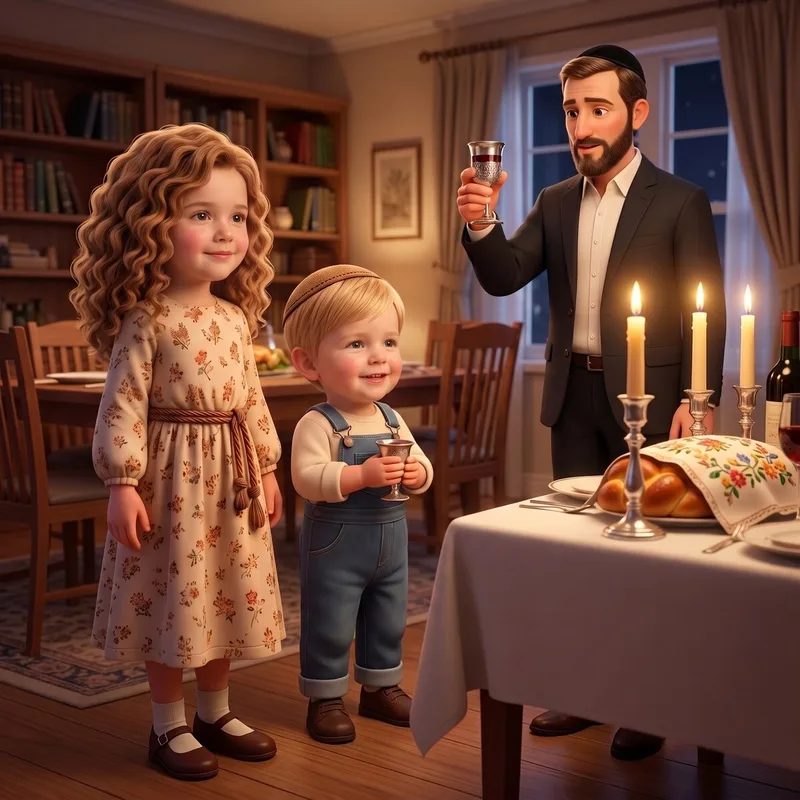
Kiddush is the mitzvah of saying out loud, over a cup of wine, that Shabbos is holy. A father or mother lifts the becher at the Friday night table, the family stands or sits quietly, the words are said, everyone answers amen, and the Shabbos meal begins. Children love it because it is the one moment of the week that belongs to the whole table at once, and because they can hear exactly where their part comes in.
What is Kiddush, in one sentence a child can repeat?
Kiddush means "making holy." We say words over a cup of wine or grape juice to announce that this day is different from the other six.
A four-year-old can hold on to this: Shabbos comes by itself, and Kiddush is how we say it out loud. Hashem made Shabbos holy at the beginning of the world. Our job is to say so, with our mouths, in front of our family.
It is worth separating two things children mix up. Kiddush is said at the Shabbos and Yom Tov table over a cup. Kiddush Levana is a different mitzvah, said outside at night when the new moon is visible. Same word, different mitzvah.
Where does Kiddush come from?
The Torah says Zachor es yom haShabbos l'kadsho, remember the day of Shabbos to make it holy (Shemos 20:8). Chazal teach (Pesachim 106a) that this remembering is done with words said over a cup of wine.
On Friday night, Kiddush opens with Vayechulu, the three pesukim of Bereishis 2:1-3 that tell how the heavens and the earth were finished, how Hashem rested on the seventh day, and how He blessed that day and made it holy. Then comes the bracha on the wine, and then the longer bracha that ends with the words mekadesh haShabbos.
Two details children should know. Kiddush is said in the place where the meal will be eaten, which is why we do not make Kiddush in one room and eat in another. And women are obligated in Kiddush exactly as men are, so a mother standing and listening is fulfilling the same mitzvah, not watching someone else fulfill it. For the details of how much is drunk, which cup is used and what counts in your own home, ask your rav.
What happens in the Making Kiddush story
This story is from the Mitzvos collection, the one set in everyday life today rather than long ago. There is no desert, no palace and no kings. There is a kitchen on erev Shabbos, a table being set, licht already lit, and a family coming home from shul.
The child in the story is the child holding the book. They watch the becher being filled, they hear the first words of Vayechulu, they stand where they are told to stand, they listen to the whole bracha without wandering off, and they answer amen. Then comes the small cup of grape juice that is theirs, and the meal starts.
That is the whole arc, and it is deliberately small. A mitzvah story set in a child's own week does something a far-away story cannot: the child recognizes the table.
What the mitzvah asks of a child
Kiddush is a good teacher of a middah children do not practice often, which is listening all the way to the end. The mitzvah is not fulfilled by being in the room. It is fulfilled by hearing the words.
So the child's part has real content:
- Be at the table before Kiddush starts, not halfway through.
- Stay quiet from the first word to the last, and answer amen at the end.
- Have in mind that you are hearing Kiddush, not just hearing words.
- Wait. Many families are careful not to talk between Kiddush and the bread, and a child who can manage those two quiet minutes has learned something about kavod for a mitzvah.
An older child can also notice who is not yet at the table and call them, which turns a passive moment into a small chesed.
How to explain Kiddush at different ages
Ages 3 to 4. "Shabbos is here. Kiddush is how we tell everyone." Give the child one physical job during the week: bringing the clean becher to the table before Shabbos. Not candles, not matches, not anything hot.
Ages 5 to 6. Teach the opening words of Vayechulu and what they mean: Hashem finished making the world, and the seventh day was the day He rested. Ask them to find the moment in Kiddush where everyone says amen, and let them be the one who says it clearly.
Ages 7 to 9. Teach the source: the Torah says Zachor, remember, and Chazal teach that we remember over a cup. Explain that Kiddush is said where we eat, and ask them why they think the mitzvah is tied to the table and not to shul.
Ages 10 to 12. Learn the text of Kiddush with them, word by word, during the week. Point out the phrase zecher l'maaseh Bereishis and the phrase zecher litzias Mitzrayim, and ask what two different things Shabbos is reminding us of. A boy practicing for the day he makes Kiddush himself can read it aloud at a weekday meal; what he may do on Shabbos itself is a question for your rav.

Softcover 8″×8″

Hardcover 8″×8″

Board book 6″×6″

Coloring book 8.5″×11″
What a personalized Torah Tale book of Making Kiddush is like
In a Torah Tale book, the child at that Shabbos table is your child. Their name is in the text and, from one uploaded photo, their likeness appears on every page, illustrated in high-resolution 3D animated-film style. Up to eight siblings, ages 0 to 18, can appear in the same book, which matters in a story about a family table.
Three formats, each with its own age range. The 6"x6" board book with rounded safety corners is for ages 0 to 4, which is exactly the age that pulls a book off the shelf twenty times. The 8"x8" softcover photo book is for ages 4 to 8. The 8"x8" hardcover photo book is for ages 5 to 18. The softcover and hardcover open with a dedication page, and if you add parents, grandparents and other relatives with their photos, they appear with the children on a closing family page in every format.
Every book ends with a dedicated discussion page carrying ten questions about the story, mixing comprehension with middos. That is what turns a book you read to a child into something that gets talked about at the table, and reading it on Shabbos itself is entirely appropriate. The matching coloring book, 8.5"x11" in black-and-white line art, is a weekday item: color it on a weekday afternoon or on erev Shabbos, never on Shabbos itself, since coloring is melacha.
Five questions for the Shabbos table
Talking, singing and asking are all Shabbos-appropriate. Try these between Kiddush and bentching:
- What are the very first words of Kiddush, and what do they tell us about?
- Why do we say Kiddush out loud instead of thinking it quietly?
- Who in this room is obligated to hear Kiddush? (Answer: everyone old enough, men and women alike.)
- What is the hardest part of Kiddush for you, and what helps?
- If a guest walked in right now and asked what Kiddush is, what would you say in one sentence?
And one job for erev Shabbos, during the week: let a child wash and dry the becher and set it at its place before Shabbos comes in. A child who prepared the cup listens to the words differently.
If this is a mitzvah your family is working on right now, a book that puts your own child at your own Shabbos table is a quiet way to keep it going. You can create the book in about five minutes: a free account and a few short questions covering each child's name, boy or girl, age and one photo, any siblings, the story, your community, the language (English, Hebrew or Yiddish) and the format.
Frequently asked questions
What is Kiddush and why do we make it?
Kiddush is the mitzvah of saying out loud that Shabbos is holy, over a cup of wine or grape juice, before the Friday night meal. The Torah says Zachor es yom haShabbos l'kadsho, remember the day of Shabbos to make it holy, and Chazal teach that this remembering is said over a cup. The same mitzvah applies on Yom Tov night, and a shorter Kiddush is said before the Shabbos day meal.
How do I explain Kiddush to a 4-year-old?
Tell your child that Shabbos arrives on its own, and Kiddush is how we say hello to it out loud so everybody hears. Point to the becher and say that the words tell the story of how Hashem made the world in six days and rested on the seventh. Give your child a job that matches the age, such as standing quietly, listening to the whole thing and answering amen.
Can a child make Kiddush?
A child learning to make Kiddush is practicing a mitzvah, and many families let a boy say the words along with his father, or say them at his own little cup afterward. Whether a child's Kiddush can fulfill the obligation for others depends on his age and on halachos that differ from case to case, so ask your rav. Many families give young children grape juice rather than wine.
What is the difference between Friday night Kiddush and Shabbos morning Kiddush?
Friday night Kiddush begins with Vayechulu, the pesukim about Hashem finishing the world, and includes a full bracha that ends with mekadesh haShabbos. The Shabbos day Kiddush, often called Kiddusha Rabba, is much shorter, and minhagim differ about which pesukim are said before the bracha on the wine. Both are said in the place where the meal will be eaten.
Is there a children's book about making Kiddush?
Torah Tale's Making Kiddush is a story in the Mitzvos collection, set in a family's home today rather than long ago. The child who receives the book is the child at the Shabbos table, with their name and, from one uploaded photo, their likeness on every page in 3D animated-film style. Every book ends with a discussion page of ten questions mixing comprehension with middos.
How long does a Torah Tale book take to arrive?
Creating a book takes about five minutes at torahtale.com/create: a free account and a few short questions covering each child's name, boy or girl, age, one photo, any siblings, the story, the family's community, the language and the format. On one-time orders, US standard shipping is $5.99, free on orders of $75 or more, and arrives in about 12 business days counted from the order. We ship worldwide, with rates shown at checkout.