Shlomo HaMelech and the Shamir for Kids: Gittin 68a & No Iron
How did Shlomo HaMelech build the Beis HaMikdash without the sound of iron? Chazal tell of the shamir. Here is the story, its lesson, and how to tell it to children from age 3 to 12.
Published by Torah Tale.
Create this book for your child
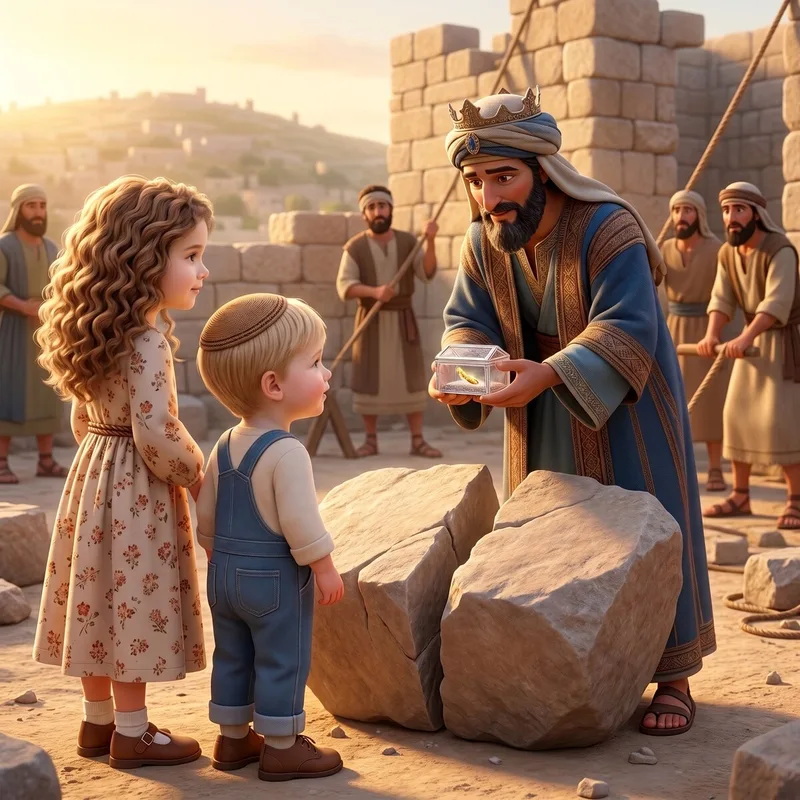
The story of Shlomo HaMelech and the shamir comes from the Gemara (Gittin 68a-b, and Sotah 48b) and explains how the Beis HaMikdash was built without the sound of iron. Children enjoy it because it is a real search: a king who needs something very small and very rare, advisors who know where to look, and a trusted man sent to bring it back. It also gives a parent an easy way to talk about doing a mitzvah carefully and properly.
What is the story of Shlomo HaMelech and the shamir?
The pasuk tells us that while the Beis HaMikdash was being built, the sound of hammers, axes and iron tools was not heard in the house (Melachim I 6:7). The Gemara in Gittin 68a asks how the stones could have been shaped without iron.
Chazal tell us that Shlomo HaMelech put the question to the Chachamim. They answered that there is a shamir, the same one Moshe Rabbeinu used for the stones of the efod. Shlomo HaMelech then wanted to know where it could be found.
The Gemara goes on to tell a long account of how the shamir was located. It is kept by a wild bird, called a tarnegol bar, and Benaiahu ben Yehoyada was sent to bring it. In the Gemara's telling the search has several stages, and it ends with Benaiahu succeeding in bringing the shamir to Shlomo HaMelech. Parts of this account are long and involved, so this article follows only its main thread. With the shamir in hand, the stones of the Beis HaMikdash could be cut without the sound of iron.
What is the shamir?
The shamir is a tiny creature that Chazal say could cut through stone. Pirkei Avos 5:6 lists the shamir among ten things created at twilight on the first Erev Shabbos, so Chazal see it as part of Hashem's plan from the very beginning.
Chazal also tell us that the shamir had served earlier, for the stones of the efod. The Mishnah in Maseches Sotah lists the shamir among the things that ceased when the Beis HaMikdash was destroyed.
Why couldn't iron be used for the Beis HaMikdash?
The pasuk in Melachim says plainly that no iron tool was heard in the house while it was being built. About the stones of the mizbeach, the Torah says not to wield iron over them (Devarim 27:5).
The Mishnah in Middos 3:4 gives a reason regarding the mizbeach: iron was created to shorten a person's life, and the mizbeach was created to lengthen it, so it is not right to lift the one that shortens over the one that lengthens. This is a good point to share with older children. A tool that can be used for war should not be the tool that shapes a place whose purpose is to bring people closer to Hashem.
What is the lesson of the shamir story for children?
There are a few lessons, and a parent can choose the one that suits the child.
- A mitzvah deserves real effort. Shlomo HaMelech did not settle for an easier way. He wanted the Beis HaMikdash built exactly as the pasuk describes, and he was willing to search for the shamir.
- We ask wise people. According to the Gemara, Shlomo HaMelech first asked the Chachamim. Even a king asks for advice.
- A shaliach does the job faithfully. Benaiahu ben Yehoyada was sent and did not give up until he brought back what was needed.
You may also like to read Shlomo HaMelech's Wisdom for Kids, which tells of the king's listening heart.
How do I explain the shamir to a 4-year-old, a 6-year-old and a 10-year-old?
Ages 3 to 4. Keep it to one sentence: "Shlomo HaMelech wanted to build the Beis HaMikdash very quietly, so he looked for a tiny creature, the shamir, that could cut stone." Then ask: "Who helped him find it?" The answer is the Chachamim and Benaiahu.
Ages 5 to 7. Tell the search as a short adventure: the king asks, the Chachamim answer, and Benaiahu is sent. You can simply say that Benaiahu brought the shamir back. Then talk about why the Beis HaMikdash was so special.
Ages 8 to 12. Show them the sources: the pasuk in Melachim I 6:7, the Gemara in Gittin 68a-b, and Pirkei Avos 5:6. Ask why iron was not appropriate for the mizbeach, using the Mishnah in Middos 3:4. Older children can also learn that the Gemara's full account of finding the shamir is long, with parts that are best learned with a rebbe or parent.
What questions can we ask at the Shabbos table?
These are all for talking, with no writing or crafts needed.
- What was Shlomo HaMelech trying to build, and what was special about how it was built?
- Who was the first person Shlomo HaMelech asked for help? Why is it smart to ask?
- Benaiahu ben Yehoyada was sent on a job. What does it mean to do a job faithfully?
- Is there a mitzvah you do slowly and carefully, the right way?
- Would you keep trying if a job seemed hard to finish? What would help you?
If you have a book of this story, its discussion page carries ten questions on the story, mixing comprehension with middos, which is a good place to start at the table. Reading a storybook on Shabbos is entirely appropriate.
What is a personalized Torah Tale book of this story like?
Torah Tale makes personalized Torah storybooks in which the child is the hero. Your child's name and, from one uploaded photo, their likeness appear on every page, illustrated in high-resolution 3D animated-film style. Up to eight children can appear in the same book, ages 0 to 18.
This story is in the Midrash & Aggadah collection, the stories Chazal tell behind the pesukim, each from its named source in the Gemara or Midrash. For this story the source is the Gemara. Every book is written with careful rabbinical guidance and strict tznius, and it is reviewed by our team before it goes to print.
There are three formats, matched to age: a 6x6 board book with rounded safety corners for ages 0-4, an 8x8 softcover photo book for ages 4-8, and an 8x8 hardcover photo book for ages 5-18. Softcover and hardcover books open with a dedication page. If you add parents, grandparents and other relatives with their photos, they appear with the children on a closing family page in every format. An optional matching coloring book is a weekday activity, for a weekday afternoon or before Shabbos, and never for Shabbos or Yom Tov.

Softcover 8″×8″

Hardcover 8″×8″

Board book 6″×6″

Coloring book 8.5″×11″
If you enjoy stories like this one, you might also like Miriam's Well for Kids, another story from the Gemara.
Creating a book takes a free account and a few short questions: each child's name, boy or girl, age and one photo, any siblings, the story, your community (asked once), the language and the printed format. The whole flow takes about five minutes. When you are ready, you can create the book for your child.
Frequently asked questions
What is the shamir in the Torah story of Shlomo HaMelech?
The shamir is a tiny creature that Chazal say was able to cut stone. Pirkei Avos 5:6 lists it among ten things created at twilight on the first Erev Shabbos. The Gemara in Gittin 68a-b and Sotah 48b connects it to the building of the Beis HaMikdash.
Why was the Beis HaMikdash built without iron?
The pasuk in Melachim I 6:7 says that no hammer, axe or iron tool was heard in the Beis HaMikdash while it was being built. Regarding the stones of the mizbeach, the Torah says not to wield iron over them, and the Mishnah in Middos 3:4 explains that iron was made to shorten life while the mizbeach lengthens it. The Gemara in Gittin tells how Shlomo HaMelech sought the shamir to shape the stones without iron.
Who brought the shamir for Shlomo HaMelech?
The Gemara in Gittin 68a-b says that Shlomo HaMelech sent Benaiahu ben Yehoyada. The account is long and has several stages, and the shamir is kept by a wild bird that the Gemara calls a tarnegol bar. Parents can tell younger children simply that Benaiahu was sent and succeeded in bringing it.
How do I explain the shamir to a 4-year-old?
Keep it to one thought: Shlomo HaMelech wanted to build the Beis HaMikdash in a very special, quiet way, so he looked for a tiny creature that could cut stone. You can add that he asked wise people for help and that Benaiahu went to bring it. Leave the long account to older children.
What is the lesson of Shlomo HaMelech and the shamir?
The story shows that a mitzvah is worth real effort and care in how it is done. It also shows that Shlomo HaMelech asked the Chachamim first and then sent a trusted shaliach, so we learn to ask for help and to do a job faithfully. Your family can talk about which mitzvos are worth doing slowly and carefully.