Shir HaShirim for Kids: What It Means, Why We Read It & How to Explain It
What is Shir HaShirim, why is it called the Holy of Holies, and how do you explain a mashal to a young child? A plain guide for parents, with Shabbos table questions.
Published by Torah Tale.
Create this book for your child
Shir HaShirim is a sefer in Kesuvim, one of the five Megillos, and it is a song written by Shlomo HaMelech. Chazal and the meforshim teach that it is a mashal for the love between Hashem and Klal Yisrael. Children connect to it through a few simple images, springtime and singing among them, and one clear idea: Hashem loves us, and we love Hashem.
What is Shir HaShirim?
Shir HaShirim means the Song of Songs. It is one of the Megillos, together with Rus, Esther, Eichah and Koheles. The first pasuk tells us who it belongs to: Shir HaShirim asher liShlomo. Chazal credit Shlomo HaMelech with Mishlei and Koheles as well, and you can read about his wisdom in Shlomo HaMelech's Wisdom for Kids.
Rabbi Akiva says in the Mishnah (Yadayim 3:5) that all the Kesuvim are holy, but Shir HaShirim is the Holy of Holies. That is worth telling an older child, because it shows how seriously Chazal took this sefer.
What happens in Shir HaShirim, told for children?
Shir HaShirim is different from Rus or Esther. It is not a story with a plot that moves from event to event. It is a song of longing and closeness, and the meforshim explain it as a mashal. Chazal read it as following Klal Yisrael's journey with Hashem, from Yetzias Mitzrayim, through the years of galus, toward the geulah.
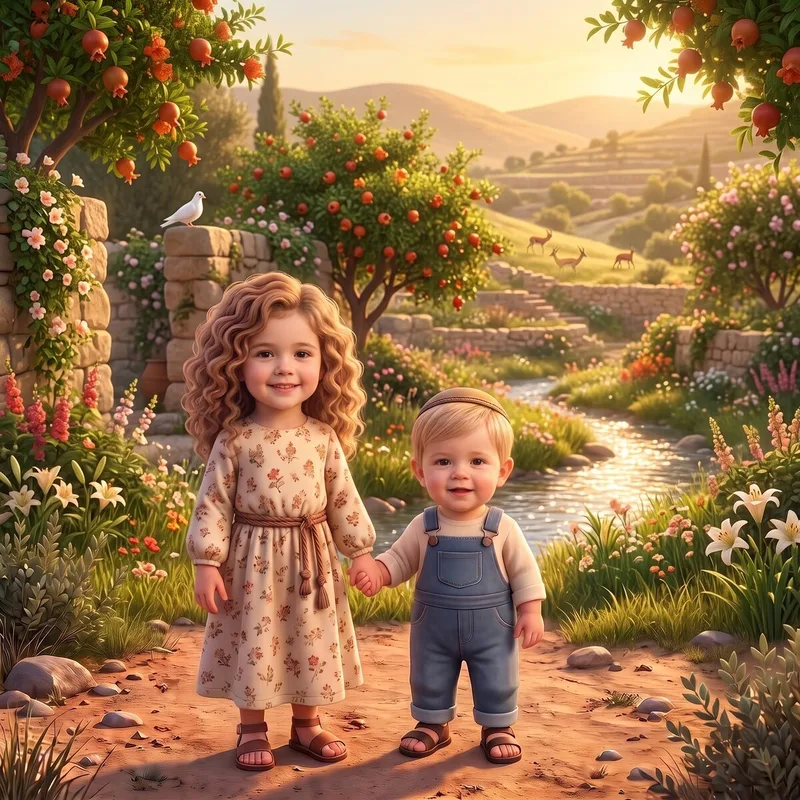
For children, a few pesukim are easy to picture. The sefer speaks of winter passing, the rains being over and gone, flowers appearing in the land and the sound of the turtledove being heard. Near its end it says that many waters cannot extinguish love. The meforshim explain that no hardship can put out the love between Hashem and Klal Yisrael.
One line many children already know from Elul is Ani l'dodi v'dodi li (6:3). You can tell a young child that it means: I belong to Hashem, and Hashem is with me.
Why do we read Shir HaShirim on Pesach?
Many communities read Shir HaShirim on Shabbos Chol HaMoed Pesach, and some also have a minhag to say it on erev Shabbos. One reason often given is the spring. The sefer speaks of winter passing and the land coming alive, and Pesach is the Yom Tov of spring.
The deeper connection is that Pesach is when Hashem took Bnei Yisrael out of Mitzrayim, and Chazal read Shir HaShirim as the story of that closeness through all the generations. If your family is learning about Pesach, The Pesach Story for Kids is a good companion, since the two connect naturally.
What is the lesson of Shir HaShirim for kids?
The lesson is that Hashem's love for us is real and steady, and that we show our love back by staying close to Him. For a child, that looks like small, ordinary things: saying Modeh Ani in the morning, making a bracha before eating, davening, keeping Shabbos with the family.
It also teaches that closeness is something we hold on to. When a day goes badly, a child can still say Shema at night and know that Hashem's love has not gone anywhere. That is the child's version of the pasuk about many waters not extinguishing love.
How do I explain Shir HaShirim to a 3-year-old, a 6-year-old and a 10-year-old?
- Ages 3 to 4: Keep it to one sentence. Shlomo HaMelech wrote a very special song about how much Hashem loves Yidden. Then ask who else loves your child, and tell them that Hashem loves them too.
- Ages 6 to 7: Talk about the springtime pesukim. Winter is over, flowers are growing and the birds are singing, and Shlomo HaMelech used pictures like these to teach about Hashem's love. Explain that a mashal is a story that teaches something bigger.
- Ages 10 to 12: Explain that Chazal read the whole sefer as a mashal for Hashem and Klal Yisrael through exile and geulah. Share what Rabbi Akiva said about the Holy of Holies, and ask why Chazal might have used a mashal here. Learn Rashi's introduction with a parent or rebbi.
With every age, learn the pesukim themselves with a rebbi or a parent who knows the meforshim, rather than reading them on your own.
What is a personalized Shir HaShirim book like?
Torah Tale's Shir HaShirim book comes from the Kesuvim collection, with your child's name and, from one uploaded photo, their likeness on every page in 3D animated-film style. It is written with careful rabbinical guidance and strict tznius, and reviewed by our team before it goes to print. If you add parents and grandparents with their photos, they appear with the children on a closing family page in every format.
Every book ends with a discussion page of 10 questions mixing comprehension with middos. That is what turns the book from something read to a child into something talked about at the table. A sibling set can share one book, with up to eight children from ages 0 to 18.

Softcover 8″×8″

Hardcover 8″×8″

Board book 6″×6″

Coloring book 8.5″×11″
The formats are matched to age: a 6x6 board book with rounded safety corners for ages 0-4, an 8x8 softcover for ages 4-8, and an 8x8 hardcover for ages 5-18. An optional matching coloring book is a weekday activity, for an erev Shabbos or weekday afternoon or for Chol HaMoed, and never for Shabbos or Yom Tov itself. The storybooks themselves are fine to read on Shabbos and Yom Tov.
What questions can we ask at the Shabbos table?
Reading and talking are exactly right for Shabbos. Here are questions to try, at the table or on a long Shabbos afternoon:
- Who wrote Shir HaShirim, and what is it called in English?
- What is a mashal, and can you think of one you know?
- What signs of spring are in the pesukim, and why might Shlomo HaMelech have chosen them?
- What is one thing we do every day to stay close to Hashem?
- When something is hard, how can we remember that Hashem's love is still with us?
For a weekday, take a walk on a spring afternoon before Pesach, or on Chol HaMoed, and look for new leaves and birds. Then talk about the pesukim that mention them. A story with a family theme, such as Megillas Rus for Kids, makes a good next step into the Megillos.
If you would like your child to meet this sefer as a book with their own name in it, you can create the book. It takes a free account and a few short questions, about five minutes in all.
Frequently asked questions
What is Shir HaShirim about, in simple words for a child?
Shir HaShirim is a song that Shlomo HaMelech wrote. Chazal and the meforshim teach that it is a mashal for the love between Hashem and Klal Yisrael, so for a child it is a song about how close Hashem is to us and how we love Hashem.
Who wrote Shir HaShirim?
The first pasuk calls it Shir HaShirim asher liShlomo, the song of Shlomo HaMelech. Chazal also credit Shlomo with Mishlei and Koheles.
Why do we read Shir HaShirim on Pesach?
Many communities read it on Shabbos Chol HaMoed Pesach. One reason often given is that its pesukim speak of winter passing and spring arriving, and Pesach falls in the spring. Chazal also read the sefer as following Klal Yisrael's journey, which begins with Yetzias Mitzrayim.
At what age can I start teaching my child about Shir HaShirim?
You can begin with a single sentence for a three- or four-year-old: Hashem loves you, and a song of Shlomo HaMelech says so. Older children can learn that it is a mashal and why Chazal called it the Holy of Holies. Learn the pesukim themselves with a rebbi or a parent who knows the meforshim.
Is there a personalized Torah Tale book about Shir HaShirim?
Yes, Shir HaShirim is one of the stories in the Kesuvim collection. Your child's name and likeness appear on every page in 3D animated-film style, and the book is written with careful rabbinical guidance and strict tznius. Every book ends with a discussion page of 10 questions mixing comprehension with middos.