A Shalom Zachor (שלום זכר) for Kids: Meaning & How to Explain It
A Shalom Zachor is the Friday night gathering for a newborn boy before his bris. Here is what happens, why we make one, and how to explain it to a young child.
Published by Torah Tale.
Create this book for your child
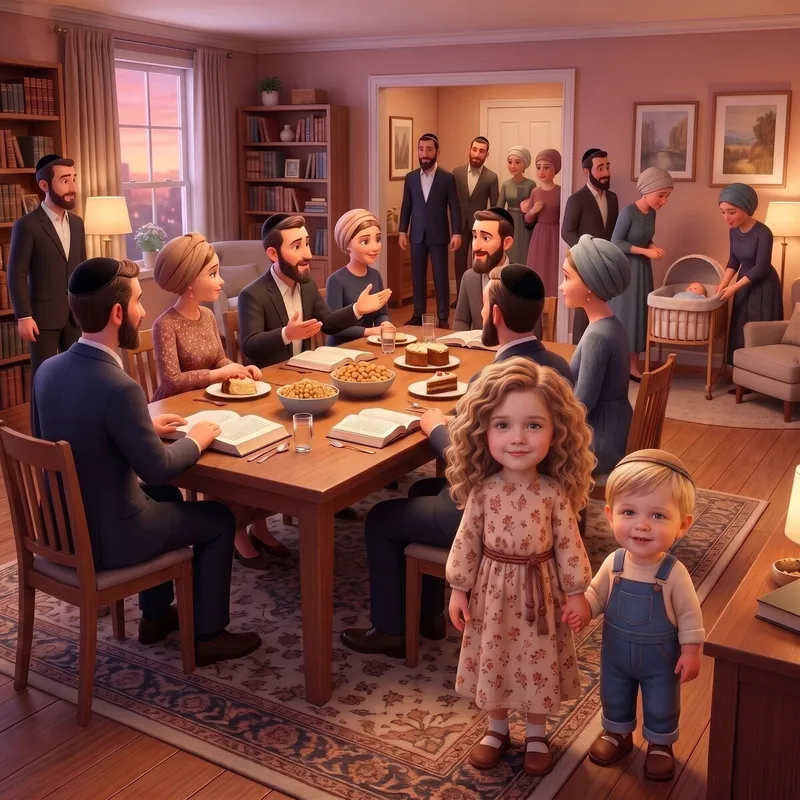
A Shalom Zachor (שלום זכר) is the gathering held at the home of a newborn boy, in many communities on Shabbos night before the bris. Friends and family come to wish mazal tov, share a l'chaim and some refreshments, and welcome the new baby. Children love it because the house fills with guests, there is something special to eat, and they get to be part of a simcha in their own home.
What is a Shalom Zachor?
The name is simple: shalom is peace and zachor is a male. It is a minhag, not a mitzvah written in the Torah, so the details differ from community to community and from family to family. If you are unsure what your family does, ask your rav or a grandparent.
In many communities it is held on the first Shabbos night after the baby is born, often after the Friday night meal. It is separate from the bris itself, which takes place on the eighth day. If you would like to explain that day to your children as well, see our article on Bris Milah for kids.
Why do we make a Shalom Zachor?
The Gemara in Maseches Nidah (30b) teaches that a baby is taught the entire Torah before he is born, and that he forgets it when he enters the world. Many explain the Shalom Zachor in this light: a gathering that welcomes the baby and expresses our hope that he will grow up to learn Torah. Other reasons are also given, and it is fine to tell a child that people have more than one way of understanding a minhag.
For a child, the simplest message is this: a new Yid has joined our family, and we welcome him with simcha, with brachos and with the hope that he will grow in Torah and mitzvos.
What happens at a Shalom Zachor?
Neighbors, friends and relatives come to the baby's home, usually in the evening of Shabbos. There are refreshments, singing, often a few words of Torah, and warm brachos for the parents. In many communities it is customary to serve chickpeas (arbis) among the other refreshments, and the foods and songs change from place to place.
Like everything on Shabbos, it is held without phones, cameras or any melacha. That helps children see a simcha that is made entirely of people, food, singing and Torah.
Older siblings can often take part in small ways, such as welcoming guests at the door or helping set out plates. Keep their jobs simple and safe for their age, and leave anything hot or heavy to the grown-ups.
How do I explain a Shalom Zachor to a young child?
The right words depend on the child. Here are three ways, for ages 3 to 4, 6 to 7 and 9 to 10.
Ages 3 to 4
Say it in a sentence or two: "We have a new baby boy. On Friday night our friends come to say mazal tov and to welcome him." Then show what will happen, such as the guests, the singing and the food. A small child needs to know who is coming and what the evening will look like.
Ages 6 to 7
At this age you can tell what the Gemara says: before a baby is born he is taught the whole Torah, and when he is born he forgets it. We welcome him with a simcha and hope that he will learn Torah as he grows. Children this age often ask, "Why does he forget?" It is fine to say that Chazal teach this and that we learn from it how precious Torah learning is.
Ages 9 to 10
Older children can look at the source in Nidah 30b and talk about it with you. They can also find out how your own family keeps the minhag: what Zaidy or Bubby did when the older children were born, and what the community does today. Learning that minhagim differ, and that each family keeps its own with care, is a real lesson in itself.
Shabbos table questions about the Shalom Zachor
These questions need only talking, so they fit the Shabbos table. Ask whichever suit your children:
- Who comes to a Shalom Zachor, and why do you think people come to a simcha like this?
- What does the Gemara in Nidah teach about a baby before he is born?
- How can a big brother or sister help make a new baby feel welcome?
- Why do we make a simcha before the bris and not only after it?
- What can we do so that every guest feels happy to be at our simcha?
For something to do with your hands, plan it for a weekday or erev Shabbos, never for Shabbos itself. Children can prepare a welcome picture or a small card for the baby, or help with simple baking before Shabbos. A matching coloring book is a weekday activity too.
What is a personalized Shalom Zachor book like?
A Shalom Zachor is one of the stories in the Jewish Life collection, which covers the simchos and minhagim of a Yiddishe life. In a Torah Tale book, the child receiving it is the hero: their name and, from one uploaded photo, their likeness appear on every page, illustrated in 3D animated-film style. Up to eight children, ages 0 to 18, can appear in the same book, so brothers and sisters can share one story about welcoming the baby.

Softcover 8″×8″

Hardcover 8″×8″

Board book 6″×6″

Coloring book 8.5″×11″
Every book ends with a discussion page of 10 questions about the story, mixing comprehension with middos. It turns the book from something read to a child into something talked about at the table. If you add parents, grandparents and other relatives with their photos, they appear with the children on a closing family page in every format.
There are three formats: a 6"x6" board book with rounded safety corners (ages 0-4), an 8"x8" softcover photo book (ages 4-8) and an 8"x8" hardcover photo book (ages 5-18). The softcover and hardcover open with a dedication page, and an optional matching 8.5"x11" black-and-white coloring book can be added, for weekday use. Reading is entirely appropriate on Shabbos, so a storybook is welcome at the Shabbos table.
Creating a book takes about five minutes. It needs a free account and a few short questions: each child's name, boy or girl, age and one photo, any siblings, the story, your community (asked once), the language and the format. Books can be ordered in English, Hebrew or Yiddish. For a story that focuses on the baby himself, see My New Baby Brother, and for a story about the Shabbos at home, see Shabbos with My Family.
The middos a Shalom Zachor brings out
A simcha is a good place to practice middos. A child learns to welcome guests, to share in someone else's happiness, to make room for a new baby in the family, and to say thank you to Hashem. A child who may feel a little left out by all the attention on the baby can be given a real part in the evening, and that often helps more than any lecture.
When you are ready, you can create the book and make your child the hero of a simcha they will recognize from their own home.
Frequently asked questions
What is a Shalom Zachor?
A Shalom Zachor is a gathering held in the home of a newborn boy's family, in many communities on Shabbos night before the bris. Friends and relatives come to wish mazal tov, share refreshments and welcome the baby. It is a minhag, and customs differ between communities.
When is a Shalom Zachor held?
In many communities it is held on the first Shabbos night after the baby is born, often after the Friday night meal, and before the bris on the eighth day. Questions such as a baby born on Shabbos or a bris that falls early in the week are best asked of your rav.
Why do we make a Shalom Zachor?
The Gemara in Nidah (30b) teaches that a baby learns the whole Torah before he is born and forgets it at birth. Many explain the Shalom Zachor in this light, as a gathering that welcomes the baby and expresses the hope that he will grow in Torah. Other reasons are also given, and families follow their own minhag.
How do I explain a Shalom Zachor to a young child?
Keep it simple and warm: a new baby boy joined our family, and on Friday night friends come to say mazal tov and welcome him. We thank Hashem and hope the baby grows up to learn Torah and do mitzvos. Let your child help in a small way, such as welcoming guests or setting out plates.
Is there a Torah Tale book about a Shalom Zachor?
Yes, A Shalom Zachor is one of the stories in the Jewish Life collection. The child's name and likeness, taken from one uploaded photo, appear on every page in 3D animated-film style, and up to eight children can appear in one book. Every book ends with a discussion page of 10 questions.