Sefer Amos for Kids: The Shepherd Navi, Honest Scales & Speaking Up
Amos was a shepherd from Tekoa whom Hashem sent to speak to Yisrael. Here is the story, its lesson about honesty and caring for others, and how to talk about it with a 4-year-old, an 8-year-old and an 11-year-old.
Published by Torah Tale.
Create this book for your child
Sefer Amos tells of a shepherd from Tekoa whom Hashem sent to speak to Yisrael, and children connect to him because he was an ordinary working man with a flock. He spoke the truth about honesty and caring for others, even when a powerful man told him to stop. It is a story about being sent, about tefillah for others, and about hope at the end.
Who was Amos, the shepherd navi?
The sefer opens by introducing him: 'The words of Amos, who was among the herdsmen of Tekoa.' The pasuk places his prophecy in the days of Uziyahu, king of Yehuda, and Yerovam ben Yoash, king of Yisrael, two years before the earthquake (Amos 1:1).
Later Amos describes himself as a herdsman and a tender of sycamore figs (7:14). Nothing in the pesukim makes him a person of rank. That is the first thing a child can hold onto: Hashem sent a man who spent his days outdoors with sheep and fig trees.
Amos is part of Trei Asar, the twelve shorter books of Nevi'im. Yonah is also in Trei Asar, and you can read about him in Yonah and the big fish.
What happens in Sefer Amos, retold for children?
Amos begins by speaking about the nations around Yisrael, such as Damesek, Aza, Tzor, Edom, Amon and Moav, and then about Yehuda. Then he speaks to Yisrael itself. The pasuk speaks of people who sold a poor person for the price of a pair of shoes (2:6), and later of merchants who made the measure small and the shekel big and cheated with false scales (8:5-6). Amos told them that Hashem sees this.
Amos was then shown two visions. In the first, locusts were about to eat the land's growth. Amos cried out, 'Hashem Elokim, please forgive! How can Yaakov stand, for he is small?' and the pasuk says Hashem relented, 'This shall not be' (7:1-3). In the second, a great fire was about to consume the land. Amos pleaded again, and Hashem relented again (7:4-6).
Then Amos was shown a plumb line, with Hashem saying He was setting it in the midst of His people (7:7-8). A plumb line shows whether a wall is straight. For a child, the picture is that Hashem looks at how we really behave.
Amaziah, the kohen of Beis El, sent word to the king and then told Amos to go back to Yehuda, earn his bread there and not prophesy at Beis El (7:10-13). Amos answered calmly. He said he was no navi by profession, but a herdsman and a tender of sycamore figs, and that Hashem took him from behind the flock and said, 'Go, prophesy to My people Yisrael' (7:14-15).
The sefer closes with hope. Hashem promises to raise up the fallen sukkah of Dovid (9:11), and to bring back His people, who will rebuild their cities, plant vineyards and gardens, and never be uprooted from their land again (9:14-15).
What is the lesson of Sefer Amos?
There are three ideas children can grasp, each tied to the pesukim.
- Hashem cares how we treat each other. Amos hoped to see justice flow 'like water, and tzedakah like a mighty stream' (5:24). Being fair with a friend, an honest customer or a worker is part of serving Hashem.
- An ordinary person can be sent. Amos did not come from a famous family of nevi'im. He did what Hashem told him, wherever he was told to go.
- We daven for others. Amos saw what was coming and pleaded for Yisrael. The pasuk shows him caring for the people he had to warn.
For a gentle parallel to a navi who felt too small for his task, see Yirmiyahu's call.
How do I explain Sefer Amos to a 4-year-old, an 8-year-old and an 11-year-old?
Age 4: Keep it short and concrete. Amos looked after sheep. Hashem picked him to tell the Yidden to be kind and honest. A man told him to go home, but Amos said Hashem sent him. Skip the visions.
Age 8: Add the scales and the two tefillos. Ask why a person would cheat with a measure, and why Amos davened for the same people he was warning. Children this age love the moment when Amos answers Amaziah.
Age 11: Talk about speaking up. Amos was not popular for it. The pasuk also says Hashem does nothing without revealing His secret to His servants the nevi'im (3:7), which is why a navi has to speak. Ask how to be honest without being harsh, and whether Amos's tefillah shows a navi who cares for the people he rebukes.
A shepherd also links to other stories your child may know, such as Dovid and Golyas, where Dovid was a shepherd too.
What can we talk about at the Shabbos table?
Reading the story at the table is a good fit for Shabbos. These questions are for talking only, with nothing to write or draw:
- What was Amos's job before Hashem sent him?
- Why do you think Amaziah wanted him to leave?
- Why did Amos daven for Yisrael instead of just warning them?
- What does it mean to be honest with a measure or a price?
- How can a child speak the truth when it is hard?
Parents can add a question of their own, such as 'When did you stay honest even though nobody would have known?'
What is a personalized Torah Tale book of Sefer Amos like?
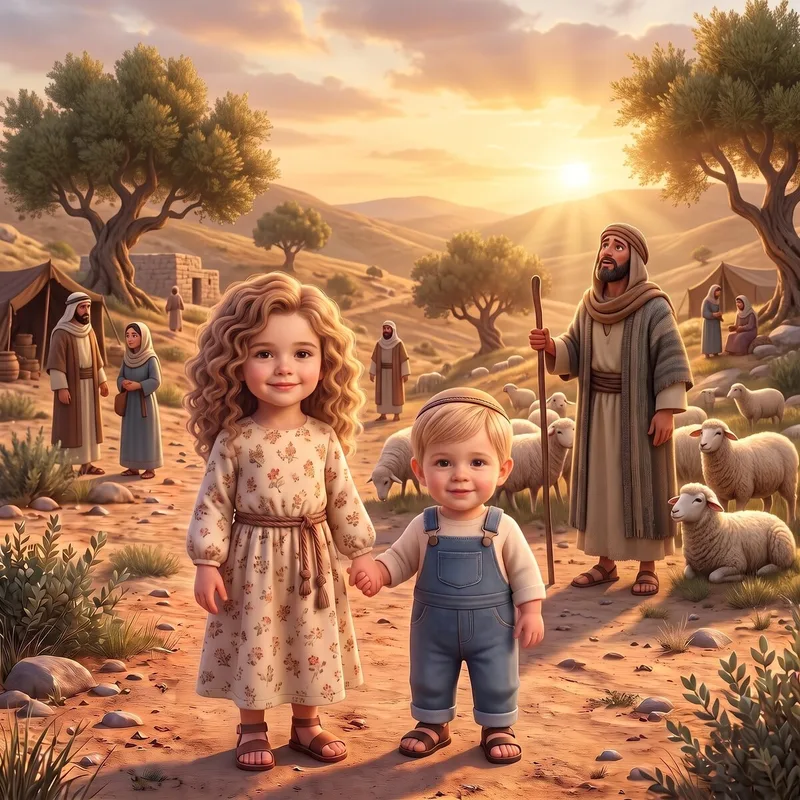
The Sefer Amos book is in the Nevi'im collection, in Sefer Trei Asar. Your child's name and likeness, from one uploaded photo, appear on every page in 3D animated-film style. Up to eight siblings, ages 0 to 18, can appear in the same book, and if you add parents and grandparents they appear with the children on a closing family page in every format.
Every book ends with a discussion page of 10 questions mixing comprehension with middos. That page is what turns a story read to a child into a conversation at the table.

Softcover 8″×8″

Hardcover 8″×8″

Board book 6″×6″

Coloring book 8.5″×11″
The board book is 6x6 with rounded safety corners, for ages 0-4. The softcover photo book is 8x8, for ages 4-8, and the hardcover photo book is 8x8, for ages 5-18. Softcover and hardcover open with a dedication page. The optional coloring book is 8.5x11 in black-and-white line art, and it is a weekday activity, for erev Shabbos or a weekday afternoon, never for Shabbos or Yom Tov. The book can be ordered in English, Hebrew or Yiddish.
Every book is written with careful rabbinical guidance and strict tznius, and our team reviews it before it goes to print. Customers do not preview or approve the book before printing.
You need a free account and a few short questions: each child's name, boy or girl, age and one photo, siblings, the story, your community (asked once), the language and the format. It takes about five minutes, and you can create the book now.
Frequently asked questions
Who was Amos HaNavi?
Amos was a shepherd from Tekoa who also tended sycamore fig trees. Hashem took him from behind the flock and sent him to prophesy to Yisrael in the days of Uziyahu, king of Yehuda, and Yerovam ben Yoash, king of Yisrael. His words are in Sefer Amos, one of the books of Trei Asar.
What is the lesson of Sefer Amos for children?
Hashem cares how we treat one another, including being honest in business and caring for people who have little. Amos also shows that an ordinary person can be sent by Hashem and that we should speak the truth even when someone tells us to stop. The sefer ends with hope, which is a good note to leave with a child.
How do I explain Amos to a 4-year-old?
Keep it to a few simple pictures: Amos looked after sheep, Hashem chose him to tell the Yidden to be kind and honest, and he did it even when a man told him to go away. Ask a small question such as 'What would you do if you found a lost sheep?' to connect it to caring for others. Leave out the visions and warnings for now.
Why did Amos say 'Lo navi anochi'?
Amaziah, the kohen of Beis El, told Amos to go back to Yehuda and earn his bread there. Amos answered that he was not a navi and not the son of a navi, but a herdsman and a tender of sycamore figs. He then said that Hashem took him from behind the flock and told him to go prophesy to His people Yisrael, so he was speaking because he was sent.
Is there a Torah Tale book about Sefer Amos?
Yes, it is in the Nevi'im collection, in Sefer Trei Asar. Your child's name and likeness, from one uploaded photo, appear on every page in 3D animated-film style, and up to eight siblings can share one book. The book ends with a discussion page of 10 questions mixing comprehension with middos.