Rivka and the Light in Sarah's Tent for Kids: Midrash & Lesson
Chazal tell that a light burned in Sarah's tent from one erev Shabbos to the next, and that it returned when Rivka came. Here is the story, its source, and how to tell it to a 3-year-old, a 6-year-old and a 10-year-old.
Published by Torah Tale.
Create this book for your child
The Midrash about Rivka and the light in Sarah's tent is a story Chazal tell on the pasuk where Yitzchak brings Rivka into his mother's tent. While Sarah lived, a light burned in the tent from one erev Shabbos to the next, there was blessing in the dough, and a cloud hung over the tent. When Sarah passed away these signs stopped, and when Rivka came they returned. Children connect to it quickly because the signs are things they know from home: a light, bread and Shabbos.
What is the Midrash about the light in Sarah's tent?
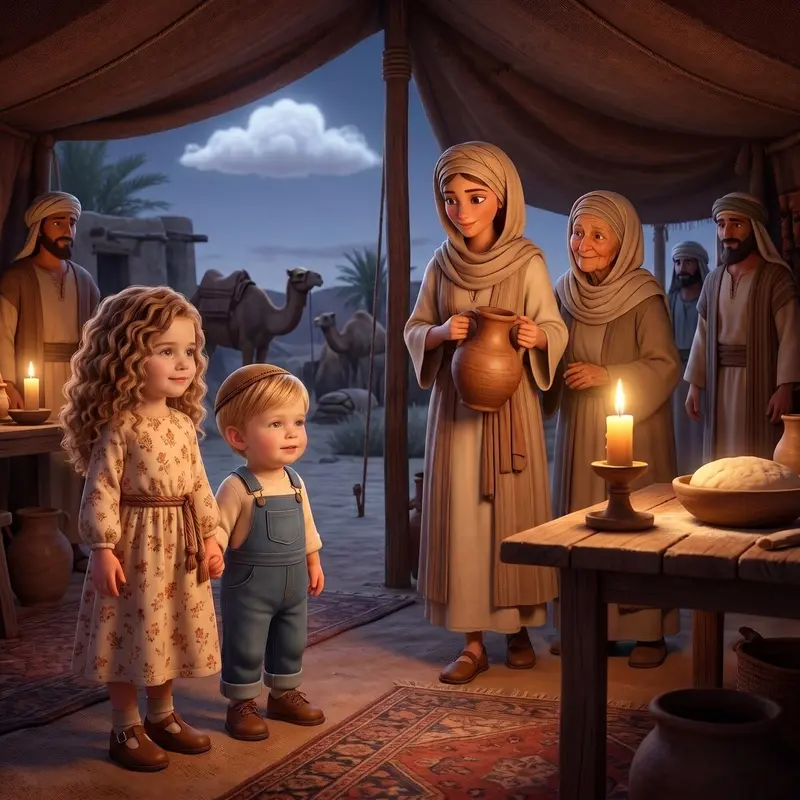
The Midrash relates that Sarah Imeinu's tent was different from other tents. A light stayed lit there from erev Shabbos until the next erev Shabbos. There was a special blessing in the dough, and a cloud hung over the tent.
Then Sarah passed away, and the three signs stopped.
Later Rivka was brought to Yitzchak, and he brought her into the tent of Sarah his mother. The Midrash says the light, the blessing in the dough and the cloud came back. That is the whole story, and it is best told simply, without adding to what Chazal say.
What does the pasuk say, and what does the Midrash add?
It helps to keep pshat and Midrash apart, even with young children. The Torah tells us in Bereishis 24:67 that Yitzchak brought Rivka into the tent of Sarah his mother, and that Yitzchak was comforted after his mother. That is pshat.
The three signs come from Chazal. The source is Bereishis Rabbah 60:16, and Rashi brings it on the words about the tent of Sarah his mother. Rashi explains that Rivka became like Sarah, Yitzchak's mother, and then lists the light, the blessing in the dough and the cloud, which stopped when Sarah died and returned when Rivka came.
The Midrash does not tell us how the light was lit or what Rivka did each day, so we do not invent it. If your child asks, it is fine to say, Chazal tell us this much, and we leave it there.
What is the lesson for children?
The Midrash lists the signs and does not state a moral, so the lessons below are ones we draw from it. First, a home can have something special about it, and people feel it. A light that burns all week, bread that is blessed and a cloud over the tent describe a home close to Hashem.
Second, goodness can be carried forward. Rashi says Rivka became like Sarah, and the signs came back with her. A child can understand that when we keep the good ways of our grandparents and parents, we keep something alive.
Third, we know Rivka from the pasuk as someone who gave water generously to a stranger and his camels. It is natural for a child to see that the person who showed such chesed is the person Chazal describe in Sarah's tent.
You can also connect this story to Avraham's tent with four doors, another Midrash about the open, welcoming home of the Avos.
How do I explain it to a 3-year-old, a 6-year-old and a 10-year-old?
Around age 3: Use one picture. Sarah's tent had a light that stayed lit all week. When Rivka came, the light came back. Point to the Shabbos candlesticks. Repeat it as often as your child wants.
Around age 6: Add the three signs and count them on your fingers: a light, blessing in the dough, a cloud. Explain that the Torah says Yitzchak brought Rivka into Sarah's tent, and Chazal tell us what the tent was like. Ask what a home can have that people can feel, such as Shabbos, kindness and a warm welcome.
Around age 10: Talk about the source. Open a Chumash to Bereishis 24:67 and read the pasuk together, then show where Rashi brings the Midrash. Ask why Chazal tell us the signs stopped when Sarah died and returned with Rivka, and what that says about how a home continues from one generation to the next.

Softcover 8″×8″

Hardcover 8″×8″

Board book 6″×6″

Coloring book 8.5″×11″
What questions can we ask at the Shabbos table?
Talking, questions and stories are all right for Shabbos. Here are some to try:
- How many signs were in Sarah's tent, and what were they?
- Which part is written in the pasuk, and which part do Chazal tell us?
- What was Rivka known for at the well, and why might it matter here?
- What makes our home feel special on Shabbos?
- What is something good from Bubby or Zaidy's home that we want to keep?
For a weekday, such as erev Shabbos afternoon, a child can help a grown-up set out the candlesticks and prepare the challah while you tell the Midrash. Lighting stays with the grown-ups. Coloring is also a weekday activity only, never for Shabbos or Yom Tov.
What is a personalized book of this story like?
Torah Tale's book of this story is in the Midrash & Aggadah collection, which tells the stories Chazal tell behind the pesukim, each from its named source in the Gemara or Midrash, and does not add to what the source says. Your child's name and, from one uploaded photo, their likeness appear on every page, illustrated in 3D animated-film style.
Every book ends with a discussion page of 10 questions mixing comprehension with middos. That turns a story read to your child into one that gets talked about at the table. If you add parents and grandparents, they appear with the children on a closing family page in every format.
There are three formats. The 6x6 board book has rounded safety corners and suits ages 0-4. The 8x8 softcover suits ages 4-8, and the 8x8 hardcover suits ages 5-18. Softcover and hardcover open with a dedication page. An optional matching coloring book (8.5x11, black-and-white line art) can be added for weekday afternoons. The book is written with careful rabbinical guidance and strict tznius, and our team reviews it before it goes to print.
Creating a book takes about five minutes. You open a free account and answer a few short questions: each child's name, boy or girl, age and one photo, any siblings, the story, your family's community (asked once), the language and the format. English, Hebrew and Yiddish are available.

Where does this story fit with the parsha?
The pasuk about Yitzchak and Rivka is in Parshas Chayei Sarah, so this Midrash is a natural one to tell when that parsha comes around. Our article on Parshas Chayei Sarah for kids covers Rivka at the well and the camels, which is the pshat that leads into this scene.
When you are ready, you can create the book and choose this story from the Midrash & Aggadah category.
Frequently asked questions
What is the story of the light in Sarah's tent?
Chazal tell us in Bereishis Rabbah that while Sarah Imeinu lived, a light burned in her tent from one erev Shabbos to the next, there was blessing in the dough, and a cloud hung over the tent. When Sarah passed away these signs stopped, and when Rivka came into the tent they returned. Rashi brings this on the pasuk where Yitzchak brings Rivka into his mother's tent.
Is the light in Sarah's tent written in the Torah?
No. The Torah tells us only that Yitzchak brought Rivka into the tent of Sarah his mother and that he was comforted after his mother. The light, the blessing in the dough and the cloud are told by Chazal in the Midrash, and it is good to say that to children so they know which part is pasuk and which is Midrash.
How do I explain this Midrash to a 3-year-old?
Keep it to one sentence and a picture: Sarah's tent had a light that stayed lit all week, and when Rivka came, the light came back. Connect it to something your child sees, such as the Shabbos candles, and leave the cloud and the dough for when your child asks. Young children usually enjoy simply hearing that a home can feel warm and special.
What is the lesson of Rivka and the light in Sarah's tent?
The Midrash tells the three signs without stating a moral, so the lesson is what we draw from it. Rashi explains that Rivka became like Sarah, Yitzchak's mother, which teaches children that the goodness of a home can be carried forward by the people who come after. It also fits the chesed the Torah shows us in Rivka at the well.
Is there a children's book about Rivka and the light in Sarah's tent?
Yes, Torah Tale has a personalized book of this story in its Midrash & Aggadah collection, with your child's name and likeness illustrated in 3D animated-film style. It comes as a 6x6 board book with rounded safety corners (ages 0-4), an 8x8 softcover (ages 4-8) or an 8x8 hardcover (ages 5-18), and ends with a discussion page of 10 questions.