Returning a Lost Object (השבת אבידה) for Kids
Returning a lost object is a mitzvah every child can keep this week. Here is where it comes from, how to explain it to a 4, 8 and 11-year-old, and questions for the Shabbos table.
Published by Torah Tale.
Create this book for your child
Returning a lost object (hashavas aveidah) is the mitzvah of giving back something that belongs to someone else when you find it, and children grasp it quickly because every child has lost something and remembers how that felt. The Torah Tale story of this mitzvah is set in everyday life today, with your child as the hero who notices, does not walk past, and gets the item back to its owner. This page explains the mitzvah, how to talk about it at different ages, and what the book gives you to work with.
Where is returning a lost object in the Torah?
The mitzvah is in Parshas Ki Seitzei, Devarim 22:1-3. The Torah says that if you see your brother's ox or sheep wandering, you may not ignore it, and you must bring it back to him.
The Torah continues: if the owner is not nearby, or you do not know him, you bring the animal into your house and keep it with you until he comes looking for it. Then you give it back. The Torah adds that the same applies to his donkey, to his garment, and to any lost item of your brother's, and that you may not ignore it.
The halachos of lost objects are detailed, and Chazal discuss them at length in Maseches Bava Metzia. For a real situation, such as money found on the street or an item with no name on it, ask your rav. For children, the heart of it is simple, and you can find the wider parsha in our article on Parshas Ki Seitzei for kids.
What does the Torah Tale story of returning a lost object show?
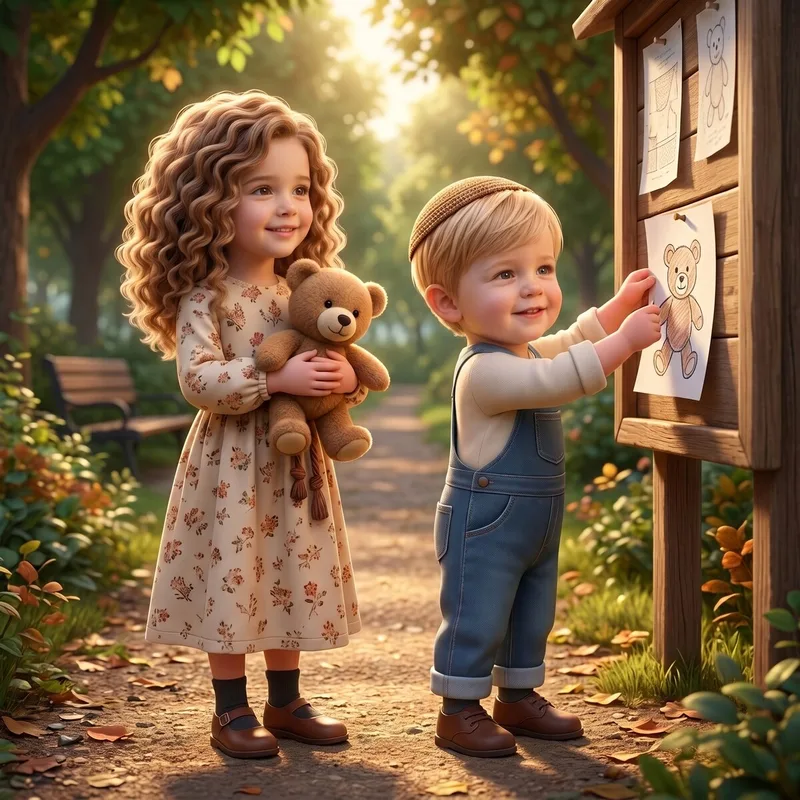
This book is part of the Mitzvos collection, which is about mitzvos a child keeps, set in everyday life today. Rather than a scene from the days of the Torah, it puts your child, with their name and their likeness from the photo you upload, into a modern child's world, keeping this mitzvah.
However the details play out, the mitzvah has three steps a child can say out loud:
- Notice. Something is here that belongs to somebody.
- Do not ignore it. The Torah's own words are that you may not look away.
- Get it back. Bring it to a grown-up, a teacher or the place where lost items are kept, so the owner can find it.
What is the lesson of returning a lost object?
The first lesson is that someone else's loss matters to us. Notice that the Torah calls the owner your brother. A lost item is not a stranger's problem, it is a fellow Yid's, and we are asked to care about it.
The second lesson is honesty. A found item can easily become mine if nobody is watching, and the mitzvah asks a child to do the harder thing. This is closely connected to never taking what is not mine, and it is also a quiet form of chesed, as in a helping hand.
How do I explain returning a lost object to a 4-year-old, an 8-year-old and an 11-year-old?
A 4-year-old. Use one sentence and a real object: "If it is not ours, we give it to a grown-up so it can go back to the person who lost it." Hold up a single mitten and ask, "How would you feel if this were yours and you could not find it?" Feelings come first at this age, rules later.
An 8-year-old. Now add the owner. Who might be looking for this? How could we find out whose it is? Talk about what happens in school and shul, where a sweater or a siddur is left behind, and who the right grown-up is to bring it to. Make clear that finders keepers is not the Torah's way.
An 11-year-old. Add the hard part: nobody saw, the item is small, and it would be easy to say it was not worth the trouble. The Torah says you may not ignore it, so the question becomes what it costs to do the right thing and whether it is worth it. This is also a good age to tell them that the halachos have details, such as how an owner identifies an item, and to ask your rav together.
What can we talk about at the Shabbos table?
Reading a storybook is appropriate on Shabbos, and talking about a mitzvah is an easy fit for the table. These questions need no props:
- Has something of yours ever been lost? How did it feel when you got it back?
- What do you do if you find something and you do not know whose it is?
- Why do you think the Torah calls the owner "your brother"?
- Is it harder to return something when nobody is watching? Why?
- Who is a grown-up we could ask if we were not sure what to do?
Every Torah Tale book also ends with a discussion page of 10 questions about the story, mixing comprehension with middos: what happened, and what it asks of the child. That is what turns the book from something read to a child into something talked about at the table.
What is a personalized Torah Tale book of this story like?
Your child is the hero. Their name and, from one uploaded photo, their likeness appear on every page, illustrated in 3D animated-film style. Up to eight siblings, ages 0 to 18, can appear in the same book. If you add parents, grandparents and other relatives with their photos, they appear with the children on a closing family page in every format.
There are three formats, chosen by age: a board book (6x6, rounded safety corners, ages 0-4), a softcover photo book (8x8, ages 4-8) and a hardcover photo book (8x8, ages 5-18). Softcover and hardcover open with a dedication page. The books are written with careful rabbinical guidance and strict tznius, and reviewed by our team before they go to print.

Softcover 8″×8″

Hardcover 8″×8″

Board book 6″×6″

Coloring book 8.5″×11″
A matching coloring book (8.5x11, black-and-white line art) can be added to a one-time order. It is a weekday activity, never for Shabbos or Yom Tov. If you would like a few books on mitzvos together, a collection subscription is available as Monthly (4 books a month in one delivery) or Yearly (the whole collection, paid once, $30 off), with each plan covering only that collection's own books.
How can we practice returning a lost object this week?
Children learn this mitzvah by doing it, so make it small and familiar:
- Set up a found-items spot at home. A basket by the door works for a stray sock, a toy from a friend or a borrowed book, until it goes back to its owner.
- Play "whose is it?" Put a few items on the table and have your child suggest how to find each owner.
- Name it when it happens. When your child hands you a found item, say plainly, "That was hashavas aveidah. You did a mitzvah."
- Weekday coloring. If you add the coloring book, keep it for a weekday afternoon or erev Shabbos, and talk about the story while the crayons come out.
Remind your child to bring found things to a grown-up rather than carrying them far alone, and to tell a grown-up straight away about anything that looks valuable or unsafe.
How do I order the book?
Creating a book takes about five minutes. You make a free account and answer a few short questions: each child's name, boy or girl, age and one photo, any siblings, the story, your community (asked once), the language (English, Hebrew or Yiddish) and the printed format. The story picker has the Mitzvos category where you will find this story.

When you are ready, you can create the book and give your child a story where they are the one who does not look away.
Frequently asked questions
What is the mitzvah of hashavas aveidah?
Hashavas aveidah is the mitzvah to return a lost object to its owner. The Torah teaches it in Parshas Ki Seitzei, Devarim 22:1-3, where it says you may not ignore something your brother lost, and that you must keep it safe and give it back. The halachos of what to do in each situation are detailed, so ask your rav about real cases.
How do I explain returning a lost object to a 4-year-old?
Keep it to one sentence: if something is not yours, we bring it to a grown-up so it can go back to the person who lost it. Hold up a real item, such as a single mitten, and ask how the child would feel if it were theirs. Young children understand this best through a feeling they already know.
What is the lesson of returning a lost object?
The lesson is that another person's loss matters, and that we do not look away when we can help. The Torah calls the owner your brother, which teaches us to treat his lost item as something we care about. It is also a lesson in honesty, because it asks a child to do the right thing even when nobody would know.
Is there a Torah Tale book about returning a lost object?
Yes. Returning a Lost Object (השבת אבידה) is in the Mitzvos collection, which is about mitzvos a child keeps, set in everyday life today. The book stars your child by name and likeness, and ends with a discussion page of 10 questions mixing comprehension with middos.
Which Torah Tale format suits this book for my child's age?
The board book (6x6, rounded safety corners) is for ages 0-4, the softcover (8x8) is for ages 4-8, and the hardcover (8x8) is for ages 5-18. Your child's age is one of the few short questions in the book creator. An optional matching coloring book is a weekday activity only, never for Shabbos or Yom Tov.
Can we read the book on Shabbos?
Yes. Reading a storybook is appropriate on Shabbos and Yom Tov, and the discussion page works well for talking at the Shabbos table. Coloring is melacha, so keep the optional coloring book for weekdays.