Rabbeinu Tam for Kids: Rashi's Grandson & the Tosafos
Rabbeinu Tam was Rashi's grandson and one of the great leaders of the Baalei HaTosafos. Here is who he was, how to tell his story to children from the youngest to the preteens, and questions for the Shabbos table.
Published by Torah Tale.
Create this book for your child
Rabbeinu Tam was a great Torah teacher in France in the twelfth century, a grandson of Rashi, and a leader of the Baalei HaTosafos, the teachers who asked and answered questions on the Gemara. Children connect with him because he shows that a person can love Torah deeply and still ask, "But how can that be?" The idea is simple enough to say in one sentence, and it grows as the child grows.
Who was Rabbeinu Tam?
His name was Rabbi Yaakov ben Meir. His mother was Rashi's daughter, which makes Rashi his grandfather. His brother, the Rashbam, was also a talmid chacham and also a grandson of Rashi.
Rabbeinu means "our teacher," and that is how Yidden have spoken about him for centuries. He is counted among the Rishonim, the great teachers of the period after the Geonim. You can read about two others in our articles on Rabbeinu Gershom Me'or HaGolah and Rabbeinu Chananel.
Why is he called "Tam"?
His own name was Yaakov. The name Tam is commonly connected to Yaakov Avinu, about whom the Torah says ish tam yosheiv ohalim (Bereishis 25:27). Tam is a word for someone wholehearted and sincere.
This is a nice thing to tell a child, because it gives them a picture of what the title means: a person with a whole heart who sits and learns.
What did Rabbeinu Tam do? The story for children
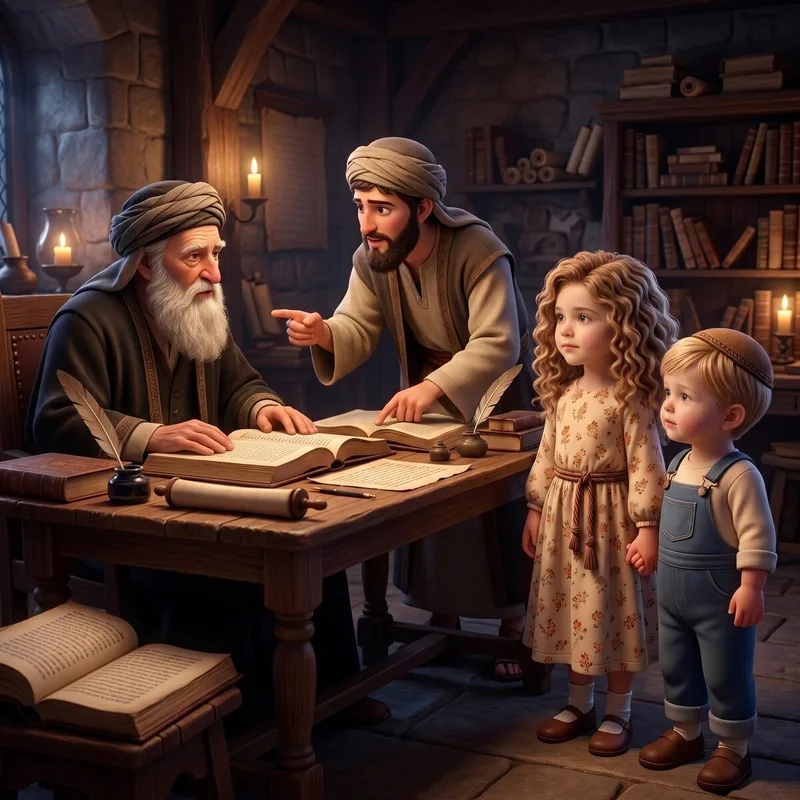
Imagine a beis midrash in France. A group of talmidim sit with the Gemara open. Rashi's commentary explains the words and the pshat, and now these students read it very carefully and ask: "Why does it say it this way? Does this agree with another Gemara we learned? How do we resolve it?"
Rabbeinu Tam was one of the great leaders of these teachers. The questions and answers that came out of such learning are called Tosafos, which means "additions." They are printed on the page of the Gemara opposite Rashi, so a child can open a Gemara and see both with their own eyes.
He also wrote a work called Sefer HaYashar. And he respectfully disagreed at times with the great teachers before him, including Rashi, his own grandfather. For children, that is the heart of it: a grandson who loved his grandfather's Torah so much that he wanted to understand it down to the last detail.
A hard time in his life
For older children, and at a parent's discretion, there is a sadder chapter. During the Second Crusade, Yidden in northern France were in danger. Accounts from the time record that Rabbeinu Tam was hurt and that a local nobleman who knew him helped him get away. Keep this part brief and gentle for younger children. What matters for them is that he stayed a Torah teacher for the rest of his life.
What is the lesson for a child?
The first lesson is that a respectful question is a way of loving Torah. A child who asks "why?" is not being difficult, as long as the question is asked with respect for the teacher and for the Torah. That is something you can tell your child directly when the questions come.
The second lesson is about family. Torah passed from Rashi to his daughter's sons, and a home that values learning can give it to the next generation. The third is middos: to disagree, you need to listen first, and to disagree respectfully, you need to care about the person you disagree with.
How do I explain Rabbeinu Tam to different ages?
For a 4-year-old, say one sentence: "Rabbeinu Tam was a very great Torah teacher, Rashi's grandson, and he loved to learn and ask careful questions." Then ask, "What do you like to learn about?"
For a 7- or 8-year-old, show a Gemara page if you have one. Point to Rashi and to Tosafos and explain that Tosafos are questions and answers from teachers like Rabbeinu Tam. Ask your child to think of a question they asked in cheder or school this week and how they asked it.
For a child of 10 to 12, mention that Rabbeinu Tam had well-known opinions that differ from Rashi's, and that this is not a fight but part of learning. A good example is tefillin: Rashi and Rabbeinu Tam differ about the order of the parshiyos inside the tefillin. Some people put on a second pair, so that they follow both. Ask your rav about the minhag in your family. Our article on putting on tefillin is a good companion.
Another place children may hear his name is at the end of Shabbos. The calendar lists a later time called Rabbeinu Tam's zman, and some Yidden wait until then to end Shabbos. Which time your family follows is a question for your rav.
Questions for the Shabbos table
Reading and talking are right for Shabbos. Here are questions to ask, with no pens or paper needed:
- Who was Rabbeinu Tam's grandfather, and what did he write?
- What are Tosafos, and where on the Gemara page can you find them?
- When is a question a good way to show respect to a teacher?
- Why do you think the Torah calls Yaakov Avinu an ish tam?
- Is there something you learned from a grandparent that you want to pass on?
During the week, you can look at a Gemara page together or flip through a sefer of Tosafos. Keep it for a weekday, since any drawing or writing activity belongs there.
What is a personalized Rabbeinu Tam book like?
Torah Tale has a book about Rabbeinu Tam in its Stories of Tzaddikim collection. Your child's name and likeness, from one uploaded photo, appear on every page in 3D animated-film style. If you have more than one child, up to eight can appear in the same book, ages 0 to 18.

Softcover 8″×8″

Hardcover 8″×8″

Board book 6″×6″

Coloring book 8.5″×11″
There are three formats: a board book (6x6, rounded safety corners, ages 0-4), a softcover (8x8, ages 4-8) and a hardcover (8x8, ages 5-18). The softcover and hardcover open with a dedication page. If you add parents and grandparents with their photos, they appear with the children on a closing family page in every format. An optional matching coloring book (8.5x11, black-and-white line art) can be added as a weekday activity for erev Shabbos or a weekday afternoon.
Every book ends with a discussion page of ten questions that mix comprehension with middos. That page turns reading into a conversation at the table. Each book is written with careful rabbinical guidance and strict tznius and reviewed by our team before it goes to print. Customers do not preview the book before printing.
How do I order one?
Creating a book needs a free account and a few short questions: each child's name, boy or girl, age and one photo, any siblings, the story, your community (asked once), the language and the format. The languages are English, Hebrew and Yiddish. The whole flow takes about five minutes. If you would like a series, a collection subscription is available as well.
When you are ready, you can create the book and give your child a Rishon who loved to learn, ask and teach.
Frequently asked questions
Who was Rabbeinu Tam, in simple words for a child?
Rabbeinu Tam was a great Torah teacher in France about nine hundred years ago. He was Rashi's grandson, and he and his students asked careful questions on the Gemara. Their answers and questions are called Tosafos.
Why is he called Rabbeinu Tam?
His own name was Yaakov, and Rabbeinu means our teacher. The name Tam is commonly connected to Yaakov Avinu, whom the Torah calls an ish tam, a wholehearted person (Bereishis 25:27). It is a respectful title that Yidden have used for him ever since.
What are Tosafos, and how do I show them to a child?
Tosafos are explanations and questions on the Gemara written by the Baalei HaTosafos, the teachers of France and the surrounding lands, among them Rabbeinu Tam. Open any printed Gemara and show your child Rashi on one side of the page and Tosafos on the other. Let the child find the two blocks of smaller writing.
What is the lesson of Rabbeinu Tam for children?
One lesson is that asking a respectful question is a way of loving the Torah, because a question shows you want to understand it truly. Another is that a family can be devoted to Torah across generations, as Rashi's daughter's sons were. Both lessons can be taught at any age.
What age is a story about Rabbeinu Tam right for?
A young child can hear a one-sentence version about a great teacher who was Rashi's grandson. A school-age child can follow the idea of Tosafos and questions on the Gemara. Older children can learn about his well-known opinions, such as the order of the parshiyos in tefillin.
Can my child be the hero of a Rabbeinu Tam book?
Yes. Torah Tale makes personalized storybooks in which your child's name and likeness, from one uploaded photo, appear on every page in 3D animated-film style. Up to eight children can appear in one book, and every book ends with a discussion page of ten questions.