Putting on Tefillin (תפילין) for Kids: The Boxes & the Order
Tefillin are two black leather boxes holding four parshiyos written by a sofer, worn on the arm and the head at Shacharis on weekdays. Here is how to explain the mitzvah to a child at ages 3 to 4, 6 to 7 and 9 to 12, what happens in the story, and questions to ask at the Shabbos table.
Published by Torah Tale.
Create this book for your child
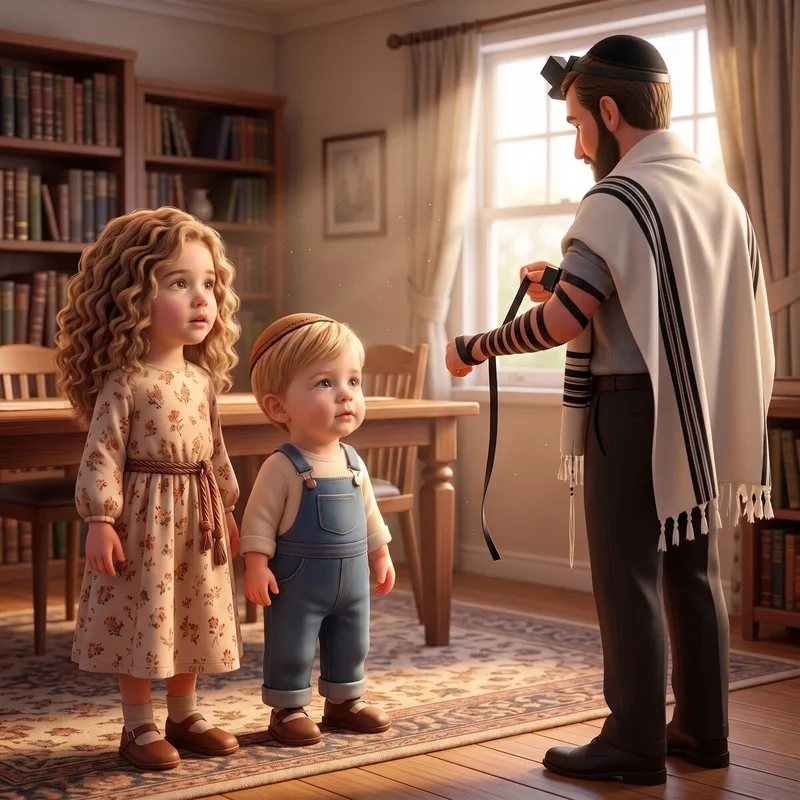
Putting on tefillin is a mitzvah a Jewish boy keeps every weekday morning once he reaches bar mitzvah age: two black leather boxes, each holding parshiyos of the Torah written by a sofer on klaf, one tied on the arm opposite the heart and one set on the head. It lands with children because it is a mitzvah you can see and hold. There is a bag, there are straps to wrap, there is an order to follow, and there is a moment when a boy stops watching his father do it and does it himself.
This story belongs to the collection of mitzvos a child keeps, set in everyday life today, which is exactly where it is learned best: not as a far-off halacha but as something that happens in your own kitchen before school.
What are tefillin, in words a child understands?
Tefillin are two batim, boxes, made of leather and painted black. Inside each one are small pieces of klaf with words of the Torah written by hand by a sofer, the same careful writing used for a mezuzah.
There are four parshiyos inside: Kadesh (Shemos 13:1-10), V'haya ki yeviacha (Shemos 13:11-16), Shema (Devarim 6:4-9) and V'haya im shamoa (Devarim 11:13-21). All four of them mention the mitzvah of tefillin. In the shel yad all four are written on one klaf and placed in a single compartment. In the shel rosh they are written on four separate klafim, one in each of the four compartments.
Two of those four parshiyos, Shema and V'haya im shamoa, are also the ones inside the mezuzah on the door. Children find that connection satisfying: the same words guard the house and go out with a Yid on his arm.
The Torah says, Ukshartam l'os al yadecha v'hayu l'totafos bein einecha - bind them as a sign on your arm, and they shall be totafos between your eyes. Chazal teach that "between your eyes" means the upper part of the head, in line between the eyes and above the hairline, not on the forehead itself.
What happens when a boy puts on tefillin?
The order is part of the mitzvah, and it is the part a child can learn by heart long before he is obligated.
- The shel yad goes on first, on the weaker arm. A right-handed boy wears it on his left arm, a left-handed boy on his right; if there is any question, ask a rav.
- The bayis sits on the upper arm, tilted toward the heart, and the knot is drawn tight.
- The bracha is said before tightening; the exact wording and whether there is a second bracha on the shel rosh follows the family's minhag.
- The strap is wound around the forearm - many wrap seven times, according to their minhag.
- The shel rosh is placed on the head above the hairline, centered, with the knot at the back of the head at the nape.
- The rest of the strap is wound around the hand and fingers, again according to minhag, usually three times around the finger.
Many are careful not to talk at all between the shel yad and the shel rosh. When tefillin come off, the order reverses: the shel rosh first, the shel yad last.
On the box of the shel rosh there is a letter shin on each side, one with three heads and one with four. The knot of the shel rosh is shaped like a daled and the knot of the shel yad like a yud, so that together with the shin they spell a Name of Hashem.
What is the lesson of tefillin for children?
The simplest way to say it: the arm, the head and the heart. The shel yad rests opposite the heart, the shel rosh sits over the mind, and the strap runs down to the hand that does things. A Yid does not serve Hashem with only one part of himself. What he feels, what he thinks and what he does are all tied to the same words.
There is a second middah here that children feel even earlier, and that is kavod for something holy. Tefillin are not left on a chair. They are not dropped. The bag is carried with two hands. A boy who has learned that a tefillin bag is treated with care has learned something about how a Yid treats everything that belongs to Hashem, the same way tzitzis teach a child that a mitzvah can be worn all day.
And a third: tefillin are a weekday mitzvah, and that itself is a lesson. We put them on for the ordinary mornings, the rushed ones, the ones where everyone is looking for a shoe. The mitzvah belongs to real life, not only to special days.
How to explain tefillin at different ages
Ages 3 to 4. Keep it to one picture. "These little black boxes have words from the Torah inside. Totty ties one near his heart and one on his head, so his whole self belongs to Hashem." Let him watch the wrapping. Give him a safe job he can really do, like bringing the tefillin bag to the table before davening, carried with two hands.
Ages 6 to 7. Now the order matters, and children this age love an order. Shel yad first, shel rosh second; coming off, shel rosh first. Tell him what is inside, and that a sofer wrote it by hand. Mention that we do not wear tefillin on Shabbos or Yom Tov and ask him if he can guess why before you explain.
Ages 9 to 12. This is the age to teach the mitzvah properly, because for many boys it is only a year or two away. Talk about guf naki, keeping a clean body and clean thoughts while the tefillin are on. Talk about where the shel rosh sits and why it must be above the hairline. Talk about tefillin being checked by a sofer. And talk about the fact that he will one day own a pair, and that owning them is a responsibility, not only a present. If he is approaching thirteen, pair this with the conversation about what a bar mitzvah actually is.
Shabbos table questions about tefillin
Shabbos morning, with no tefillin on the table, is a surprisingly good time to talk about them. These are for talking only.
- Why are there no tefillin in shul today?
- What is written inside tefillin, and who writes it?
- Why do you think the mitzvah is on the arm and the head, and not somewhere else?
- What is one thing in our house that we treat with extra kavod, and why?
- Which comes off first when tefillin are removed, and why do you think that is the order?
- What is something you can do with your hands this week that Hashem would want?
For a weekday activity, an older brother can show a younger one the shape of the shin on the box and let him count the wraps out loud. If you add the matching coloring book to an order, that is a weekday or erev Shabbos activity, never for Shabbos or Yom Tov itself.
What is the Torah Tale book of this story like?
Torah Tale prints personalized Torah storybooks in which the child who receives the book is the hero. From one uploaded photo, your child's name and likeness appear on every page, illustrated in high-resolution 3D animated-film style, so the boy in the story putting on tefillin on an ordinary weekday morning looks like the boy sitting next to you.
Up to eight siblings, ages 0 to 18, can appear in the same book. If you add parents and grandparents with their photos, they appear with the children on a closing family page, in every format.

Softcover 8″×8″

Hardcover 8″×8″

Board book 6″×6″

Coloring book 8.5″×11″
There are three formats: a 6x6 board book with rounded safety corners for ages 0-4, an 8x8 softcover for ages 4-8, and an 8x8 hardcover for ages 5-18. For a boy nearing bar mitzvah, the hardcover is the one that stays on the shelf. The softcover and hardcover open with a dedication page, which is where a grandparent's words belong. There is also an optional matching coloring book in black-and-white line art, a weekday add-on.
Every book ends with a discussion page carrying ten questions about the story, mixing comprehension with middos: what happened, and what it asks of the child. That page is what turns a book from something you read to your child into something the table talks about. Every Torah Tale book is written with careful rabbinical guidance and strict tznius and reviewed by our team before it goes to print.

Putting on Tefillin sits in the Mitzvos category of the story picker. You can order it as a single book, or take the Mitzvos & Middos collection as a subscription - monthly, four books a month in one delivery, or yearly, paid once with $30 off, still four books a month until the collection is done. Reading it is entirely appropriate on Shabbos and Yom Tov, which is when most families actually sit down together.
Say it in one sentence
If you have thirty seconds in the car: "Tefillin are two boxes with words of the Torah inside. One goes near the heart and one on the head, and when a boy turns thirteen he puts them on every weekday morning, because everything he feels and thinks and does belongs to Hashem." That sentence will hold a child until he is ready for the halachos, and it will still be true when he is.
Creating a book takes about five minutes and a free account, with a few short questions: each child's name, boy or girl, age and one photo, any siblings, the story, your community (asked once), the language - English, Hebrew or Yiddish - and the printed format. You can create the book and see your own child holding the tefillin bag on the page.
Frequently asked questions
At what age does a boy start putting on tefillin?
The obligation begins at bar mitzvah, when a boy turns thirteen. In most communities a boy begins putting on tefillin before that, so that by the time he is obligated he already knows exactly what to do. How long before varies widely by minhag, from a few weeks to a few months, so ask your rav what your family and community do.
Why don't we wear tefillin on Shabbos?
Tefillin are an os, a sign between Hashem and Klal Yisrael, and Shabbos and Yom Tov are themselves an os. On a day that is already a sign, we do not put on the sign of tefillin. This is why a boy who has just started wearing tefillin comes to shul on Shabbos morning with no tefillin bag, and it is a good thing to explain to him in advance.
What is written inside tefillin?
Inside the batim are small pieces of klaf with four parshiyos written on them by a sofer: Kadesh (Shemos 13:1-10), V'haya ki yeviacha (Shemos 13:11-16), Shema (Devarim 6:4-9) and V'haya im shamoa (Devarim 11:13-21). All four of these parshiyos mention the mitzvah of tefillin. In the shel yad all four are written on a single klaf in one compartment; in the shel rosh they are written on four separate klafim in four compartments.
How do I explain tefillin to a 4-year-old?
Say it in one sentence: these are little boxes with words of the Torah inside, and we tie them on the arm near the heart and on the head, so that our heart and our mind and our hands all belong to Hashem. A 4-year-old does not need the halachos, only the picture. Let him watch, let him hold the tefillin bag with two hands, and tell him that when he is older he will have his own.
Which goes on first, the shel yad or the shel rosh?
The shel yad goes on first, on the weaker arm, and then the shel rosh on the head. The pasuk mentions the hand before the head. When taking tefillin off, the order reverses: the shel rosh comes off first and the shel yad last. Many are careful not to talk between putting on the shel yad and the shel rosh.
Is there a children's book about putting on tefillin?
Yes. Putting on Tefillin is one of the stories in Torah Tale's collection of mitzvos a child keeps, set in everyday life today, and the book is personalized so that your own child is the one in the story. It comes in a 6x6 board book with rounded safety corners for ages 0-4, an 8x8 softcover for ages 4-8, and an 8x8 hardcover for ages 5-18, and every book ends with a discussion page of ten questions. A one-time order with US standard shipping arrives in about 12 business days.