The Potter's Clay in Yirmiyahu for Kids: The Wheel & Teshuvah
Hashem sent Yirmiyahu to a potter's workshop to learn one idea: a vessel that is spoiled on the wheel goes back onto the wheel. Here is the story of the potter's clay retold for children, what it teaches about teshuvah, and how to say it to a 4-year-old and to a ten-year-old.
Published by Torah Tale.
Create this book for your child
The Potter's Clay is a short scene in Sefer Yirmiyahu, perek 18. Hashem tells Yirmiyahu to go down to a potter's house and watch him work. The vessel the potter is forming gets spoiled in his hands, and instead of throwing the clay away he works it again into a different vessel. Then Hashem gives Yirmiyahu the message: הנה כחומר ביד היוצר כן אתם בידי בית ישראל - like clay in the hand of the potter, so are you in My hand, Beis Yisrael. For a child, that is one of the clearest pictures of teshuvah in all of Nevi'im: a mistake does not mean a person is thrown out.
What happens in the story of the potter's clay?
Yirmiyahu was a navi in the last years of the first Beis HaMikdash. Much of what he was sent to say was hard, and much of it was not listened to. This scene is one of the times Hashem did not give him words to repeat but a place to go and something to see.
- Hashem tells Yirmiyahu: get up and go down to the potter's house, and there I will let you hear My words.
- Yirmiyahu goes down and finds the potter at work on the ovnayim, the potter's wheel.
- The vessel the potter is making from the clay is spoiled in his hand.
- The potter does not discard the clay. He works it again and makes it into another vessel, the way it looked right to him to make.
- Then the word of Hashem comes to Yirmiyahu with the meaning: can I not do to you, Beis Yisrael, like this potter? Like clay in the hand of the potter, so are you in My hand.
The pesukim that follow say it without any mashal at all. If Hashem has spoken about a nation to uproot it, and that nation turns back from its bad ways, Hashem relents from the harm He had intended. Yirmiyahu is then told to say to the people, שובו נא איש מדרכו הרעה, let each person turn back from his bad way. The clay on the wheel was an introduction. Teshuvah was the point.
What does "like clay in the hand of the potter" mean?
Two ideas sit inside the same picture, and both are worth saying out loud to a child.
The first is that we belong to Hashem. A lump of clay does not decide what it will become. The Hebrew word for the potter is yotzer, the one who forms, and it is a word we use about Hashem in our tefillos every day. Knowing that we are in Hashem's hand is not a frightening thought; it is the reason we daven.
The second is the one children grab onto first: the clay was spoiled, and it still became a vessel. Not the same vessel. A different one, made again by the same hands. Many children assume, quietly, that once they have ruined something about themselves - lost their temper at a sibling, copied an answer, said the thing they promised themselves they would stop saying - the matter is closed. Yirmiyahu was sent to a workshop to see with his own eyes that it is not.
If your children have heard Ki Hinei KaChomer sung on the night of Yom Kippur, this is where those words come from. Telling the story once makes that piyut mean something the next time they hear it. It pairs naturally with the Yom Kippur story and the second Luchos, which is the same idea in a different form: what was broken was given again.
How do I explain the potter's clay at different ages?
Ages 3 to 4. Put a ball of dough in their hands. "Hashem told Yirmiyahu to watch a man make cups out of clay. One cup came out crooked. Did he throw it in the garbage? No. He squashed it and made it again. Hashem said: that is how I am with you. When you say sorry and you really mean it, we start again." That is the whole story at this age, and it is enough.
Ages 6 to 7. Add the fact that Yirmiyahu was a navi with a hard job, and that Hashem sent him to look at something instead of just telling him. Ask why. Children at this age enjoy the answer: because you remember what you saw. Then read them the words of the pasuk about clay in the potter's hand, and say the follow-up plainly: Hashem said that if people turn back from doing wrong, He does not bring what He had said He would bring.
Ages 9 to 12. Older children can hold the next perek too. In perek 19 Hashem tells Yirmiyahu to take a potter's flask, a finished and hardened one, and break it in front of the elders, saying that a broken vessel like that cannot be mended again. Set the two side by side. Soft clay on the wheel can be remade. Clay that has been fired and dropped cannot. That is the whole argument Yirmiyahu was making to his generation: do your teshuvah now, while you are still on the wheel. It is a serious idea, and a ten-year-old can carry it.
Questions for the Shabbos table
These are talking questions, nothing to write or bring. Ask one or two, not all five.
- Why do you think Hashem sent Yirmiyahu to watch a potter instead of just telling him the message?
- What is the difference between clay that is still soft and a cup that has already been baked hard?
- The potter made a different vessel out of the same clay. What does that tell us about someone who does teshuvah?
- Yirmiyahu said these things and most people did not listen. What does that teach us about saying the right thing anyway?
- Can you think of something small you want to fix about yourself this week, while the clay is still soft?
A weekday activity that makes it stick
Do this on a weekday afternoon or erev Shabbos, never on Shabbos or Yom Tov, since molding and shaping are melacha. Give each child a lump of modeling clay or dough and ask them to make a cup. While they work, tell the story. At the point where the vessel is spoiled, have them press their own cup flat on purpose. There is usually a protest. Then tell them to make something else out of the same clay. When they are done, say the sentence of the pasuk once: like clay in the hand of the potter, so are you in My hand, Beis Yisrael.
Families who order the matching 8.5x11 coloring book alongside a Torah Tale storybook use it the same way, on a weekday table or in the days before a Yom Tov. The storybook itself is the opposite: a book to read on Shabbos afternoon or on a long Yom Tov day.

Softcover 8″×8″

Hardcover 8″×8″

Board book 6″×6″

Coloring book 8.5″×11″
What a personalized Torah Tale book of the Potter's Clay is like
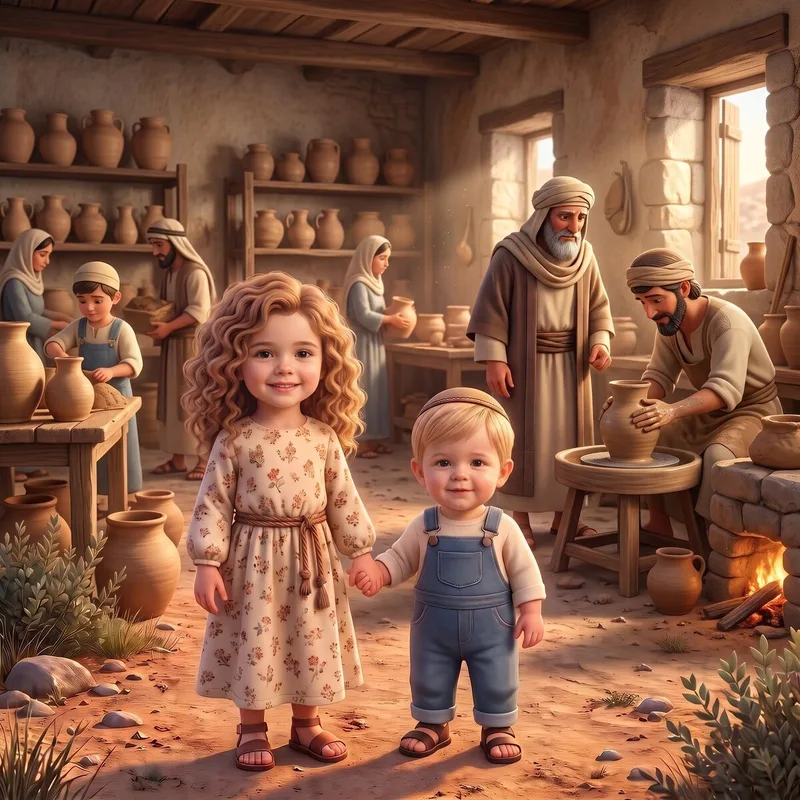
The Potter's Clay is one of the stories in the Nevi'im collection, alongside Yirmiyahu's call and the almond branch and the stories of Yeshayahu, Eliyahu and Elisha. In a Torah Tale book your child is in the scene: their name and, from one uploaded photo, their likeness appear on every page, illustrated in high-resolution 3D animated-film style. They are standing in the potter's workshop with Yirmiyahu, watching the wheel turn and watching the spoiled clay become something else.
Up to eight siblings can appear in the same book, ages 0 to 18. The softcover and hardcover open with a dedication page, and if you add parents and grandparents with their photos, they appear with the children on a closing family page in every format. Every book ends with a discussion page of ten questions about the story, mixing comprehension with middos, which is what turns this from a book you read to a child into a conversation at the table.
Formats: a 6x6 board book with rounded safety corners for ages 0-4, an 8x8 softcover for ages 4-8, and an 8x8 hardcover for ages 5-18, in English, Hebrew or Yiddish. Every book is written with careful rabbinical guidance and strict tznius and reviewed by our team before printing.

How to order this story
You can order the Potter's Clay as a single book, or subscribe to the Nevi'im collection. That collection can be taken four books a month in one delivery on the Monthly plan, or paid once for the whole collection on the Yearly plan with $30 off, still four books a month until it is done, with only that collection's own books. US standard shipping on a one-time order is $5.99 and arrives in about 12 business days, free on orders of $75 or more; we ship worldwide, with rates shown at checkout.
Creating a book takes about five minutes. It needs a free account and a few short questions: each child's name, boy or girl, age and one photo, any siblings, the story, your community (asked once), the language and the format. If you want to pair it with a parsha book for an upcoming Shabbos, the creator suggests a parsha a few weeks ahead with a live countdown to its order deadline, and this guide walks through choosing one.
Ready to put your child in the potter's workshop next to Yirmiyahu? Create the book and let them hear, in their own name, that clay that is spoiled goes back on the wheel.
Frequently asked questions
What is the story of the potter's clay in Sefer Yirmiyahu?
In perek 18 of Sefer Yirmiyahu, Hashem tells Yirmiyahu to go down to the potter's house and listen there. Yirmiyahu goes and watches the potter working on the ovnayim, the potter's wheel, and sees the vessel he was forming get spoiled in his hands. The potter does not throw the clay out; he works it again into a different vessel. Hashem then tells Yirmiyahu that Klal Yisrael are like clay in the hand of the potter.
What is the lesson of the potter's clay for children?
The lesson is that a person who has done something wrong is not finished. Soft clay that is spoiled goes back on the wheel and is made again, and the pesukim right after the mashal say that when people do teshuvah from their bad ways, Hashem relents from what He had intended to bring. For a child it means that a bad day, a bad week or a bad habit can be reshaped, and that trying again is not pretending the mistake never happened.
How do I explain "like clay in the hand of the potter" to a 5-year-old?
Use dough or clay in your hands while you say it. Tell the child that Hashem made every person and keeps making them, the way a potter keeps shaping a cup, and that a potter who does not like how the cup came out does not throw the clay in the garbage - he makes it again. Then say the one sentence: when we are sorry and we change, Hashem lets us start again.
Why did Hashem send Yirmiyahu to a potter's workshop instead of just telling him the message?
The pasuk says Hashem told him to go down to the potter's house and there He would let him hear His words. Yirmiyahu had to see the clay spoiled and then see it formed again before the message was given to him. Seeing a thing happen in front of you stays with you differently than hearing about it, which is also why this scene works so well with children when you put real clay in their hands on a weekday.
Is the potter's clay connected to Yom Kippur?
The words of the piyut sung on the night of Yom Kippur, Ki Hinei KaChomer, come from this mashal in Sefer Yirmiyahu. Children who have heard that tune in shul often recognize it the moment you tell them the story. Learning the story before the Yamim Noraim gives the piyut a picture to go with it.
Which Torah Tale format should I choose for this story?
Torah Tale prints three formats plus an optional add-on: a 6x6 board book with rounded safety corners for ages 0-4, an 8x8 softcover for ages 4-8, and an 8x8 hardcover for ages 5-18, with a matching 8.5x11 black-and-white coloring book available as a one-time add-on for weekday use. The child's age is one of the short questions when you create the book. Every format ends with a discussion page of ten questions about the story, mixing comprehension with middos.