Pesach Sheni for Kids: The Second Chance & How to Explain It
Pesach Sheni, on 14 Iyar, is a second chance to bring the Korban Pesach. Here is the story, the lesson, and how to explain it to a 4, 7 or 10-year-old.
Published by Torah Tale.
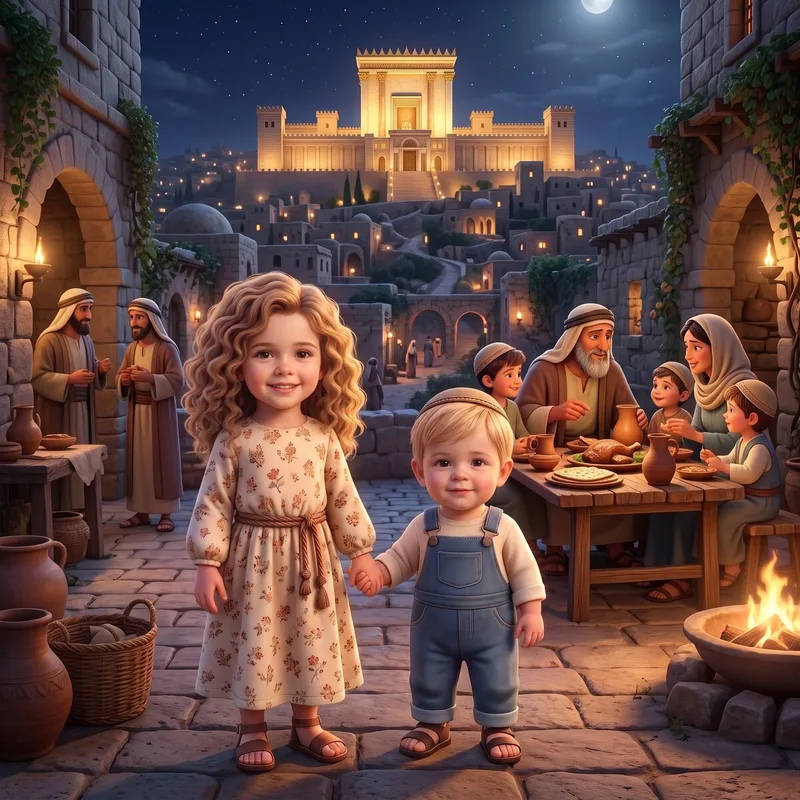
Create this book for your child
Pesach Sheni, the "Second Pesach" on 14 Iyar, is the day the Torah gave to people who could not bring the Korban Pesach in Nisan. Children connect with it because it begins with a question: a group of men said, "Why should we lose out?" and Hashem answered by teaching Moshe a mitzvah for them and for all the generations after.
What is Pesach Sheni, and why do we have it?
Pesach Sheni falls exactly one month after Erev Pesach, on 14 Iyar. The Torah sets it as the day on which a person who could not bring the Korban Pesach in Nisan may bring it instead. The pesukim give two reasons: being tamei for a dead person, or being on a distant journey (Bamidbar 9:10-11).
It is a quiet day on the calendar, not a Yom Tov. Its message is simple enough for a small child: a missed mitzvah is not always lost. If you want to know more about the first Pesach, see The Pesach Story for Kids.
What happens in the story of Pesach Sheni?
The story is told in Parshas Beha'aloscha, and you can read how it fits into the parsha in Parshas Beha'aloscha for Kids. It was the first month of the second year after Yetzias Mitzrayim, in the Midbar. Hashem told Moshe to have Bnei Yisrael make the Korban Pesach at its appointed time, and they made it on the fourteenth day, at twilight.
The Torah then tells us there were men who were tamei for a dead person, and they could not make the Pesach on that day. So they came to Moshe and Aharon that same day and asked: "Lamah nigara?" - why should we lose out on bringing Hashem's offering at its time, among Bnei Yisrael?
Moshe answered, "Stand, and I will hear what Hashem commands concerning you." Hashem told Moshe that anyone tamei for a dead person, or on a distant journey, in that generation or in the future ones, should make the Pesach in the second month, on the fourteenth day, at twilight. The Torah says it is eaten with matzos and merorim, nothing is left until morning, and no bone is broken.
The Torah also speaks of the opposite case: someone who was tahor and not on a journey, yet did not bring the Pesach, is not given this second chance. Pesach Sheni is for those who could not, not for those who chose not to.
Who were the men who asked?
The pasuk does not name them. Chazal discuss who they were in Maseches Sukkah 25a, and Rashi brings this. One view is that they were the men who carried Nadav and Avihu out of the camp, and another is that they were the men who carried Yosef's coffin through the Midbar.
That is worth telling an older child, because on either view the men became tamei while doing something Chazal see as a kindness. Present it as Chazal's explanation of who they were, not as something the pasuk says.
What is the lesson of Pesach Sheni for children?
The lesson is in the question. The men could have said, "We could not do it, so never mind." Instead they cared so much that they asked. We learn that a mitzvah is precious enough to ask for, and that a person who truly wants to do a mitzvah is not turned away.
There is also a gentler message for children who feel they always miss out: a hard moment does not have to be the end of the story. A child who got sick on the day of a class trip, or missed a siyum, can hear that wanting something good matters. Keep the balance above in mind too: a second chance is not a reason to put things off.
How do I explain Pesach Sheni to a 4-year-old, a 7-year-old and a 10-year-old?
For a 4-year-old: "Some Yidden could not make the Korban Pesach on time. They asked Moshe, 'Can we still do it?' Hashem said yes, in one month." Then ask, "How do you think they felt when they heard yes?" Leave out the details of tumah.
For a 7-year-old: Tell the story in order and let your child say the question in the men's words: lamah nigara? Ask what they were really saying. Point out that Moshe did not guess; he said, "Stand, and I will hear what Hashem commands."
This is also a good age to explain the difference between "could not" and "did not want to."
For a 10-year-old: Bring in Chazal's discussion of who the men were, and ask why a person who had been busy with a chesed would be so upset about the mitzvah he missed. Ask what we do today when we feel left out of something important. Older children can enjoy noticing that this mitzvah came about because of the men's question.
What do we do on Pesach Sheni today?
We do not bring the Korban Pesach today. But the day is marked: Tachanun is not said, and many have a minhag to eat a little matzah on 14 Iyar. Ask your rav about your own family's minhag.
It is a natural moment to tell the story at home, since it comes a month after Pesach, when the matzah is long gone and the Seder is a memory. It is a good time to talk about how the Pesach story continues in the Midbar. You can also tell it ahead of time, in the weeks before.
What is a personalized Pesach Sheni book like?
Torah Tale's Pesach Sheni story is part of the Holidays collection. Your child's name and likeness, from one uploaded photo, appear in high-resolution 3D animated-film style. Up to eight children can appear in the same book, ages 0 to 18, which is handy when siblings want to share one story.
Choose a board book 6"x6" with rounded safety corners (ages 0-4), a softcover 8"x8" (ages 4-8), or a hardcover 8"x8" (ages 5-18). Softcover and hardcover open with a dedication page. If you add parents and grandparents, they appear with the children on a closing family page in every format.
Every book is written with careful rabbinical guidance and strict tznius, and reviewed by our team before it goes to print. It can be ordered in English, Hebrew or Yiddish. An optional matching coloring book (8.5"x11", black-and-white line art) is a weekday activity, for a weekday afternoon, and never for Shabbos or Yom Tov. Reading the storybook itself is entirely appropriate on Shabbos.

Softcover 8″×8″

Hardcover 8″×8″

Board book 6″×6″

Coloring book 8.5″×11″
What questions can we ask at the Shabbos table about Pesach Sheni?
Every Torah Tale book ends with a discussion page of 10 questions, mixing comprehension with middos. If you would like to start from your own questions, try these at the table, since talking is a good way to use Shabbos:
- What did the men ask Moshe and Aharon?
- Why did Moshe say, "Stand, and I will hear"?
- What is something you wanted to do very much, but could not?
- How do you ask for a second chance politely?
- What is the difference between "I could not" and "I did not want to"?
Let your child answer in their own words, and share one of your own too. When a child hears a parent say, "I missed that, and I wished I had not," it teaches a great deal about caring for mitzvos.
When you are ready to give your child a Pesach Sheni story with their own name and face in it, you can create the book. It takes a free account and a few short questions: each child's name, boy or girl, age and one photo, any siblings, the story, your community, the language and the format.
Frequently asked questions
What is Pesach Sheni in simple words?
Pesach Sheni means the Second Pesach, and it falls on 14 Iyar. It is the day the Torah gave to people who could not bring the Korban Pesach in Nisan, because they were tamei or on a distant journey. You can tell a young child that Hashem gave a second chance to people who really wanted to do the mitzvah.
Where is the story of Pesach Sheni in the Torah?
It is in Sefer Bamidbar, chapter 9, pesukim 1-14, in Parshas Beha'aloscha. The Torah tells us that men who were tamei for a dead person could not make the Pesach on its day, so they came to Moshe and Aharon. Hashem then taught Moshe the law of the second month.
What is the lesson of Pesach Sheni for children?
The men did not shrug and say it was too bad. They asked, "Why should we lose out on bringing Hashem's offering at its time among Bnei Yisrael?" Children can learn to care about a mitzvah, to ask when they cannot do it, and to remember that a second chance is there for those who could not, not for those who simply chose not to.
What do we do on Pesach Sheni today?
We do not bring the Korban Pesach today, but Pesach Sheni is still a day on the calendar. Tachanun is not said, and many have a minhag to eat a little matzah. Ask your rav about your family's minhag.
How do I explain Pesach Sheni to a 4-year-old?
Keep it to one sentence and one picture: some Yidden could not do the mitzvah of Pesach on time, they asked Moshe if they could still do it, and Hashem said yes, one month later. Then ask your child, "What would you ask Hashem if you could not do a mitzvah?" A short, warm retelling works better than explaining the halachos of tumah.
Is there a personalized book about Pesach Sheni?
Yes, Torah Tale has a Pesach Sheni story in its Holidays collection, with your child's name and likeness from one uploaded photo in 3D animated-film style. It is available as a board book 6"x6" with rounded safety corners (ages 0-4), a softcover 8"x8" (ages 4-8) or a hardcover 8"x8" (ages 5-18). Every book ends with a discussion page of 10 questions about the story.