The Mountains Who Wanted the Torah for Kids: Midrash, Har Sinai & Humility
Chazal tell us that the mountains each hoped the Torah would be given on them, and that Hashem chose Har Sinai, a low mountain. Here is how to retell it, what it teaches, and how to talk about it with a 3-year-old and a 12-year-old.
Published by Torah Tale.
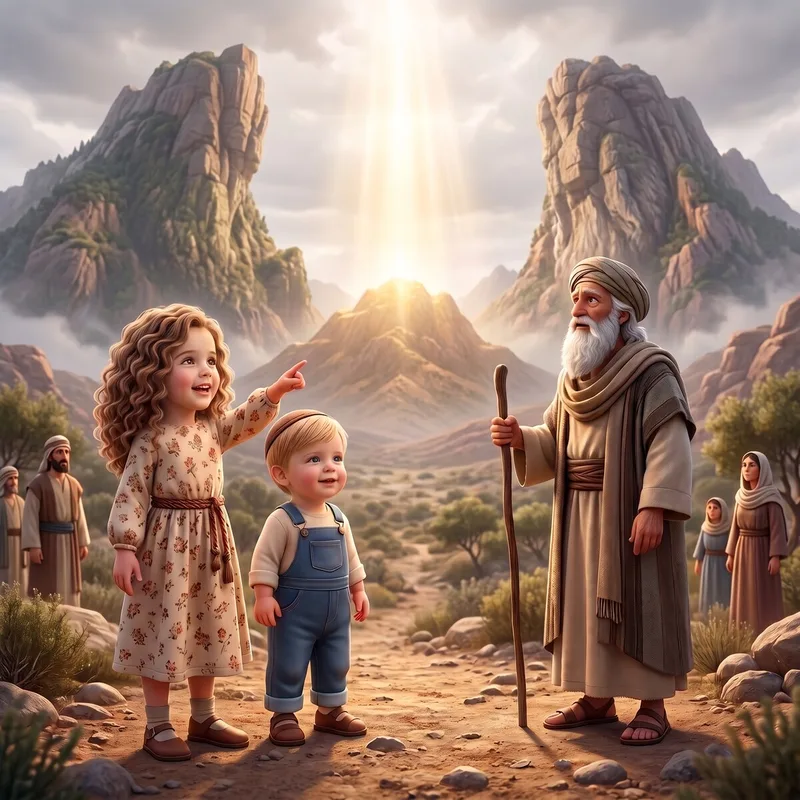
Create this book for your child
The story of the mountains who wanted the Torah is a Midrash that Chazal tell about the moment before Matan Torah: each mountain hoped the Torah would be given on it, and Hashem chose Har Sinai, which was low. Children understand it right away, because every child knows the feeling of wanting to be picked, and the answer surprises them in a good way.
What is the story of the mountains who wanted the Torah?
The Midrash relates that when the time came for Hashem to give the Torah to Bnei Yisrael, the mountains each said that the Torah should be given on them. Each one made its own case. Chazal's tellings name Har Tavor and Har Carmel among them.
Hashem did not choose a high mountain. He chose Har Sinai, a low one. The Gemara in Sotah 5a teaches that a person should learn from this: Hashem passed over all the mountains and hills and rested His Shechinah on Har Sinai.
That is the whole story, and it is short on purpose. When you tell it to children, tell it as the Midrash does, and let the quiet ending do its work.
Where does this story come from: pshat or Midrash?
It is helpful to be clear with children about what is in the pesukim and what Chazal add. The Torah tells us in Shemos 19 that Bnei Yisrael camped before the mountain and that Hashem would descend on Har Sinai. The pesukim do not describe the mountains asking for the Torah.
The competition among the mountains is Midrash. Chazal also connect the story to a pasuk in Tehillim 68:17, which speaks of the many-peaked mountains and of the mountain Hashem desired as a place for His presence. So you can say, simply, “The Midrash tells us…” or “Chazal tell us…”, and a child learns early on to tell a pasuk from a midrash.
If you enjoy stories like this, The Stones That Wanted Yaakov is another Midrash in which something in nature wants to be close to a moment of kedushah.
What is the lesson of the story?
The lesson is humility, anavah. The mountains wanted something good, and wanting to be close to Torah is a fine thing to want. What the Midrash teaches is what makes a place fit for Torah: Hashem chose the low mountain.
The Torah itself praises this middah in Moshe Rabbeinu, saying that he was very humble, more than any man on the face of the earth (Bamidbar 12:3). A child does not need that connection spelled out at length, but it is good for them to hear that humility is a middah the Torah values in its greatest teacher.
For a child, humility does not mean thinking little of yourself. It can mean learning without needing to be the loudest, answering without putting someone else down, and being glad when a friend is chosen.
How do I explain it to a 3-year-old, a 6-year-old and an 11-year-old?
Ages 3 to 4. Keep it to one picture and one sentence: “All the mountains wanted the Torah, and Hashem chose the little, low one, Har Sinai.” Then stop and let the child say something back. Pointing at a hill in a book or out the window and saying “high” and “low” makes it concrete.
Ages 6 to 7. This is the age of “why?” Ask them why they think Hashem chose the low mountain, and let them reach for the answer before you give it. Then tie it to something they know: a child who wants to be line leader and the child who is glad for a friend.
Ages 9 to 12. Older children can handle the distinction between the pesukim and the Midrash. Ask what the pesukim say and what Chazal add, and why Chazal would teach it this way. You can also discuss the harder question: how do you stay humble when you really are good at something?
What can we ask at the Shabbos table?
Reading and talking are exactly right for Shabbos. Here are questions that need no props, only conversation:
- What did the mountains want, and was it a good thing to want?
- Which mountain did Hashem choose, and what was special about it?
- Why do you think Hashem chose a low mountain?
- Is it a problem to be good at something? What makes it a problem, and what keeps it from being one?
- Can you think of a time a friend was chosen and you were glad for them?
- What is something you can do this week that is quiet and kind, with nobody watching?
Let the youngest answer first, since they usually say the simplest true thing, and then pass the question up the table.
What is a personalized Torah Tale book of this story like?
The Mountains Who Wanted the Torah is in Torah Tale's Midrash & Aggadah collection, which is made up of the stories Chazal tell behind the pesukim, each from its named source in the Gemara or Midrash. The book is written with careful rabbinical guidance and strict tznius, and reviewed by our team before it goes to print.
Your child is the hero. Their name and, from one uploaded photo, their likeness appear on every page, in high-resolution 3D animated-film style. Up to eight children, ages 0 to 18, can appear in the same book, so siblings can share one story. If you add parents and grandparents, they appear with the children on a closing family page in every format.
Every book ends with a discussion page of 10 questions about the story, mixing comprehension with middos: what happened, and what it asks of the child. That is the page that turns a book that is read to a child into one that is talked about at the table. The book can be ordered in English, Hebrew or Yiddish.
Which format fits my child's age?
There are three formats, chosen by age:
- Board book, 6x6 with rounded safety corners, ages 0-4. Suited to the youngest listeners.
- Softcover photo book, 8x8, ages 4-8. Opens with a dedication page.
- Hardcover photo book, 8x8, ages 5-18. Opens with a dedication page.
An optional matching coloring book, 8.5x11 in black-and-white line art, can be added to a book. Coloring is melacha, so it is a weekday activity only, such as a weekday afternoon or erev Shabbos, never something for Shabbos or Yom Tov. The storybook itself is the opposite: it is a good book to read at the Shabbos table or on a long Yom Tov afternoon.

Softcover 8″×8″

Hardcover 8″×8″

Board book 6″×6″

Coloring book 8.5″×11″
How do I connect this to Shavuos and Matan Torah?
This Midrash fits naturally with the story of Matan Torah, so if your family enjoys it, The Shavuos Story for Kids and Parshas Yisro for Kids cover the pesukim themselves. Telling the Midrash alongside the pesukim helps a child see how Chazal fill in the picture around what the Torah tells us.
Whenever you tell it, the retelling can be short. One sentence, one question and a pause at the table are enough for a child to carry the story with them.
When you are ready, you can create the book. It takes about five minutes: a free account and a few short questions about your child, the story, your community, the language and the format.
Frequently asked questions
Why was the Torah given on Har Sinai and not on a taller mountain?
Chazal teach that the mountains each wanted the Torah to be given on them, and that Hashem chose Har Sinai because it is a low mountain. The Gemara in Sotah 5a learns from this that a person should follow the way of Hashem, who passed over all the mountains and hills and rested His Shechinah on Sinai. The lesson children take away is that humility is what makes a place, or a person, fit for Torah.
Is the story of the mountains in the Torah itself?
No. The pesukim in Shemos 19 tell us that Bnei Yisrael camped before the mountain and that Hashem would descend on Har Sinai, but they do not describe the mountains asking for the Torah. That part is Midrash, which Chazal tell us in the Gemara and Midrash, and it is good to say 'the Midrash tells us' when you retell it.
How do I explain the mountains story to a 4-year-old?
Keep it to one picture: all the mountains wanted the Torah to be given on them, but Hashem chose the smallest, lowest one, Har Sinai. Then ask one simple question, such as 'Who do you think Hashem likes to be near, someone who says look at me, or someone who is humble?' A short retelling with a lot of listening works better than a long explanation at this age.
What is the lesson of the mountains who wanted the Torah?
The lesson is humility, anavah. The mountains wanted something good, but the Midrash teaches that Hashem chose the lowest mountain, and the Torah itself calls Moshe Rabbeinu the most humble of all men. For a child this can mean being proud to learn and do mitzvos without needing to be the biggest or the first.
Can I read this story at the Shabbos table?
Yes, reading a storybook and talking about it is entirely appropriate on Shabbos and Yom Tov. Use the questions and talking ideas in the article at the table. Anything that involves coloring or drawing, including the optional coloring book, is a weekday activity for erev Shabbos or a weekday afternoon.