Melava Malka for Kids: Escorting the Shabbos Queen & How to Explain It
Melava Malka is the meal after Shabbos that escorts Shabbos the queen out. Here is where it comes from, what it teaches, and how to explain it to a 3 to 4 year old, a 5 to 7 year old and a 9 to 12 year old.
Published by Torah Tale.
Create this book for your child
Melava Malka (מלווה מלכה) is the meal we eat after Shabbos has ended, after Havdalah, to escort Shabbos the queen out of our homes. Children understand it quickly because it works like saying goodbye to a guest we love: we do not shut the door the moment she steps out, we walk with her a little.
What is Melava Malka, in simple words?
Melava Malka is a festive, usually small meal on motzei Shabbos. The words mean escorting the queen, and the queen is Shabbos. Families gather around the table, often with the lights low and the mood calm, and eat, sing and share a thought from the parsha.
The Gemara in Maseches Shabbos (119a-b) is the place to look for the roots. It describes Rabbi Chanina going out to greet Shabbos the queen, and it also speaks of setting one's table as Shabbos departs. How much to eat and whether to eat bread are questions for your rav, but the idea is easy for a child to hold on to.
Why do we escort Shabbos out?
When a person is welcomed like royalty, it is only natural to part from them with the same honor. We greet Shabbos on Friday with candles, a set table and our best clothes. Melava Malka completes the picture, so that Shabbos is honored when she leaves too, and not only when she comes.
Chazal also tell us (Beitzah 16a) that on Shabbos a Yid is given a neshama yeseira, an extra soul. Parents sometimes tell children that Melava Malka is a gentle way of not letting go of that special feeling too quickly. Some also explain the meal as connected with Dovid HaMelech, which is one reason many families sing songs about Dovid and about Eliyahu HaNavi at this meal.
What does Melava Malka teach a child?
The main lesson is that the best things in life deserve a proper goodbye. A child who learns to escort Shabbos out is learning hakaras hatov, appreciating what Hashem gave us in the past twenty-five hours, and learning not to rush from rest into the next screen or the next errand.
There is a quieter lesson as well. Shabbos is not only a day that ends, it is a feeling we bring into the week. A child who sits at a calm table with family on motzei Shabbos is seeing that kedushah and warmth can walk into Sunday.
How do I explain Melava Malka to a 3 or 4-year-old?
Keep it to a picture and a feeling. Tell your child that Shabbos is a very special guest, and when a guest leaves we say goodbye and walk them to the door. Melava Malka is our goodbye party for Shabbos.
- Use one sentence: "Shabbos is leaving, so we eat a little and sing to say thank you."
- Let your child pick a song or a simple food for the table.
- Do not worry about attention span. Five calm minutes is a success.
How do I explain it to a 5 to 7-year-old, and to a 9 to 12-year-old?
A child of five to seven can handle the idea of a queen. Ask what we do on Friday night to welcome Shabbos, then ask what would be a nice way to say goodbye. They usually reach Melava Malka on their own, and then it feels like their idea.
Older children can hear the sources. Show them where Rabbi Chanina greets Shabbos the queen, and tell them the Gemara also speaks of setting a table as Shabbos leaves. Then invite a real question: why is it not enough to simply make Havdalah and move on? Let them struggle with it for a minute before you answer. It is also a good moment to say that the details of the meal are decided by halacha and minhag, so we ask our rav.
What is a personalized Torah Tale book about Melava Malka like?
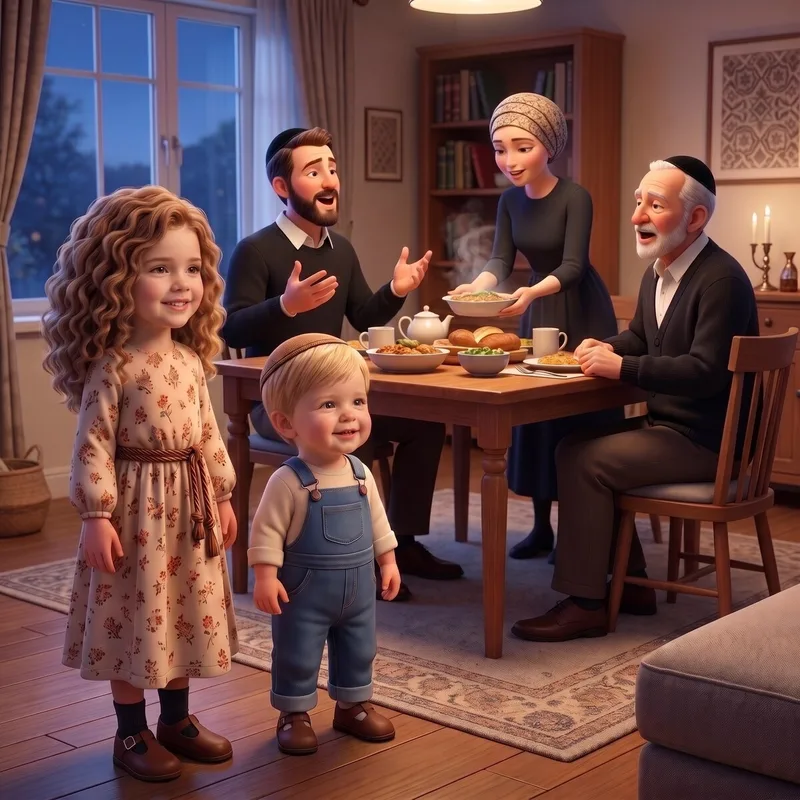
Torah Tale makes a storybook about Melava Malka in the Jewish Life collection, which covers the simchos and minhagim of a Yiddishe life. Your child is the hero: their name and, from one uploaded photo, their likeness appear on every page, illustrated in 3D animated-film style. Every book is written with careful rabbinical guidance and strict tznius, and it is reviewed by our team before it goes to print.
Every book ends with a discussion page of ten questions that mix comprehension with middos, meaning what happened and what it asks of the child. If you add parents and grandparents, they appear with the children on a closing family page in every format. Up to eight children can appear in one book, so siblings can share it.
Choose the format by age: the 6"x6" board book with rounded safety corners is for ages 0-4, the 8"x8" softcover is for ages 4-8, and the 8"x8" hardcover is for ages 5-18. The softcover and hardcover open with a dedication page.

Softcover 8″×8″

Hardcover 8″×8″

Board book 6″×6″

Coloring book 8.5″×11″
Reading is a lovely fit for Shabbos itself. You can read the book at the Shabbos table or on Shabbos afternoon to prepare for motzei Shabbos, or read it together at Melava Malka. The optional matching coloring book is a weekday activity only, for a Sunday afternoon or another weekday, never for Shabbos.
What questions can we ask at the Melava Malka table?
Use these for talking and singing only, with no writing or drawing needed. Pick one or two, not all of them.
- What was your favorite part of Shabbos this week?
- Why do you think we call Shabbos a queen?
- How do we welcome Shabbos on Friday, and how can we say goodbye to her?
- What is one thing from Shabbos we can take into the week?
- Who made Shabbos special for you this week, and how can you thank them?
For a younger child, let them point to the candle or the challah and say what it reminds them of. For an older child, ask them to bring one pshat from the parsha to the table.
If you would like a book your child will see themselves in, you can create the book in about five minutes. It needs a free account and a few short questions: each child's name, boy or girl, age and one photo, any siblings, the story, your community (asked once), the language and the format. You can also read how we think about the Shabbos story for kids and Shabbos at home with your family.
Frequently asked questions
What is Melava Malka?
Melava Malka is the meal eaten after Shabbos ends and Havdalah has been made. The name means escorting the queen, and the meal is a way of accompanying Shabbos out. Families often add songs, divrei Torah and a warm table.
Why do we call Shabbos a queen?
The Gemara in Maseches Shabbos tells us that Rabbi Chanina would go out toward Shabbos and say that we should go out to greet Shabbos the queen. Because we welcome her like a queen when she arrives, we also escort her when she leaves.
How do I explain Melava Malka to a 4-year-old?
Say that Shabbos is like a very special guest, and when a guest leaves we walk them out and say goodbye nicely. Melava Malka is our goodbye meal, with a little food and a few songs. Keep it short and let your child hold something simple, like a roll or a cup of juice.
Is Melava Malka a mitzvah or a minhag?
Details such as what to eat, whether to eat bread, and how obligated each person is are discussed by the poskim and differ among communities. Ask your rav what your family should do. What you can tell a child plainly is that it is a beloved Yiddishe custom with roots in Chazal.
What does a personalized Torah Tale book about Melava Malka include?
The child's name and, from one uploaded photo, their likeness appear on every page, illustrated in 3D animated-film style. Every book ends with a discussion page of ten questions that mix comprehension with middos, and if you add parents and grandparents they appear with the children on a closing family page in every format. The softcover and hardcover open with a dedication page.