Learning to Share (לומדים לחלוק) for Kids: Teaching Sharing at Home
Sharing is one of the first middos a child has to practice every single day. Here is how to explain it at home, what Chazal's wording gives us, and what the personalized Learning to Share book offers.
Published by Torah Tale.
Create this book for your child
Learning to Share (לומדים לחלוק) is a Middos story about the everyday middah of sharing, written so that a child can see themselves in it. It lands with children because sharing is not a faraway idea: it comes up at the table, in the playroom, on the way to school and every time a sibling reaches for the thing they are holding.
What is the Learning to Share story about?
Learning to Share belongs to the Middos collection, where each story grows one good middah in the setting of everyday life today. The middah here is sharing: giving others a turn, a portion or a place, and doing it with a good heart.
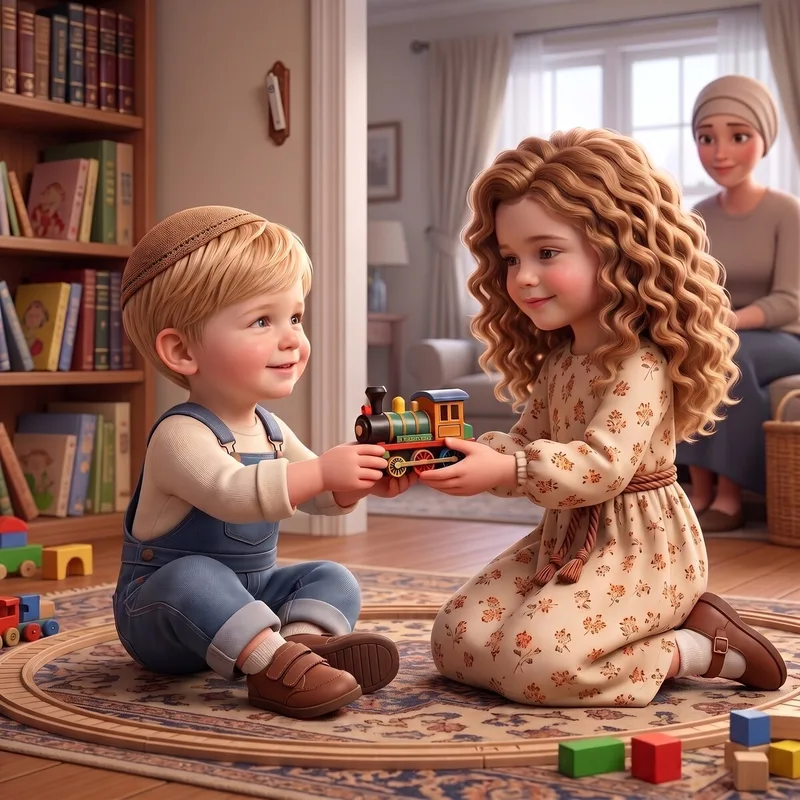
In the personalized book, the hero is your child. Their name and, from one uploaded photo, their likeness appear on every page, illustrated in 3D animated-film style. This article does not retell the book page by page. It focuses on the middah itself and on how to talk about it, so that you can use it with or without the book in your hand.
Why is sharing so hard for young children?
For a young child, a toy, a seat or a piece of challah is a real part of their world, and handing it over can feel like losing it. Sharing is something children grow into, and they need us to be patient while they do.
It helps to remember that you are teaching a middah, not stopping a fight. A child who shares because they were forced has learned to hand something over. A child who shares because they were guided, praised and given time has started to learn to give.
What does the Torah say about sharing?
Pirkei Avos (5:10) describes the person who says 'what is mine is mine and what is yours is yours' as following a middle middah, and adds that some say it is the middah of Sedom. That is a good line for a parent to know, even if you do not repeat the second half to a four-year-old. It tells us that Chazal wanted us to aim higher than simply guarding what is ours.
We also see the picture of giving openly in Avraham Avinu's tent. In Parshas Vayeira the Torah tells us he ran to greet his guests and offered them water, and that a meal was prepared, with Sarah baking and the na'ar preparing the calf. You can read more in Welcoming Guests (הכנסת אורחים) for Kids. Tzedakah is the other everyday way children practice giving, and Giving Tzedakah for Kids covers it.
How do I explain sharing to a 3-year-old, a 6-year-old and a 10-year-old?
Ages 3 to 4: say it simply
Use one short sentence and use it every time: 'First your turn, then Chaya's turn.' Describe what you see when it goes well: 'You gave Moshe a turn. That was kind.' Young children do not need a Mishnah, they need the same calm words again and again.
Ages 6 to 7: connect it to feelings
At this age children can think about how someone else feels. Ask, 'How do you think your friend felt when you let him join?' Help them see that sharing makes the other child happy, and that being the one who gives can feel good too.
Ages 9 to 12: widen what sharing means
Older children can hear the wording of Avos 5:10 and talk about it. Sharing is not only objects: it is also time, attention, a seat at the table and sharing credit when something goes well. Ask them where 'what's mine is mine' is a fair boundary and where it turns into holding back from others.
What can we ask at the Shabbos table about sharing?
Reading a storybook is entirely appropriate on Shabbos, and the questions below are for talking only. Choose one or two and let the conversation go where it goes.
- When was a time you shared something this week? How did it feel?
- Is it ever hard to share? What makes it hard?
- What can you share that is not a toy, like your time or your help?
- How does a guest feel when we share our table with them?
- Why do you think Chazal did not like 'what's mine is mine and what's yours is yours'?
- What is one small thing we can share with someone this coming week?
Every Torah Tale book ends with a dedicated discussion page of 10 questions about the story, mixing comprehension with middos: what happened, and what it asks of the child. It is built for exactly this kind of conversation at the table.
What is the personalized Learning to Share book like?
The book is a personalized Torah storybook, so your child is the one living the story. It comes as a 6x6 board book with rounded safety corners (ages 0-4), an 8x8 softcover (ages 4-8) or an 8x8 hardcover (ages 5-18). Softcover and hardcover books open with a dedication page, and every format closes with the discussion page. If you add parents, grandparents and other relatives with their photos, they appear with the children on a closing family page in every format.
Up to eight children, ages 0 to 18, can appear in the same book, which is a real help when sharing is the middah the siblings in your house are working on. For a gift idea along these lines, see Hanukkah Gifts for Siblings: One Gift They All Share. The book can be ordered in English, Hebrew or Yiddish, and every book is written with careful rabbinical guidance and strict tznius and reviewed by our team before it goes to print.

Softcover 8″×8″

Hardcover 8″×8″

Board book 6″×6″

Coloring book 8.5″×11″
What is a simple sharing activity for a weekday?
Pick a weekday afternoon or erev Shabbos and ask your child to choose one thing they can share with a brother, sister or friend. Do it together, then notice it out loud afterward: 'You shared your snack and your sister smiled.' Small, named moments teach the middah better than a lecture.
If you add the optional matching coloring book (8.5x11, black-and-white line art), save it for a weekday afternoon or the days before Shabbos, never for Shabbos or Yom Tov, since coloring is melacha. Siblings can color from one shared box of crayons while the story is fresh, and you can connect the two: 'We are sharing the crayons just like in the story.' The coloring book is a one-time add-on to a book.
Ready to make it your child's own? It takes about five minutes: a free account and a few short questions about your child, your community, the language and the format. You can create the book now, and for a related middah, see Waiting Patiently for Kids.
Frequently asked questions
What is the Learning to Share story?
Learning to Share (לומדים לחלוק) is a story in Torah Tale's Middos collection, where each book grows one good middah in the setting of everyday life today. In the personalized book your child is the hero, with their name and likeness on every page. Like every Torah Tale book, it ends with a discussion page of 10 questions about the story.
How do I explain sharing to a 3-year-old?
Keep it short and concrete: 'We take turns. First your turn, then your sister's turn.' Say it calmly each time and name the good moment when it happens, for example 'You let him have a turn, that was kind.' A toddler learns sharing through repetition and example, not through a long explanation.
What does the Torah say about sharing?
Pirkei Avos 5:10 says that someone who says 'what is mine is mine and what is yours is yours' is following a middle middah, and that some call it the middah of Sedom. In Parshas Vayeira, Avraham Avinu is the model of giving openly, running to welcome his guests. Tzedakah is another way Yidden learn to give from what they have.
Does sharing mean a child must give away everything they own?
No. Sharing means learning to let others have a turn, a portion or a place, and to give with a good heart. Many parents help a child by letting them put away one or two special items before guests come, so that sharing the rest feels manageable. If a real halachic question comes up about someone's belongings, ask your rav.
Which format of the Learning to Share book suits my child?
Torah Tale offers a 6x6 board book with rounded safety corners for ages 0-4, an 8x8 softcover for ages 4-8 and an 8x8 hardcover for ages 5-18. You can also add a matching 8.5x11 coloring book in black-and-white line art, which is a weekday activity and not for Shabbos or Yom Tov. The story can be ordered in English, Hebrew or Yiddish.
Can I order the book for siblings who are always fighting over things?
Yes, up to eight children, ages 0 to 18, can appear in the same book. The creator asks for each child's name, boy or girl, age and one photo, along with the story, your community, the language and the format. Reading it together can give brothers and sisters a shared page to talk from when sharing comes up.