Lag B'Omer for Kids: Rabbi Akiva's Students & the Bonfires
Lag B'Omer is the 33rd day of the Omer. It brings together Rabbi Akiva's students, respect between friends and Rabbi Shimon bar Yochai. Here is how to tell it to a 3-4, 6-7 or 9-12 year old.
Published by Torah Tale.
Create this book for your child
Lag B'Omer is the 33rd day of the Omer, 18 Iyar, and children usually meet it as a day of bonfires and outings. Underneath is a story every child can understand: Rabbi Akiva's students did not give one another enough respect, and what that cost the Yidden. The day is also connected to Rabbi Shimon bar Yochai, a tzaddik whose Torah is compared to light. That combination of a sad lesson and a joyful day is why it stays with children.
What is Lag B'Omer and why do we celebrate it?
From the second night of Pesach we count the Omer, forty-nine days up to Shavuos. The letters lamed and gimmel add up to thirty-three, so Lag B'Omer is the thirty-third day, which falls on 18 Iyar.
The weeks of the Omer carry some mourning customs, and Lag B'Omer is a break in them. Communities differ on exactly which customs pause and when, so this is a question for your rav. What is common to everyone is that the day has a different feeling from the days around it.
What happened to Rabbi Akiva's students?
The Gemara in Yevamos 62b tells us that Rabbi Akiva had twelve thousand pairs of students, and that they all died in the period between Pesach and close to Shavuos. The reason the Gemara gives is that they did not treat one another with respect. The Gemara says the world was left desolate of Torah.
Then Rabbi Akiva went to the south and taught new students, among them Rabbi Meir, Rabbi Yehuda, Rabbi Yosei, Rabbi Shimon and Rabbi Elazar ben Shamua. The Gemara says these students are the ones who upheld the Torah afterward.
According to a tradition brought by later authorities, the deaths stopped on Lag B'Omer. That is why many treat the day as one of relief and simcha.
Rabbi Akiva is the same sage who taught that "v'ahavta l'rei'acha kamocha" (Vayikra 19:18) is a great principle of the Torah. You can read more about his own story in Rabbi Akiva for Kids.
Who was Rabbi Shimon bar Yochai, and what does he have to do with Lag B'Omer?
Rabbi Shimon bar Yochai was one of the students Rabbi Akiva taught afterward. The Gemara in Shabbos 33b tells of the years he and his son spent hiding in a cave, where a carob tree and a spring sustained them. You can tell that story from Rabbi Shimon bar Yochai for Kids.
Lag B'Omer is traditionally marked as the day of his hilula, the day he was niftar, and many travel to Meron on it. The Zohar is traditionally associated with him as well. Customs about Meron, including cutting a boy's hair there at three, are practiced by some and not by others, so follow your own family's minhag.
Why bonfires, picnics and bows and arrows?
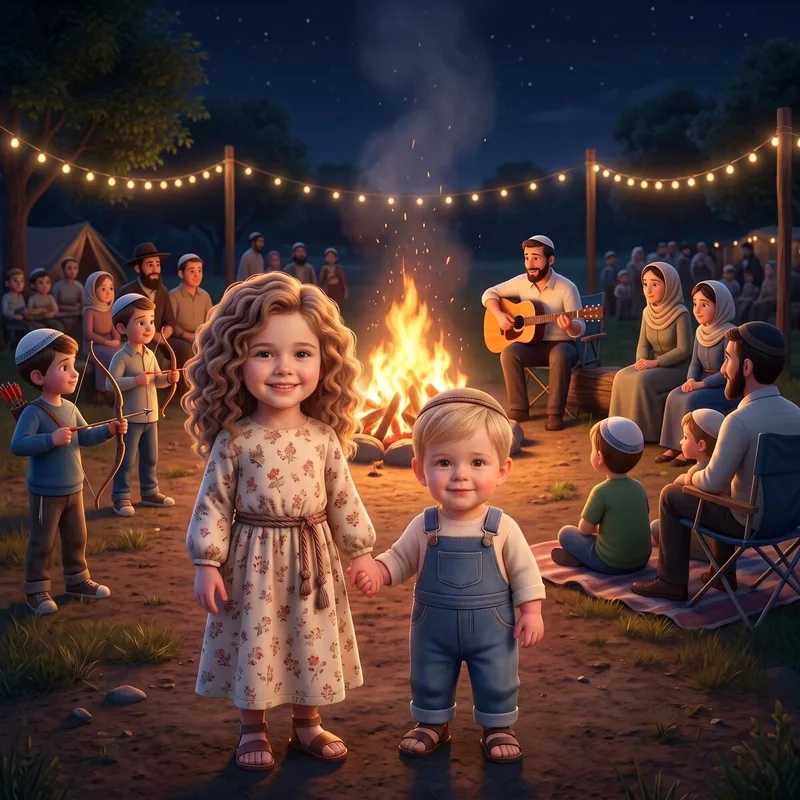
Lag B'Omer is known for bonfires, outings and, in many places, children playing with toy bows and arrows. These are minhagim, and several explanations are given for them. A common one connects the fires to the light of Rabbi Shimon bar Yochai's Torah.
If your family has a bonfire, keep the safety rule simple: adults handle fire, and children stand back at a distance the adults set. A young child can still help with a safe job such as carrying a bag of rolls to the picnic blanket.
How do I explain Lag B'Omer to a child by age?
Ages 3 to 4: Say it in one sentence. "Rabbi Akiva had many students, and Hashem wants us to be kind and respectful to our friends." Then connect it to something they can do today, such as letting a sibling go first.
Ages 6 to 7: Add that the students were great talmidim, but they did not honor one another enough, and it cost the Yidden dearly. Children this age understand "my friend is also important" very well. Ask them what a respectful way of speaking to a friend sounds like.
Ages 9 to 12: Go to the Gemara in Yevamos 62b, and ask why the Gemara links the lack of respect with such a loss. You can add how Rabbi Akiva rebuilt Torah with new students, and how Rabbi Shimon bar Yochai carried it on. Older children also like to ask why the tragedy is remembered together with a joyful day.
Questions to ask at the Shabbos table before Lag B'Omer
Reading, talking and singing all belong at the Shabbos table. These questions need nothing but conversation:
- What does it mean to give someone kavod? How can you do it without words?
- Who in our family or class is easy to respect, and who is harder? Why?
- Rabbi Akiva started again with new students. What does that teach us about not giving up?
- What would you want a friend to do if you disagreed with them?
- Why do you think we celebrate on a day connected to a tzaddik's Torah?
What is a personalized Lag B'Omer book like?
Lag B'Omer is one of the stories in the Holidays collection at Torah Tale. The book carries your child's name and, from one uploaded photo, their likeness, in 3D animated-film style, and up to eight children can appear in the same book. It is written with careful rabbinical guidance and strict tznius, and reviewed by our team before it goes to print.
Every book ends with a discussion page of 10 questions mixing comprehension with middos. For Lag B'Omer these are exactly the questions about kavod and friendship that you want at the table. If you add parents and grandparents, they appear with the children on a closing family page.

Softcover 8″×8″

Hardcover 8″×8″

Board book 6″×6″

Coloring book 8.5″×11″
For format, the board book (6x6 with rounded safety corners) is for ages 0-4. The softcover (8x8) is for ages 4-8, and the hardcover (8x8) is for ages 5-18. Softcover and hardcover open with a dedication page. The optional coloring book (8.5x11, black-and-white line art) is a weekday activity only, for erev Shabbos, an afternoon during the week or Chol HaMoed. Reading the book itself is fine on Shabbos and Yom Tov.
Lag B'Omer is months away, so there is time to order ahead. US standard shipping arrives in about 12 business days, counted from the order, and we ship worldwide, with rates shown at checkout.
Where does Lag B'Omer fit with the rest of the Omer?
The Omer leads from Pesach to Shavuos, so it can help to read the Yom Tov stories on either side. The Pesach Story for Kids opens the counting, and The Shavuos Story for Kids closes it. Lag B'Omer sits between them as a reminder of how the Torah we receive on Shavuos should be learned: with respect for one another.
When you are ready, you can create the book in about five minutes. It takes a free account and a few short questions: your child's name, boy or girl, age and one photo, any siblings, the story, your family's community (asked once), the language and the printed format.
Frequently asked questions
What is Lag B'Omer, in simple words for a child?
Lag B'Omer is the 33rd day of counting the Omer, which we count every night from Pesach toward Shavuos. It falls on 18 Iyar. For children, it is the day we remember Rabbi Akiva's students and the importance of respecting one another, and we also remember Rabbi Shimon bar Yochai.
Why did Rabbi Akiva's students die?
The Gemara in Yevamos 62b says they did not treat one another with proper respect. It also says 12,000 pairs of students died between Pesach and close to Shavuos. We learn from this how seriously the Torah takes the way Yidden treat each other, even great talmidei chachamim.
Why do we light bonfires on Lag B'Omer?
It is a minhag, and many connect it with Rabbi Shimon bar Yochai and the light of his Torah. Customs and explanations vary by community, so follow your family's minhag and ask your rav. Fires are only for adults to handle, and children should stand back.
How do I explain Lag B'Omer to a 4-year-old?
Keep it to one sentence: Rabbi Akiva had many students, and they learned that we must be kind and respectful to our friends, so Lag B'Omer is a happy day. You can then add the bonfire or the picnic your family does. Leave out details about their deaths unless your child asks, and then answer briefly.
Is there a Torah Tale book for Lag B'Omer?
Yes, Lag B'Omer is a story in the Holidays collection. The child's name and, from one uploaded photo, their likeness appear in the book, illustrated in 3D animated-film style, and every book ends with a discussion page of 10 questions. You can start at torahtale.com/create.