Hillel on the Roof in the Snow (הלל על הגג בשלג) for Kids: Yoma 35b
Hillel had no coin for the beis midrash, so he climbed to the roof to hear Torah through the skylight. Here is the story from Yoma 35b, what it teaches, and how to share it with children aged 4 to 12.
Published by Torah Tale.
Create this book for your child
The story of Hillel on the roof in the snow is one that Chazal tell in Maseches Yoma 35b. Hillel was poor, he could not get into the beis midrash one day, and so he climbed up and sat at the skylight to hear Torah from above. Children remember it because it is simple to picture and because it shows, without any lecture, how much Hillel wanted to learn.
What is the story of Hillel on the roof in the snow?
The Gemara tells us that Hillel worked every day and earned a tarpaik, a small coin. Half of it he gave to the guard of the beis midrash, and half he kept for his food and for his family.
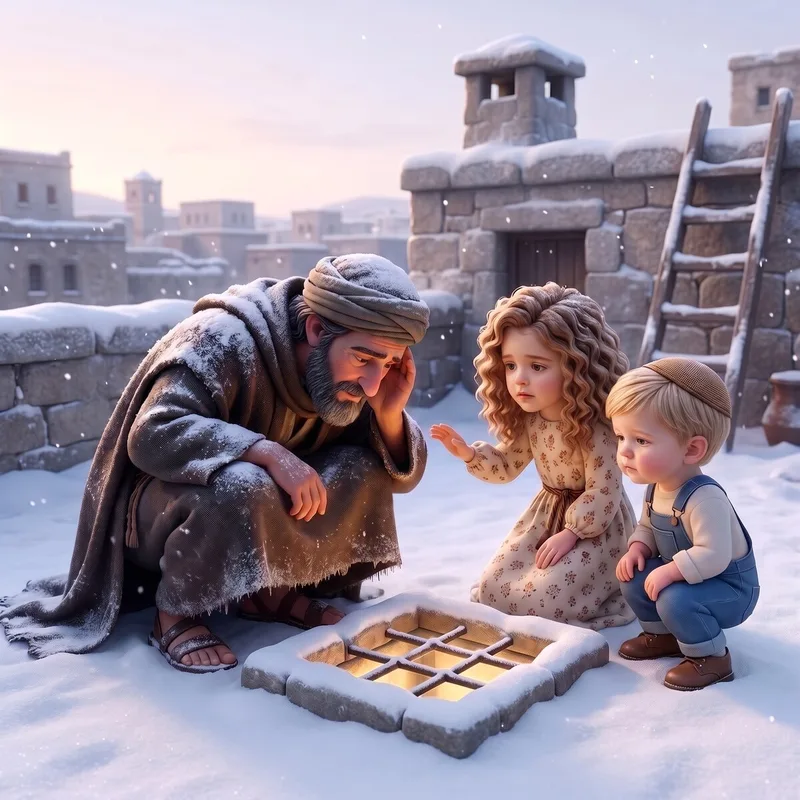
One day Hillel found no work, and the guard of the beis midrash did not let him in. So he went up to the roof and sat at the opening of the skylight. From there he could hear the words of Elokim Chayim from the mouths of Shemaya and Avtalyon.
The Gemara adds that it was erev Shabbos, in the season of Tevet, and snow fell on Hillel as he sat there. When dawn came, Shemaya said to Avtalyon: Brother, every day this house is bright, and today it is dark. Is it a cloudy day?
They looked up and saw the shape of a person in the skylight. They went up and found Hillel covered with snow. They took him out, washed him, anointed him and sat him by the fire. Then they said that this man was worthy that Shabbos be set aside for him.
Where does this story come from, and why does the Gemara tell it?
The source is Yoma 35b. The Gemara teaches that a poor man, a rich man and a wicked man each come to be judged. The poor man is asked why he did not engage in Torah. If he says he was poor and busy earning a living, he is asked: Were you poorer than Hillel?
That is why the Gemara tells about Hillel's daily tarpaik and the night on the roof. It is a story about how far a person with very little can go for Torah.
This is a lesson for each of us to take to heart about our own excuses. It is not something for us to apply to anyone else. When you tell it to children, you can stay with the part they can feel: Hillel wanted Torah, and he found a way.
What is the lesson for children?
The first lesson is love of Torah. Hillel did not give up when the door was closed to him. He looked for another place from which to hear his teachers.
The second is not making excuses. Children often say they cannot do something because it is too hard or because they are tired. Hillel gives them a picture to hold onto: a person with very little, who still learned.
The third is the care of Shemaya and Avtalyon. They noticed that something was different, that the room was darker than usual, and they went to look. They did not shrug and carry on. Then they took care of Hillel, and the Gemara says they declared that Shabbos could be set aside for him.
If you want to read about another Torah figure who kept going against the odds, there is Rabbi Akiva, the shepherd who began at forty.
How do I explain Hillel on the roof to a 4-year-old, a 7-year-old and a 10-year-old?
Ages 4 to 5. Keep it to a few pictures. Hillel loved Torah. The door was closed. He went up to the roof to listen. His teachers found him and warmed him up by the fire. A child this age does not need the lesson spelled out. You can ask, "What did Hillel want so much?"
Ages 6 to 8. Add the coin and the guard. Hillel gave half of what he earned to the guard of the beis midrash, and half to his family. Then ask what they would do if they could not get to something they loved. Children this age enjoy the detail of the bright room turning dark, and Shemaya noticing.
Ages 9 to 12. Tell them where the story comes from. It is in Yoma 35b, in the teaching about the poor man who is asked whether he was poorer than Hillel. Then you can talk about what stands between us and learning today: being tired, being busy, wanting to be doing something else. Ask what a small, steady step would look like this week. You can also ask why the Gemara says Shabbos could be set aside for Hillel.
For more stories that the Gemara tells in this way, see Miriam's Well, from Taanis 9a.
What questions can we ask at the Shabbos table?
This is a story that reads and talks well on Shabbos, and the Gemara tells that it happened on erev Shabbos. These questions need only conversation:
- What did Hillel do when the guard of the beis midrash did not let him in?
- Why did Hillel sit at the skylight?
- What did Shemaya notice that morning?
- What did Shemaya and Avtalyon do when they found Hillel?
- What is something you really want to learn, and what would you be willing to work at to get it?
- Can you think of a time you noticed that something was different, and went to see if someone needed help?
With younger children, pick two questions and let them answer in their own words. With older children, let the conversation go where it wants to go.
What is a personalized Torah Tale book of Hillel on the roof like?
This story is in the Midrash & Aggadah collection, which tells the stories Chazal tell behind the pesukim, each from its named source in the Gemara or Midrash. The Torah Tale book of Hillel is told from the Gemara's own account in Yoma, without adding to what the source says.
Your child is the hero: their name and, from one uploaded photo, their likeness appear on every page, illustrated in 3D animated-film style. Up to eight children can appear in the same book, ages 0 to 18, which suits a family with a few children at different ages.
Every book ends with a discussion page of 10 questions about the story, mixing comprehension with middos. That is what turns the book from something read to a child into something talked about at the table. If you add parents and grandparents, they appear with the children on a closing family page in every format.
Which format fits my child?
There are three formats. The softcover photo book is 8"x8" for ages 4-8, and the hardcover photo book is 8"x8" for ages 5-18. The board book is 6"x6" with rounded safety corners, for ages 0-4. The softcover and hardcover open with a dedication page.

Softcover 8″×8″

Hardcover 8″×8″

Board book 6″×6″

Coloring book 8.5″×11″
There is also an optional matching coloring book in black-and-white line art, 8.5"x11". Coloring is melacha, so it is for a weekday afternoon or erev Shabbos, never for Shabbos or Yom Tov. The storybook itself is exactly right to read on Shabbos.
Creating a book takes about five minutes. You need a free account and a few short questions: each child's name, boy or girl, age and one photo, any siblings, the story, your community (asked once), the language and the printed format. The languages are English, Hebrew and Yiddish. Every book is written with careful rabbinical guidance and strict tznius, and reviewed by our team before it goes to print.
Ready to make it? You can create the book and choose the Hillel story in the Midrash & Aggadah collection.
Frequently asked questions
Where is the story of Hillel on the roof in the snow found?
It is found in Maseches Yoma 35b. Chazal tell it as part of a teaching about three people who come to be judged: a poor man, a rich man and a wicked man. The poor man is asked why he did not engage in Torah, and if he answers that he was poor, he is asked whether he was poorer than Hillel.
What is the lesson of Hillel on the roof for children?
The lesson is a deep love of Torah and the effort to reach it when it is not easy. Hillel did not stay home when the guard did not let him in. He found another way to hear Torah from Shemaya and Avtalyon. Children can also learn from Shemaya and Avtalyon, who noticed the dark room and went to see what was wrong.
How do I explain Hillel on the roof to a 4-year-old?
Keep it short and concrete. Hillel loved Torah so much that when he could not go inside the beis midrash, he went up to the roof to listen through the window in the ceiling. His teachers found him, warmed him by the fire and took care of him. You can finish with one sentence: Hillel really wanted to learn.
Why did Hillel go up to the roof?
The Gemara tells us that one day Hillel found no work to earn, and the guard of the beis midrash did not let him in. He went up to the roof and sat at the opening of the skylight so he could hear the words of Elokim Chayim from the mouths of Shemaya and Avtalyon.
Is this a good story to read at the Shabbos table?
Yes, reading and talking about this story is entirely appropriate on Shabbos. The Gemara tells that it happened on erev Shabbos, which gives the story a natural connection to the day. You can read the book aloud and use the discussion questions at the end as conversation around the table.