Havdalah (הבדלה) for Kids: The Cup, the Flame & Saying Goodbye to Shabbos
Havdalah is the ceremony that ends Shabbos with a cup, sweet spices and a braided flame. Here is what each part means, how to explain it to a young child and an older one, and questions for the table.
Published by Torah Tale.
Create this book for your child
Havdalah (הבדלה) is the short ceremony at the end of Shabbos in which we say brachos over a cup of wine or grape juice, besamim and a flame, and thank Hashem for separating between the holy and the ordinary. Children tend to love it because it fills the senses: a braided candle, a sweet smell, a cup and a song. This guide explains what each part means and how to say it at a child's level.
What is Havdalah and why do we say it?
Havdalah means separation. Shabbos comes in with Kiddush, words that sanctify the day, and it goes out with Havdalah, words that mark the difference between Shabbos and the weekdays. The Torah says zachor es yom haShabbos l'kadsho, remember the Shabbos day to sanctify it (Shemos 20:8), and from this pasuk Chazal learn the mitzvah of Kiddush, and the Rambam includes Havdalah in the mitzvah of remembering Shabbos with words, at its beginning and at its end.
For a child, the simplest way to say it is this: Shabbos is a special guest, and Havdalah is how we walk the guest to the door with a smile. We do not pretend the week is the same as Shabbos. We thank Hashem for the difference.
If you want to help your child feel the whole arc of the day, the article on Melava Malka covers the meal that follows, and the one on making Kiddush covers the other end of Shabbos.
What are the parts of Havdalah and what does each one mean?
The cup. We say Borei pri hagafen over wine or grape juice. Wine is a sign of simcha, and the cup is the center of the ceremony.
The besamim. Chazal speak of a neshama yeseirah, an extra measure of calm and joy on Shabbos. The meforshim explain that the sweet spices are a comfort when Shabbos leaves. We say Borei minei besamim and smell them, and children are often glad to pass the spice box around.
The flame. We make the bracha Borei meorei ha'esh on a candle, and many use a braided Havdalah candle with several wicks. Chazal tell us that Adam HaRishon, as the first Shabbos ended and it grew dark, was given the idea to rub two stones together and make fire, and the bracha we say on the flame is connected to this. We do not light fire on Shabbos itself, so as Shabbos ends we make a bracha on it.
Hamavdil. The last bracha praises Hashem who separates between holy and ordinary, between light and darkness, between Yisrael and the nations, and between the seventh day and the six days of work. After it we drink from the cup.
What is the order of Havdalah, step by step?
Families have different minhagim, so check yours. This is a common order:
- Many begin with pesukim of yeshuah, such as Hinei Keil yeshuasi.
- Borei pri hagafen over the cup.
- Borei minei besamim, and everyone smells the spices.
- Borei meorei ha'esh, over the lit candle held by an adult.
- Hamavdil bein kodesh l'chol.
- The cup is drunk, and many have the minhag to put out the candle in a little wine from the cup.
Havdalah is said once Shabbos has ended, so check your local times or ask your rav. Many families then sing songs such as Hamavdil and Eliyahu HaNavi and wish each other a good week.
How do I explain Havdalah to a 3-year-old, a 6-year-old and a 10-year-old?
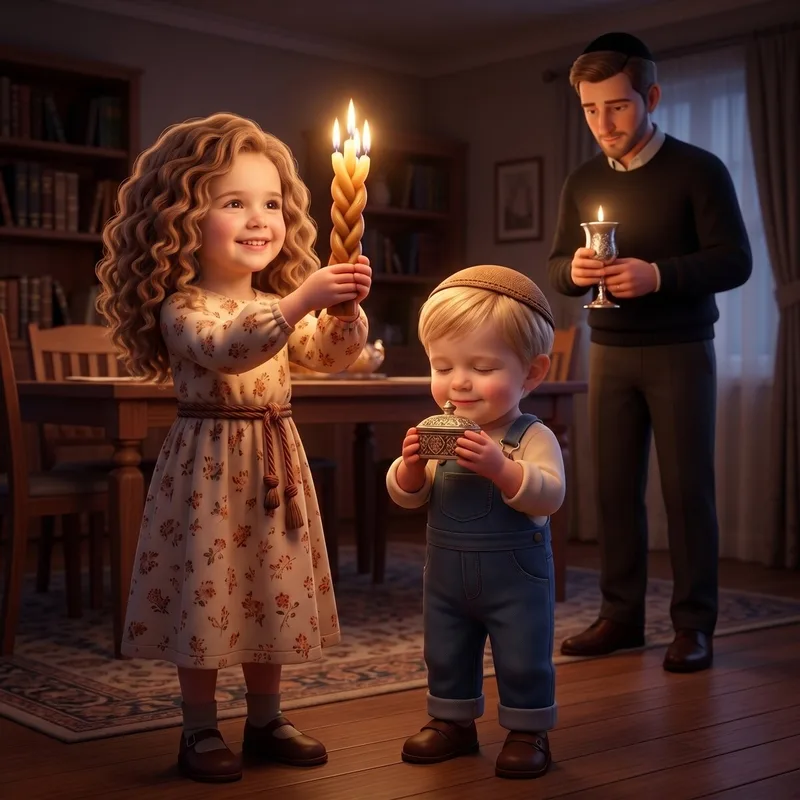
Around 3. Keep it to the senses. "Shabbos is going away, so we smell something sweet and look at the pretty light and say amen." Let the child hold the spice box when the time comes, and let him or her answer amen. An adult holds the lit candle, and the child watches from a safe distance.
Around 6. Add the idea of separation. "Hashem made Shabbos holy and the weekdays for work, and Havdalah is how we say thank you for both." Ask the child to listen for the four separations in Hamavdil, and count them on his or her fingers: holy and ordinary, light and darkness, Yisrael and the nations, the seventh day and the six days of work.
Around 10. Add the reasons. Why a cup? Why spices? Why fire? Tell what Chazal say about Adam and the first fire, and the explanation of the besamim as a comfort when the neshama yeseirah leaves. An older child can also learn how to say the brachos and the text of Hamavdil, and can ask what it means to take Shabbos with us into the week.
How can we get ready for Havdalah during the week and on erev Shabbos?
Put the cup, the besamim and a Havdalah candle in one place before Shabbos starts, so that everything is ready when Shabbos ends. Do this on erev Shabbos, and ask your rav if you have questions.
On Shabbos itself you can talk, tell stories and sing, and a book is a good fit for a quiet Shabbos afternoon. A Havdalah book can be read at the Shabbos table or on a Shabbos afternoon, and children then come to Havdalah already knowing what each part is for.
What is a personalized Havdalah book for kids like?
Torah Tale makes personalized Torah storybooks, and the Havdalah book is part of the Mitzvos collection, which is about the mitzvos a child keeps, set in everyday life today. Your child's name and, from one uploaded photo, his or her likeness appear on every page, illustrated in high-resolution 3D animated-film style. Up to eight children can appear in the same book, ages 0 to 18.
The formats are a board book 6"x6" with rounded safety corners for ages 0-4, a softcover 8"x8" for ages 4-8, and a hardcover 8"x8" for ages 5-18. Softcover and hardcover open with a dedication page. If you add parents, grandparents and other relatives with their photos, they appear with the children on a closing family page in every format.

Softcover 8″×8″

Hardcover 8″×8″

Board book 6″×6″

Coloring book 8.5″×11″
Every book also ends with a dedicated discussion page of 10 questions about the story, mixing comprehension with middos. That page is what turns a book read to a child into a conversation at the table. Every book is written with careful rabbinical guidance and strict tznius, and reviewed by our team before it goes to print. An optional matching coloring book is a weekday activity only, for a weekday afternoon or erev Shabbos, never for Shabbos or Yom Tov.
If you also want a book on another mitzvah of the day, you could look at lighting the Shabbos licht.
What questions can we ask at the table about Havdalah?
These are for talking, whether on Shabbos or after Havdalah. Pick the ones that suit your children's ages.
- What does the word Havdalah mean, and what is being separated?
- Which part do you like best: the smell, the light or the cup, and why?
- Why do we say a bracha on the besamim?
- What did Adam HaRishon need when the first Shabbos ended?
- How can we take something from Shabbos into the week, like a smile, a song or a kind word?
You can also ask your child to say amen out loud and tell you which bracha it was answered to. Even a three-year-old can do that.
When you are ready, you can create the book. It takes a free account and a few short questions: each child's name, boy or girl, age and one photo, any siblings, the story, your community (asked once), the language and the printed format. The whole flow takes about five minutes.
Frequently asked questions
What is Havdalah, in simple words for a child?
Havdalah is how we say goodbye to Shabbos. We make brachos on a cup of wine or grape juice, on sweet-smelling spices and on a candle, and then we thank Hashem for making a difference between Shabbos and the rest of the week.
Why do we smell spices at Havdalah?
Chazal speak of a neshama yeseirah, an extra measure of calm and joy that a Yid has on Shabbos. The meforshim explain that the besamim comfort us when Shabbos leaves. For a child, it is enough to say that Shabbos was so special that we take one more sweet smell with us.
Can a young child take part in Havdalah?
Yes. A young child can come to the table, smell the besamim, look at the flame and answer amen to the brachos. An adult should hold and handle the lit candle. Ask your rav about when a child should drink from the cup.
Why does Havdalah have a candle with several wicks?
The bracha on the flame is Borei meorei ha'esh, who creates the lights of the fire, and the plural word lights is the reason many use a braided candle with several wicks. Chazal tell us that Adam HaRishon was given the idea to make fire as the first Shabbos ended, and the bracha is connected to this. If you have questions about the details, ask your rav.
How can a personalized book help my child learn Havdalah?
A Torah Tale book for this mitzvah stars your child by name and likeness, so the child sees himself or herself keeping it. Every book ends with a discussion page of 10 questions mixing comprehension with middos, which makes it easy to talk about Havdalah at the table. The Havdalah book is part of the Mitzvos collection.