Good Middos & Manners (מידות טובות ודרך ארץ) for Kids
Good middos and derech eretz are learned in small daily moments. Here is how to explain them at ages 3-4, 6-7 and 10-12, with Shabbos table questions and a personalized book where your child is the hero.
Published by Torah Tale.
Create this book for your child
Good Middos & Manners is a Torah Tale story set in everyday life today, with your child as the hero, about the good character and derech eretz a child grows day by day. It lands with children because manners are not abstract: they are the please, the thank you, the patience at the table, things a child does many times before lunch. The book turns those moments into something to read together and talk about.
What is the Good Middos & Manners story about?
This story belongs to the Middos collection, which is about the good character a child grows, set in everyday life today. It is not a retelling of a story from Tanach, so there is no pasuk to translate for a young child. The setting is the child's own world.
Your child's name and, from one uploaded photo, their likeness appear on every page, illustrated in 3D animated-film style. Up to eight siblings can appear in the same book, so a family with two or three children can share one story.
What is the difference between middos and derech eretz?
Middos are the traits of character a person builds inside: kindness, patience, honesty, humility. Derech eretz is how those traits show on the outside, in manners, in the way we speak, and in how we treat the people around us.
The two feed each other. A young child often practices the action first, saying thank you before they fully feel it, and the inner middah grows along with the habit. That is why steady, small repetition at home matters more than a big speech.
What do Chazal say about derech eretz?
The Mishnah in Pirkei Avos (3:17) teaches that if there is no derech eretz, there is no Torah. The Midrash in Vayikra Rabbah also says that derech eretz came before the Torah. We learn from these sayings that being a considerate person is part of the foundation of a Torah life, not a decoration on top of it.
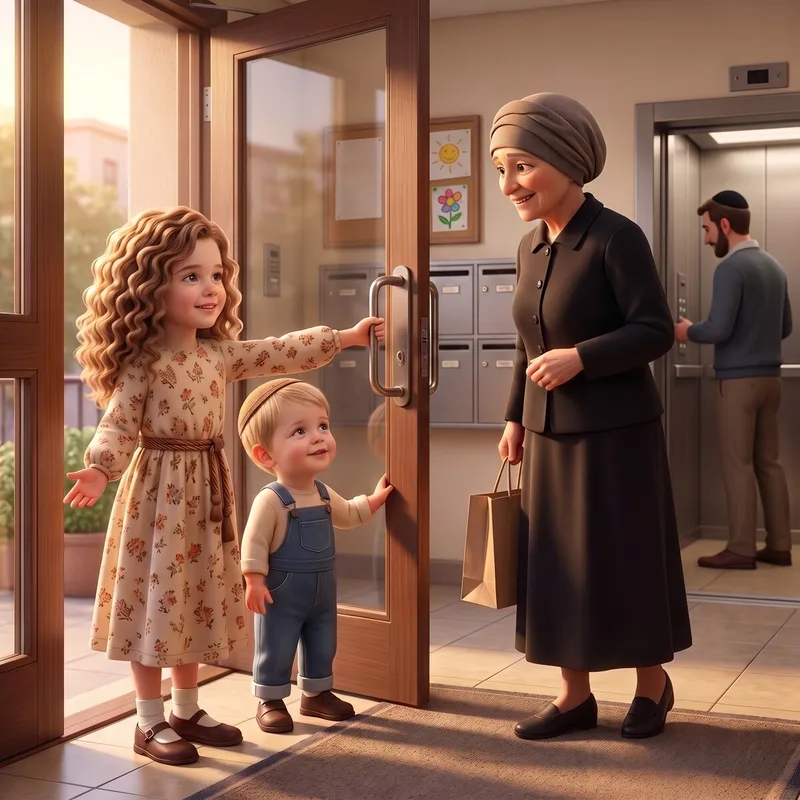
Shammai in Pirkei Avos (1:15) tells us to receive every person with a pleasant face. Children understand that one right away, because a smile at the door is something they can do today.
How do I explain good manners at different ages?
The same idea works at every age, but the words change. Here is a simple way to pitch it.
- Ages 3-4: Choose one action and call it by name. In our house we say thank you. Praise the exact thing you saw, such as waiting for Imma to sit down before starting, rather than saying good boy or good girl. Keep it short and warm.
- Ages 6-7: Give the reason. Manners tell the other person that they matter. Ask, How do you think your friend felt when that happened? Children at this age love to notice fairness and can start to catch themselves.
- Ages 10-12: Connect it to Torah. Derech eretz is part of how we represent Hashem and the Torah in the way we act, in school, on the bus and with friends. Invite them to name a place where manners are hard, such as when they are tired or in a hurry, and plan what they will do.
Whatever the age, your own example does most of the teaching. A child who hears you thank the bus driver and speak calmly to a sibling learns more than from any list.
What is a personalized Good Middos & Manners book like?
The child is the hero, so the middos in the story are things they do, not things that happen to a character far away. Every book is written with careful rabbinical guidance and strict tznius, and is reviewed by our team before it goes to print.
Every Torah Tale book ends with a dedicated discussion page of 10 questions about the story, mixing comprehension with middos: what happened, and what it asks of the child. If you add parents, grandparents or other relatives with their photos, they appear with the children on a closing family page in every format.
Three formats are available. The board book (6x6 with rounded safety corners) is for ages 0-4, the softcover photo book (8x8) is for ages 4-8, and the hardcover photo book (8x8) is for ages 5-18. Softcover and hardcover open with a dedication page. The book can be ordered in English, Hebrew or Yiddish.

Softcover 8″×8″

Hardcover 8″×8″

Board book 6″×6″

Coloring book 8.5″×11″
What can I ask at the Shabbos table about good middos?
Reading a storybook is entirely appropriate on Shabbos, and it gives the whole table something to talk about. The discussion page at the end of the book carries ten questions you can use, and you can add your own. Questions that work well:
- What was the kind thing someone did this week that you noticed?
- When is it hardest to say please or thank you?
- How can you tell that someone feels left out, and what could you do?
- What is something Abba or Imma does that shows derech eretz?
- If a guest came to our table, what would make them feel welcome?
- Which middah would you like to work on this week?
Keep it to talking, listening and singing. Let each child answer, and let a younger child answer first so the older ones do not take the words from them.
How do I make good manners stick during the week?
Pick one middah or manner for the week and mention it each day, rather than correcting a dozen things. When you see it, say what you saw. When it goes wrong, ask the child what they could do next time instead of lecturing.
Our other articles cover single middos in more depth: saying thank you, waiting patiently, and standing up for an older person. Each is a small piece of the larger picture of derech eretz.
For a weekday afternoon, such as erev Shabbos or Chol HaMoed, the optional matching coloring book (8.5x11, black-and-white line art) can be added as a one-time add-on to a book. It is a weekday activity only, never for Shabbos or Yom Tov.
Ready to make it? It takes a free account and a few short questions: each child's name, boy or girl, age and one photo, any siblings, the story, your community (asked once), the language and the format. You can choose a single book or a Middos collection subscription, and the details are on the pricing page. When you are ready, create the book and put your child at the center of a story about the kind of person they are growing into.
Frequently asked questions
What is the difference between middos and derech eretz?
Middos are the traits of character a person builds inside, such as kindness, patience and honesty. Derech eretz is how those traits show outwardly in manners, speech and the way we treat people. A child usually practices the action first, and the inner middah grows along with it.
What do Chazal say about derech eretz?
The Mishnah in Pirkei Avos (3:17) says that if there is no derech eretz there is no Torah. Chazal also say in the Midrash, in Vayikra Rabbah, that derech eretz came before the Torah. We learn from this that being a considerate person is part of the foundation of a Torah life, not an extra.
How do I teach good manners to a 3 or 4 year old?
Keep it to one small action at a time, such as saying please and thank you or waiting until everyone is seated, and say it in the same words each day. Praise the specific thing the child did, and let your own manners at home be the main lesson. A short story with the child as the hero helps the idea stick.
What is Good Middos & Manners from Torah Tale?
It is a personalized Torah storybook in the Middos collection, set in everyday life today, where your child is the hero. Their name and, from one uploaded photo, their likeness appear on every page in 3D animated-film style. Like every Torah Tale book, it ends with a discussion page of 10 questions mixing comprehension with middos.
Which format of the book suits which age?
The board book (6x6 with rounded safety corners) is for ages 0-4, the softcover photo book (8x8) is for ages 4-8, and the hardcover photo book (8x8) is for ages 5-18. The child's age is one of the short questions when you create the book. An optional matching coloring book can be added as a one-time add-on.
Can I read the book on Shabbos?
Yes, reading a storybook is entirely appropriate on Shabbos and Yom Tov, and it works well at the Shabbos table. The coloring book is different, because coloring is melacha, so keep it for a weekday such as erev Shabbos or Chol HaMoed.