Giving Maaser (מעשר כספים) for Kids: Teaching a Tenth at Home
Maaser kesafim means setting aside a tenth of what comes in for tzedakah. Here is where it comes from, how to explain it at ages 3-4, 6-7 and 9-12, and what to talk about at the Shabbos table.
Published by Torah Tale.
Create this book for your child
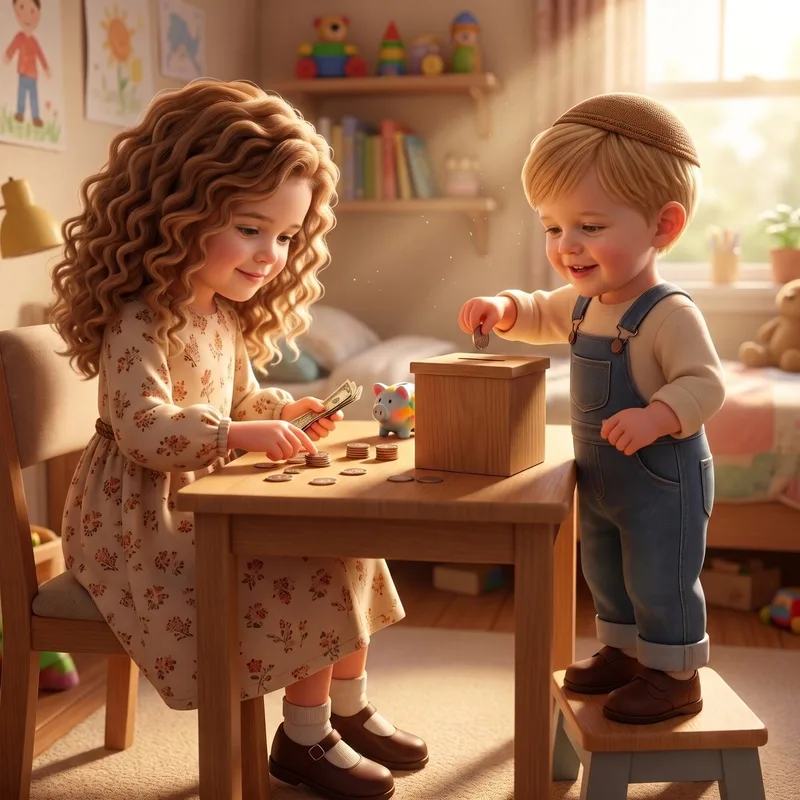
Maaser kesafim (מעשר כספים) is the practice of setting aside a tenth of the money that comes in for tzedakah. For a child it can be as simple as taking a tenth of birthday money or Chanukah gelt and putting it in the pushka before anything is spent, and it lands because it is so concrete: ten coins become nine and one.
What is maaser kesafim, and how do I explain it to my child?
Maaser kesafim means giving a tenth of one's income to tzedakah. A simple way to say it to a child is: "When money comes to us, we first put aside one part out of ten for tzedakah, and then we use the rest."
It is different from the maaser of produce that the Torah describes, which is taken from crops. Maaser kesafim is the tenth of earnings. How it applies to a child's pocket money, and whether a tenth is taken from gross or net income, are halachic questions. Ask your rav rather than guessing.
Where does giving a tenth come from?
The Torah tells us that Yaakov Avinu was leaving home and traveling toward Charan when he lay down and dreamed of the ladder. When he woke, he made a vow. If Hashem would be with him, guard him on the way, give him bread to eat and clothing to wear, and bring him back to his father's house in peace, then Hashem would be his God. He ended with the words vechol asher titen li aser a'asrenu lach, "and of everything You give me, I will surely give a tenth to You" (Bereishis 28:22).
That is the pshat of the pasuk, and it is why Yaakov's vow is so often connected with giving a tenth. The Shulchan Aruch (Yoreh Deah 249) discusses giving a tenth of one's income to tzedakah. You can read more about the night itself in our article on Parshas Vayeitzei for kids. When Parshas Vayeitzei is read, it is a good moment to bring it up at the table.
How do I explain maaser to a 3-4 year old, a 6-7 year old and a 9-12 year old?
The same mitzvah can grow with the child. Here is what tends to work at three stages.
- Ages 3-4: Keep it to one action. Give your child a handful of coins, help them find the pushka, and say, "This one is for tzedakah." There is no need for fractions yet. They are learning that part of what comes in goes to someone else.
- Ages 6-7: Use ten coins. Lay them out, move one to the side, and say, "That is a tenth." Let the child choose whether it goes in the home pushka or toward a tzedakah you pick together.
- Ages 9-12: Bring in the arithmetic. If they receive a set amount for chores or gelt, let them work out the tenth themselves. This is also a good age to ask your rav together how the halacha applies, so the child hears that questions about money are brought to a rav like any other.
What is the lesson of giving maaser?
The lesson is that giving comes first, before the money is spent and before the wanting starts. A child who sets aside the tenth on the day the money arrives is learning to plan generosity instead of leaving it for whatever is left over.
There is also a thread of hakaras hatov. After the people gave toward the Beis HaMikdash, Dovid HaMelech said to Hashem, ki mimcha hakol umiyadcha nasanu lach, "everything is from You, and from Your hand we have given to You" (Divrei HaYamim I 29:14). You can see this at work in our article on Dovid preparing the Beis HaMikdash. When a child gives a tenth, they are practicing the same idea at their own size. For the wider mitzvah of tzedakah, see Giving Tzedakah for kids.
What is a personalized Torah Tale book about giving maaser like?
Torah Tale makes personalized Torah storybooks in which your child is the hero: their name and, from one uploaded photo, their likeness appear on every page, illustrated in 3D animated-film style. This story comes from the Mitzvos category of the story picker, the collection of mitzvos a child keeps, set in everyday life today. Up to eight siblings can appear in the same book.
Every book ends with a dedicated discussion page of 10 questions about the story, mixing comprehension with middos: what happened, and what it asks of the child. That page is what turns a book you read to a child into something talked about at the table. If you add parents and grandparents, they appear with the children on a closing family page in every format.

Softcover 8″×8″

Hardcover 8″×8″

Board book 6″×6″

Coloring book 8.5″×11″
Choose the format by age. The board book (6x6, with rounded safety corners) is for ages 0-4, the softcover (8x8) for ages 4-8, and the hardcover (8x8) for ages 5-18. Softcover and hardcover open with a dedication page. Every book is written with careful rabbinical guidance and strict tznius, and reviewed by our team before it goes to print.
What can we talk about at the Shabbos table?
Shabbos is for talking, so keep this one to questions. Money stays out of sight, and the pushka waits for a weekday. Here are a few to try:
- What did Yaakov promise Hashem, and when did he say it?
- If you got ten coins, how many would you set aside for tzedakah?
- Why might it be easier to give first than to give what is left over?
- Who do you think a tzedakah gift helps, and how might they feel?
- What is something you could do this week to practice giving, even without money?
For a weekday activity, sit down on a weekday afternoon or erev Shabbos and label two jars, one for spending and one for tzedakah. Let your child divide whatever coins they have between them. The matching coloring book, an optional add-on to a Torah Tale book, is black-and-white line art, and it is a weekday activity too, never for Shabbos or Yom Tov.
When you are ready, you can create the book for your child. It takes a free account and a few short questions: each child's name, boy or girl, age and one photo, any siblings, the story, your community (asked once), the language and the printed format.
Frequently asked questions
What is maaser kesafim?
Maaser kesafim is the practice of giving a tenth of one's income to tzedakah. Many families set the tenth aside as soon as money comes in, so that it is already separate before anything is spent. Details such as gross versus net are best asked of your rav.
How do I explain maaser to a 4-year-old?
Keep it physical and short. Give your child a few coins, help them put one in the tzedakah pushka, and say that this part is for tzedakah and the rest is for them. A very young child learns the habit of giving long before they understand percentages.
Where does giving a tenth come from?
The Torah tells us that when Yaakov Avinu left home, he vowed that of everything Hashem would give him, he would give a tenth (Bereishis 28:20-22). The Shulchan Aruch (Yoreh Deah 249) discusses giving a tenth of one's income to tzedakah. For how the halacha applies in your family, ask your rav.
Does a child have to give maaser from allowance or gelt?
Whether and how maaser applies to a child's own money is a question for your rav. Many parents teach it as chinuch, a habit the child practices so that it feels natural when they earn their own income. Decide together with your rav what suits your family.
What is the lesson of giving maaser?
The lesson is that giving comes first and is built into the way we handle money. Dovid HaMelech said to Hashem, ki mimcha hakol umiyadcha nasanu lach, 'everything is from You, and from Your hand we have given to You' (Divrei HaYamim I 29:14), which is a way to understand why we give. For a child it grows into generosity, planning and hakaras hatov.
Which Torah Tale format suits a book about giving maaser?
It depends on your child's age. The board book (6x6, rounded safety corners) is for ages 0-4, the softcover (8x8) for ages 4-8, and the hardcover (8x8) for ages 5-18. Every book ends with a discussion page of 10 questions about the story.